13 min read
Nursing is the largest clinical occupation in metro Atlanta and the deepest single source of healthcare hiring in the region. More than 56,000 registered nurses work across the 29-county metro, and that is before counting licensed practical nurses, nursing assistants, or nurse practitioners [1]. This guide covers nursing jobs in Atlanta end to end: what each level of the ladder pays, every specialty and setting that hires here, how Georgia licensing actually works, and which systems are hiring. It sits under our broader guide to healthcare jobs in Atlanta.
How strong is the nursing job market in Atlanta in 2026?
Metro Atlanta means the 29-county Atlanta-Sandy Springs-Roswell metropolitan statistical area. Key facts on nursing jobs in Atlanta as of 2026, per the U.S. Bureau of Labor Statistics, the Georgia Board of Nursing, and the Metro Atlanta Chamber:
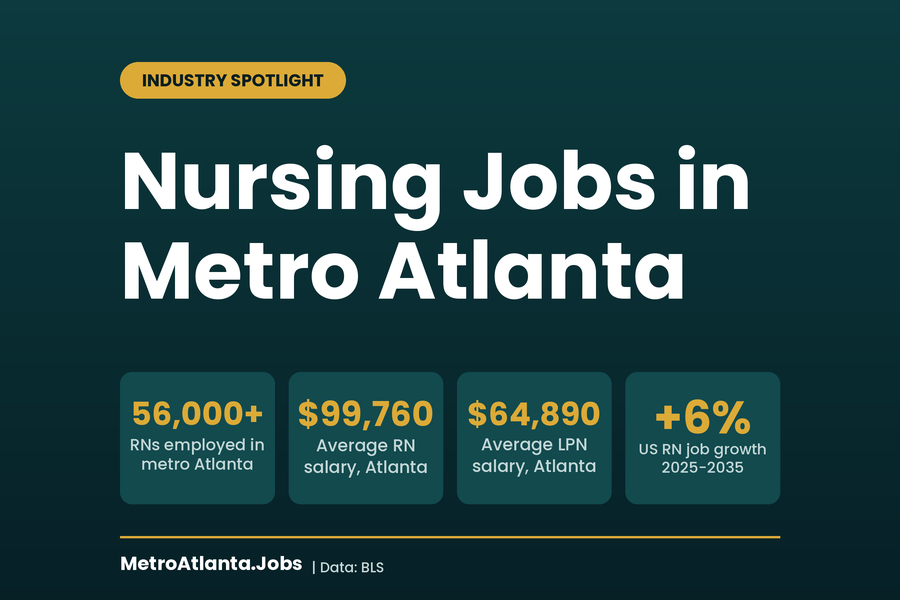
Metro Atlanta employs more than 56,000 registered nurses, making registered nursing the single largest healthcare occupation in the region [1].
Registered nurses in metro Atlanta average $99,760 a year, against a national median of $97,550 [1][2].
Nursing is growing faster than the economy overall. U.S. Bureau of Labor Statistics projections for 2025 to 2035 put registered nurse employment up 6 percent nationally, rising from 3,465,400 jobs to 3,660,100, against 3 percent for all occupations [2].
Turnover creates most of the openings. About 180,800 registered nurse openings are projected each year nationally over the decade, most of them from nurses transferring to other occupations or leaving the workforce rather than from new positions [2].
Advanced practice is the fastest growing tier. Employment of nurse anesthetists, nurse midwives, and nurse practitioners is projected to grow 36 percent from 2025 to 2035, per U.S. Bureau of Labor Statistics projections [3].
Georgia is a compact state. Under the Georgia Board of Nursing, a Georgia multistate license lets a nurse whose primary residence is Georgia practice across every other Nurse Licensure Compact jurisdiction without a second license [5].
Ready to look? Browse current nursing openings across all 29 metro counties on our healthcare and medical jobs page, then create a free job seeker profile so local employers can find you.
What do nursing jobs in Atlanta pay in 2026?
The figures below are annual mean wages for the Atlanta metro from the U.S. Bureau of Labor Statistics Occupational Employment and Wage Statistics program, May 2025 [1].
Nurse practitioner: $134,960. The top of the ladder for most nurses in metro Atlanta, and within about 2 percent of the national mean [1][4].
Registered nurse: $99,760. Nationally the RN median is $97,550, with the bottom 10 percent under $68,940 and the top 10 percent above $137,470, so experience and specialty move this number far more than geography does [1][2].
Licensed practical nurse: $64,890. Nationally the LPN median is $64,400 [1][11].
Nursing assistant: $40,570. The entry point to the field, and roughly 5 percent below the national mean [1][4].
Setting matters as much as title. Nationally in May 2025, registered nurse median pay ran $110,780 in government, $100,220 in hospitals, $91,230 in ambulatory care, $84,300 in nursing and residential care, and $78,620 in educational services [2]. That spread of roughly $32,000 between government nursing and school nursing is larger than the gap between most Atlanta employers.
Base pay is also only part of a nursing check. Night, weekend, and holiday differentials, charge pay, on-call, overtime, certification bonuses, and sign-on incentives routinely add thousands, and they vary more between units than between systems. For the full role-by-role comparison against national, see healthcare salaries in Atlanta vs the U.S, and for pay outside healthcare see the Atlanta salary guide.
What is the nursing career ladder in Georgia?
Nursing is one of the few fields where you can enter in weeks and reach six figures without ever leaving the profession. Each rung below is a real job with its own license or credential.
Certified nursing assistant (CNA). Weeks of training, no degree. CNAs handle direct patient care under RN supervision and are the highest-volume entry point in metro Atlanta healthcare.
Patient care technician. A CNA with added skills such as phlebotomy or EKG, usually hospital-based and better paid than a long-term care CNA.
Licensed practical nurse (LPN). About a year through a Board-approved practical nursing program, then the NCLEX-PN. LPNs concentrate in long-term care, physician practices, home health, and correctional health rather than acute hospital units.
Registered nurse (RN). Three education paths lead to the NCLEX-RN: an associate degree, a bachelor's degree, or a hospital diploma program. Nationally, a bachelor's degree is now the typical entry-level education for the occupation, and hospitals in particular often require the BSN [2].
BSN and RN-to-BSN. Associate-prepared RNs commonly bridge to the BSN while working, and most large Atlanta systems offer tuition assistance for it. A bachelor's or higher is generally necessary for administration, research, consulting, and teaching [2].
Advanced practice registered nurse (APRN). Nurse practitioner, certified registered nurse anesthetist, certified nurse midwife, and clinical nurse specialist. All four require at least a master's, state licensure, and national certification, and many APRNs hold a doctorate [3].
Nursing leadership. Charge nurse, assistant nurse manager, nurse manager, director of nursing, then chief nursing officer. Management roles increasingly expect a graduate degree in nursing or health administration [2].
What nursing specialties are hiring in metro Atlanta?
Specialty determines pay, schedule, and how quickly you get hired far more than employer choice does. These are the specialty tracks active across the metro.
Critical care and emergency nursing
ICU, MICU, SICU, CVICU, neuro ICU, emergency department, trauma, rapid response, and flight and critical care transport. Metro Atlanta supports an unusually deep critical care market because Grady operates the region's Level 1 adult trauma center and Children's Arthur M. Blank Hospital operates a Level I pediatric trauma center. Common certifications: CCRN for critical care, CEN for emergency, TCRN for trauma.
Perioperative and procedural nursing
Operating room circulator, scrub RN, PACU, pre-op, endoscopy, interventional radiology, and cardiac catheterization lab. OR experience is among the hardest to hire for in the metro, which is why perioperative residency programs exist at the larger systems. Certification: CNOR for the OR, CPAN and CAPA for perianesthesia.
Women's health and newborn nursing
Labor and delivery, antepartum, postpartum, mother-baby, NICU, and lactation. Women's and newborn services are a distinctive Atlanta strength, concentrated at Northside, which is also the metro's largest healthcare employer at 32,000 [6]. Certifications: RNC-OB, RNC-NIC for neonatal intensive care, IBCLC for lactation.
Medical-surgical, telemetry, and progressive care
Med-surg, telemetry, step-down, progressive care, and observation units. The largest single block of hospital nursing jobs and the most common first RN role in the metro. Certifications: CMSRN and PCCN.
Oncology and infusion nursing
Inpatient oncology, bone marrow transplant, outpatient infusion, and radiation oncology. Both Emory's Winship Cancer Institute, Georgia's only National Cancer Institute designated comprehensive cancer center, and the Cancer Institute at Northside drive steady demand. Certification: OCN.
Pediatric nursing
Pediatric med-surg, PICU, NICU, pediatric emergency, and pediatric specialty clinics. Children's Healthcare of Atlanta is Georgia's only freestanding pediatric health system, which makes metro Atlanta one of the strongest pediatric nursing markets in the Southeast. Certification: CPN.
Behavioral health nursing
Inpatient psychiatric, crisis stabilization, addiction and substance use, and psychiatric nurse practitioner roles. Behavioral health is the metro's most persistently understaffed segment, which means shorter hiring timelines than most specialties. Certification: PMH-BC.
Nephrology, cardiac, and rehabilitation nursing
Dialysis, apheresis, transplant, cardiac care, cardiac rehabilitation, inpatient rehabilitation, and wound and ostomy care. The Shepherd Center gives metro Atlanta a deep rehabilitation nursing employer base. Certifications: CNN for nephrology, CRRN for rehabilitation, CWOCN for wound care.
Nursing roles away from the bedside
Not every nursing job involves patient care, and all of these still require an active license [2]. Case management and utilization review, nursing informatics and Epic analyst work, quality and infection prevention, clinical research nursing, legal nurse consulting, nurse educator and clinical instructor, occupational health, public health, telehealth triage, and insurance and payer roles. These are the standard landing spots for nurses leaving bedside shift work without leaving the profession.
Hiring nurses in metro Atlanta? Employers can post a job in a few minutes and reach candidates searching by specialty and county. See plans and pricing, and read our guide to writing a job posting that works in Atlanta first.
Where do nurses work in metro Atlanta?
Hospitals dominate but do not monopolize. Nationally, per U.S. Bureau of Labor Statistics data for 2025, hospitals employ 59 percent of registered nurses, ambulatory healthcare services 19 percent, nursing and residential care facilities 6 percent, government 5 percent, and educational services 3 percent [2].
Across metro Atlanta that means acute care hospitals, freestanding emergency departments, ambulatory surgery centers, urgent care, physician and specialty practices, infusion and dialysis centers, home health and hospice agencies, skilled nursing and long-term care facilities, assisted living and memory care, school systems, county health departments, correctional facilities, occupational health clinics, the CDC and other federal employers, insurance and managed care companies, clinical research organizations, staffing and travel agencies, and telehealth providers.
Two settings deserve specific mention. Travel and contract nursing is active here year-round, and Georgia's compact membership makes the metro an easy market for travelers to work. Outpatient and ambulatory nursing is where schedules are most predictable, which is why experienced hospital nurses often move there mid-career.
Who is hiring nurses in metro Atlanta?
By full-time equivalent headcount across the 29-county metro, the largest healthcare employers are Northside Hospital at 32,000, Piedmont Healthcare at 29,646, Wellstar Health System at 21,020, Children's Healthcare of Atlanta at 10,489, and Grady Health System at 7,274 [6]. Emory Healthcare is Georgia's most comprehensive academic health system, with 11 hospital and provider locations.
For nurses specifically, Magnet recognition from the American Nurses Credentialing Center is the credential worth tracking, because it signals nursing governance, professional development structure, and staffing practice rather than general hospital quality. Metro Atlanta has an unusual concentration of it. Emory Healthcare holds Magnet recognition across multiple hospitals: in 2025 Emory Johns Creek earned its second designation, while Emory University Hospital Midtown and Emory Decatur earned theirs for the first time [7]. Wellstar Kennestone achieved Magnet recognition in 2025 [8]. Wellstar Paulding was redesignated in March 2026 and also earned Magnet with Distinction, an elevated tier held by only about 80 hospitals nationwide [8].
Beyond the large systems, hundreds of metro Atlanta employers hire nurses and never appear on a top-employer list: independent practices, urgent care groups, dialysis providers, home health and hospice agencies, behavioral health practices, senior living communities, and school districts.
How do you become a licensed nurse in Georgia?
As of 2026 the Georgia Board of Nursing licenses RNs and LPNs through the Georgia Secretary of State's Professional Licensing Boards division. Applications and renewals run through the GOALS portal [5].
Education. Graduate from a Board-approved program. Practical nursing and associate degree nursing programs run across the metro through the Technical College System of Georgia, including Gwinnett Technical College, Chattahoochee Technical College, and Atlanta Technical College. Bachelor's and graduate programs run through public and private universities including Kennesaw State University and Chamberlain. Approval status changes, so confirm any program against the Board's current list before enrolling. The Board publishes the full approved nursing program list, and enrolling in an unapproved program is the single most expensive mistake a nursing student can make [9].
Application. Apply through the GOALS portal. Georgia no longer accepts paper applications [12].
Examination. Pass the NCLEX-RN or NCLEX-PN through Pearson VUE.
Background check. Georgia requires a fingerprint-based criminal history check through GAPS, the state's Applicant Processing Service run by Idemia [13]. Register with GAPS the same day you submit your licensure application. GAPS emails the fingerprinting instructions once your registration is processed, so registering late is the most common source of delay [12].
Endorsement. Already licensed in another state? Apply for licensure by endorsement rather than by examination [13]. Endorsement also carries a recency requirement: proof of graduation from an approved program within the past four years, or verification of 500 hours of licensed practice within that same window [12]. License verification transfers between boards through Nursys [13].
Timeline. The Georgia Board of Nursing typically reviews applications within fifteen business days of receiving all required documents. Prior discipline or criminal history can extend that substantially [13].
The compact. Georgia belongs to the enhanced Nurse Licensure Compact. If Georgia is your primary state of residence you can hold a multistate license valid across all compact jurisdictions, and the Board has issued multistate licenses since January 19, 2018. If you live in another compact state, your home-state multistate license already lets you work in Georgia without a Georgia license. You cannot hold a multistate license in a state where you do not primarily reside [5][10].
Renewal. Georgia nursing licenses renew every two years, but RNs and LPNs run on separate calendars. RN and APRN licenses expire January 31 of even-numbered years [5]. LPN licenses renew January 1 through March 31 of odd-numbered years, with a late window through April 30, and an expired license bars you from practicing until it is reinstated [14]. Renewal requires a continuing competency option, and APRNs must renew the RN license before the APRN license through two separate applications [5].
Which metro Atlanta counties have the most nursing jobs?
Fulton County holds Georgia's highest concentration of healthcare employment, with Emory, Grady, Children's, Northside Atlanta, and the CDC. See our Fulton County jobs guide.
Cobb County is Wellstar territory, anchored by Kennestone in Marietta and Wellstar Cobb in Austell. See our Cobb County jobs guide.
Gwinnett County centers on Northside Gwinnett in Lawrenceville alongside a growing life sciences base. See our Gwinnett County jobs guide.
DeKalb County hosts Emory University Hospital, Emory Decatur, the Atlanta VA Medical Center, and Children's Arthur M. Blank Hospital. See our DeKalb County jobs guide
Cherokee and Forsyth Counties are the fastest-growing suburban nursing markets in the state. See our guides to Cherokee County and Forsyth County.
Clayton, Henry, Paulding, Rockdale, Newton, and Coweta Counties are adding outpatient and long-term care capacity with far less applicant competition than inside the perimeter. See our guides to Clayton County, Henry County, and Paulding County.
How do you get hired as a nurse in Atlanta?
Enter through the shortest credential that gets you inside. CNA training takes weeks, and once you are employed by a system you gain access to internal postings and tuition assistance that outside applicants do not have.
Specialize deliberately. Med-surg and telemetry hire new graduates most readily, and both are recognized launching pads into ICU, emergency, and perioperative work after 12 to 24 months.
Certify past the minimum. CCRN, CEN, CNOR, RNC-OB, OCN, CMSRN, and PCCN all move applicants up the queue and often carry pay differentials.
Look at nurse residency programs. New-graduate residencies at the large systems open on a hiring calendar rather than continuously.
Work the outer ring. Roles in Cherokee, Forsyth, Henry, Paulding, and Coweta draw a fraction of the applicants that Fulton and DeKalb do.
Consider the non-bedside track early. Case management, informatics, quality, and clinical research all prefer candidates with recent bedside experience, so plan the move rather than making it in a hurry. Our career pivot guide covers transferable skills.
Sharpen the application. Large systems screen through applicant tracking software before a human reads anything. Our Atlanta resume tips covers that, and our salary negotiation guide covers differentials and sign-on bonuses.
Frequently asked questions
How much do nurses make in Atlanta?
Registered nurses in metro Atlanta average $99,760 a year, nurse practitioners $134,960, licensed practical nurses $64,890, and nursing assistants $40,570, per May 2025 federal wage data [1]. Nationally the RN median is $97,550, with the bottom 10 percent under $68,940 and the top 10 percent above $137,470 [2]. Specialty, shift, and years of experience move Atlanta nursing pay far more than which system you work for.
Is there a nursing shortage in Atlanta?
Nursing demand in metro Atlanta is persistent rather than uniform. Nationally, per the U.S. Bureau of Labor Statistics, about 180,800 registered nurse openings are projected each year through 2035, and most come from nurses moving to other occupations or leaving the workforce rather than from newly created positions [2]. Locally the pressure concentrates in critical care, emergency, perioperative, behavioral health, and long-term care, while new-graduate competition for desirable day-shift hospital units in Fulton and DeKalb stays intense.
What nursing specialty is most in demand in metro Atlanta?
Critical care and emergency nursing carry the deepest and most consistent demand in metro Atlanta, followed by perioperative, labor and delivery, and behavioral health. Behavioral health is the metro's most persistently understaffed segment and often has the shortest hiring timeline. Operating room nursing is among the hardest for local employers to fill, which is why several systems run perioperative training programs rather than hiring only experienced OR nurses.
Do I need a BSN to work as a nurse in Atlanta?
Not to be licensed in Georgia. The Georgia Board of Nursing licenses RNs who complete an associate degree, a bachelor's degree, or a hospital diploma program and pass the NCLEX-RN [2][5]. In practice a bachelor's degree is now the typical entry-level education for the occupation nationally, and hospitals in particular often require it [2]. Associate-prepared nurses are commonly hired and then bridge through RN-to-BSN programs with employer tuition assistance.
Is Georgia a compact nursing state?
Yes. Georgia belongs to the enhanced Nurse Licensure Compact, and the Georgia Board of Nursing has issued multistate licenses since January 19, 2018 [10]. If Georgia is your primary state of residence, a Georgia multistate license lets you practice in every other compact jurisdiction without a separate license. If you live in another compact state, your home-state license already covers you in Georgia. You cannot hold a multistate license in a state where you do not primarily reside [5].
How long does it take to become a nurse in Georgia?
Timelines in Georgia run from weeks to years. A CNA credential takes weeks, and a Georgia practical nursing program leading to the NCLEX-PN takes about a year. An associate degree in nursing and a bachelor's degree in nursing are both typically four-year paths, while hospital diploma programs run two to three years and are far less common [2]. Accelerated programs exist for candidates who already hold a bachelor's in another field, and advanced practice roles require at least a master's on top of RN licensure [3].
Which Atlanta hospitals are Magnet designated?
Metro Atlanta holds an unusual concentration of ANCC Magnet hospitals. Emory Healthcare holds Magnet recognition at multiple hospitals: Emory Johns Creek earned a second designation in 2025, and Emory University Hospital Midtown and Emory Decatur earned theirs for the first time that year [7]. Wellstar Kennestone achieved Magnet recognition in 2025, and Wellstar Paulding was redesignated in March 2026 with the additional Magnet with Distinction honor, held by roughly 80 hospitals nationwide [8]. Magnet status matters to nurses because it reflects nursing governance and professional development structure, not general hospital rankings.
Can I work as a travel nurse in Atlanta?
Yes, and Georgia's compact membership makes it straightforward. A nurse holding a multistate license from another compact state can take Atlanta assignments without applying for a Georgia license, provided their primary residence stays in that home state [5]. Metro Atlanta supports year-round contract demand across critical care, emergency, perioperative, and labor and delivery. Nurses relocating to Georgia permanently must apply for a Georgia multistate license after establishing residency.
What nursing jobs can I get without bedside work?
Metro Atlanta nurses move into case management, utilization review, nursing informatics, quality and infection prevention, clinical research, nurse education, occupational health, public health, telehealth triage, legal nurse consulting, and insurance and payer roles. All still require an active nursing license, per the U.S. Bureau of Labor Statistics [2]. Metro Atlanta has more of these than most markets because of the CDC, a large academic research enterprise, and several major payers headquartered here.
How do I find nursing jobs near me in metro Atlanta?
Search by specialty and location on the healthcare and medical jobs page, which covers all 29 metro counties rather than just the city of Atlanta. Create a free job seeker profile so local employers can reach you directly, and turn on daily job alerts so new postings in your county arrive before the applicant pile builds.
Get started on your Atlanta nursing job search
Browse Nursing Jobs in Metro Atlanta: search current openings across all 29 counties on the healthcare and medical jobs page.
Create a Free Job Seeker Profile: set up your job seeker profile so metro Atlanta employers can find you.
Get Daily Atlanta Job Alerts: turn on job alerts so new nursing roles in your county reach you first.
Compare Healthcare Pay: see how nursing stacks up against every other clinical role in healthcare salaries in Atlanta vs the U.S..
See the Wider Field: nursing is one of twelve healthcare job families in our guide to healthcare jobs in Atlanta.
Tighten Your Application: get past applicant tracking software with our Atlanta resume tips for 2026.
Hiring nurses in metro Atlanta?
Post a Nursing Job: reach local candidates searching by specialty and county. Post a job.
See Plans and Pricing: single postings and multi-job plans for employers who hire year-round. View pricing.
Write a Posting That Works: name the unit, the shift, the ratio, and the differentials. Read how to write a job posting in Atlanta.
New to Posting Locally: where to post, what to include, what it costs. Read how to post a job in Atlanta.
Sources
2. U.S. Bureau of Labor Statistics, Occupational Outlook Handbook, Registered Nurses
5. Georgia Board of Nursing, Georgia Secretary of State, nursing licensure and renewal information
6. Metro Atlanta Chamber, 2025 Metro Atlanta Top Employers Survey
7. Emory Healthcare, Magnet Recognition
9. Georgia Board of Nursing, approved registered nursing education programs
10. Georgia Board of Nursing, enhanced Nurse Licensure Compact FAQs
12. Georgia Secretary of State, How to Guide: Registered Nurse
13. Georgia Secretary of State, FAQs for Nursing
14. Georgia Secretary of State, How to Guide: Licensed Practical Nurse (LPN)