10 min read
Healthcare salaries in Atlanta track close to the national average, and once you account for a lower cost of living, they often stretch further than the raw numbers suggest. The Atlanta metro employs more than 174,000 people in practitioner and technical roles alone. If you are weighing healthcare salaries in Atlanta against what the same job pays nationally, here is the short version. Metro pay runs slightly below the national average for most clinical roles, a little above for a handful, and roughly even overall, while Atlanta's cost of living sits about 4 to 5 percent under the national benchmark. This guide compares 18 healthcare roles side by side using the latest federal wage data, then weighs them against what a paycheck actually buys here.
How Atlanta healthcare pay compares to the nation
All the figures in this guide are annual mean wages from the May 2025 Occupational Employment and Wage Statistics program, the federal government's most authoritative wage source, compared between the Atlanta metropolitan area [1] and the nation as a whole [2].
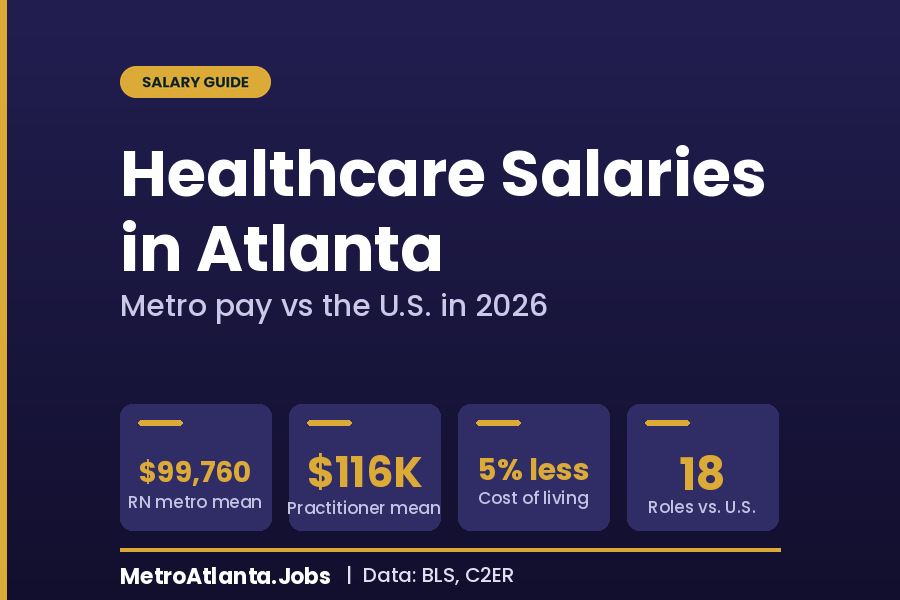
At the group level, metro Atlanta's healthcare practitioner and technical occupations average $116,410 a year, above the national $108,700 [1][2]. That top-line number, though, is lifted by the region's large base of physicians, surgeons, and specialists, whose pay pulls the group average upward. Healthcare support occupations tell a plainer story: Atlanta averages $40,200 against the national $40,800, almost exactly even [1][2]. Role for role, the picture is more balanced than the group averages suggest, and that is where the useful comparison lives.
The pattern across individual roles is consistent. For most clinical and technical jobs, Atlanta pays a little below the national average, usually by 1 to 3 percent. A smaller group of roles pays clearly above national. And once cost of living enters the math, the slight nominal gap on most roles disappears.
Several forces sit behind that pattern. Metro Atlanta trains a large share of its own healthcare workforce through a deep bench of universities, technical colleges, and hospital-based programs, which keeps a steady supply of new clinicians moving into the market. At the same time, the region's major hospital systems compete for that talent across a wide suburban footprint. The net effect is pay that lands near national norms for most roles rather than spiking far above or falling far below.
Most of these jobs also cluster inside the metro's large hospital systems and their fast-growing outpatient networks. That concentration shapes where the openings are, since a handful of counties hold the biggest campuses even though the systems recruit across all 29. It also means two workers with the same title and license can earn different totals depending on the employer, the setting, and the shift, so the averages here work best as a metro-wide baseline rather than a promise for any single job.
What a lower cost of living changes
A wage gap means little until you know what a dollar buys in each place, and this is where Atlanta's case strengthens. Metro Atlanta's overall cost of living runs modestly below the national average. The Atlanta Regional Commission, drawing on the Council for Community and Economic Research Cost of Living Index, puts the metro's composite index at 95.7 [3], roughly 4 to 5 percent below the national benchmark of 100. The main driver is housing, which runs well below the national average, while categories like utilities, groceries, and transportation sit slightly above [3]. Housing is the swing factor here. It is the largest line in most household budgets, so a metro Atlanta housing cost that runs well under the national figure is enough to pull the whole index below 100 even when a few smaller categories run a little higher [3]. For a healthcare worker weighing Atlanta against a pricier metro, that housing gap is usually the difference that matters most.
Put the two together and the comparison shifts. When a role pays 1 to 3 percent less in Atlanta than nationally, a cost of living that is 4 to 5 percent lower more than covers the difference. In real, cost-adjusted terms, that worker comes out roughly even or a little ahead. For the roles where Atlanta already pays above the national average, the lower cost of living widens the advantage. The clear exception is the lowest-paid support work: home health and personal care aides earn meaningfully less in Atlanta, and a 4 to 5 percent cost cushion does not close a gap that wide. Everything below should be read with that lens.
Atlanta healthcare salaries by role
The roles below are grouped from advanced clinical positions down to entry-level support work. Each figure is the annual mean wage for the metro area, followed by the national mean for the same role [1][2]. Keep in mind these are averages. Within any role, pay climbs with experience, credentials, setting, and shift, so the top of each local range runs well above the mean shown here.
Nurses and advanced practice
Registered nurses are the single largest healthcare occupation in metro Atlanta, with more than 56,000 employed. They earn a mean of $99,760 here versus $101,420 nationally, about 1.6 percent below [1][2]. Adjusted for the lower cost of living, Atlanta registered nurses effectively match or edge past the national figure. As the metro's anchor clinical role, RN pay also sets a local reference point that many other nursing and allied-health wages track against. Nurse practitioners average $134,960 in Atlanta against $137,300 nationally, a 1.7 percent gap that the cost of living erases [1][2]. Licensed practical and vocational nurses earn $64,890 here versus $67,050 nationally, about 3.2 percent below, one of the wider gaps among nursing roles [1][2].
Pharmacy and therapy roles
Pharmacists average $139,250 in metro Atlanta, just under the national $140,920 [1][2]. Physical therapists are nearly identical, at $104,750 here and $105,280 nationally [1][2]. Two therapy roles beat the national number outright. Occupational therapists average $106,200 in Atlanta versus $101,280 nationally, about 4.9 percent above, and respiratory therapists earn $94,720 here against $87,300 nationally, roughly 8.5 percent above, one of the strongest premiums in the metro [1][2]. Speech-language pathologists sit just under national, at $97,230 versus $98,170 [1][2].
Imaging, laboratory, and surgical technologists
Clinical laboratory technologists and technicians are another role where Atlanta leads, averaging $70,740 versus $67,350 nationally, about 5 percent above [1][2]. Radiologic technologists earn $82,290 here versus $83,840 nationally, and surgical technologists are essentially even at $68,330 against $68,710 [1][2]. The outlier on the low side is the diagnostic medical sonographer, averaging $90,680 in Atlanta versus $97,240 nationally, about 6.7 percent below, a gap wide enough that even the cost of living leaves it slightly behind [1][2].
Dental, assistant, and aide roles
Dental hygienists average $96,990 in metro Atlanta versus $98,990 nationally, about 2 percent below [1][2]. Among entry-level roles, phlebotomists stand out on the high side, earning $48,950 here against $45,520 nationally, roughly 7.5 percent above [1][2]. Dental assistants earn $48,520 versus $50,200, and medical assistants earn $44,970 versus $46,120, both a few points under national [1][2]. Nursing assistants average $40,570 here against $42,700 nationally, about 5 percent below [1][2]. At the bottom of the scale, home health and personal care aides earn $31,880 in Atlanta versus $36,120 nationally, about 11.7 percent below and the widest gap in this guide [1][2].
Where Atlanta comes out ahead, and where it lags
Four roles pay clearly above the national average before any cost adjustment: respiratory therapists (about 8.5 percent above), phlebotomists (7.5 percent), clinical laboratory technologists (5 percent), and occupational therapists (4.9 percent) [1][2]. Factor in the lower cost of living and these become the metro's real standouts.
A large middle group, including registered nurses, nurse practitioners, pharmacists, physical therapists, speech-language pathologists, dental hygienists, and radiologic technologists, sits within a few percent below national on paper. These are the roles the cost of living reshapes most. A 1 to 3 percent nominal shortfall against a 4 to 5 percent cheaper cost of living leaves the Atlanta worker even or slightly ahead in what their pay actually buys.
Two roles remain behind even after adjustment: diagnostic medical sonographers and, more sharply, home health and personal care aides, whose national gap is too wide for the cost cushion to close [1][2][3]. For those roles, national pay genuinely leads.
What base pay leaves out
Mean wages describe base pay, and in healthcare base pay is only part of the check. Roles that run nights, weekends, and holidays often carry shift differentials that add a real premium per hour, and overtime is common wherever staffing runs tight. Many systems offer sign-on bonuses for hard-to-fill positions, especially experienced nurses, surgical technologists, and imaging techs. Benefits swing total compensation as well: employer-paid health coverage, retirement matching, tuition assistance, and paid time off can be worth thousands beyond the salary line. Contract and travel assignments, common in nursing and allied health, can pay well above staff rates for a defined stretch, though usually without the same benefits or long-term stability. When you compare two offers, or compare Atlanta pay against another metro, weigh the full package and the schedule, not just the headline wage. The averages in this guide are the starting point for that math, not the finish line.
How to use these numbers in your Atlanta job search
Wage averages are a benchmark, not an offer. Use them to anchor expectations, then sharpen your search. Browse current healthcare openings across metro Atlanta and filter by role and county. Create a free job seeker profile so employers across all 29 counties can find you, and turn on daily alerts so new postings reach you first. Before you apply, tighten your resume with our Atlanta resume tips for 2026, and benchmark your target pay against our Atlanta Salary Guide and entry-level salaries guide. When an offer arrives, our guide to negotiating salary in Atlanta helps you make the case, since shift differentials, sign-on bonuses, and benefits often matter as much as base pay in healthcare.
For the wider hiring backdrop, see our healthcare jobs in Atlanta guide and our Atlanta job market and hiring trends breakdown. If you are targeting a specific area, our county guides cover the local market in Fulton, Gwinnett, Cobb, and DeKalb County, where most of the metro's major hospital systems are based.
Healthcare also remains one of the metro's steadiest sources of hiring. Nationally, healthcare occupations are projected to add more jobs than any other group this decade, and Atlanta's large hospital systems hire year-round to keep pace with turnover and growth [4].
Get started on your Atlanta healthcare job search
Create a Free Job Seeker Profile: set up your job seeker profile to apply faster and let employers find you.
Browse All Metro Atlanta Jobs: search current openings across all 29 counties on the jobs page.
Get Daily Atlanta Job Alerts: turn on daily job alerts so new healthcare roles reach you first.
Atlanta Salary Guide: benchmark your pay with the Atlanta Salary Guide.
Atlanta Resume Tips for 2026: tighten your application with our Atlanta resume tips.
How to Negotiate Salary in Atlanta: prepare for your offer with our salary negotiation guide.
Frequently asked questions
How much do healthcare workers make in Atlanta?
It depends heavily on the role. In metro Atlanta, healthcare practitioner and technical occupations average about $116,410 a year and healthcare support occupations average about $40,200, according to May 2025 federal data [1]. Individual roles range from around $31,880 for home health aides to well over $130,000 for nurse practitioners and pharmacists [1].
Do Atlanta healthcare salaries beat the national average?
For most clinical roles, Atlanta pays slightly below the national average on paper, usually by 1 to 3 percent [1][2]. But metro Atlanta's cost of living runs about 4 to 5 percent below the national average [3], so cost-adjusted pay comes out roughly even or a little ahead for most roles.
Which healthcare jobs pay the most in Atlanta?
Among the roles compared here, pharmacists (about $139,250) and nurse practitioners (about $134,960) lead, followed by occupational therapists, physical therapists, and registered nurses [1]. Physician and surgeon roles pay more still but require far longer training.
How does Atlanta's cost of living affect healthcare pay?
Atlanta's overall cost of living sits about 4 to 5 percent below the national average, driven mainly by below-average housing costs [3]. That cushion offsets the small nominal wage gap on most healthcare roles, so a paycheck tends to stretch further here than the raw number suggests.
What healthcare roles pay above the national average in Atlanta?
Respiratory therapists (about 8.5 percent above), phlebotomists (about 7.5 percent), clinical laboratory technologists (about 5 percent), and occupational therapists (about 4.9 percent) all pay above their national averages in metro Atlanta [1][2].
How much does a registered nurse make in Atlanta?
Registered nurses in metro Atlanta earn a mean wage of about $99,760 a year, compared with $101,420 nationally [1][2]. With Atlanta's lower cost of living, that slightly lower figure effectively matches the national average in buying power. Registered nurses are also the metro's largest healthcare occupation.
What is a good entry-level healthcare job in Atlanta?
Phlebotomists (about $48,950), dental assistants (about $48,520), and medical assistants (about $44,970) are common entry points that require short training programs rather than a degree [1]. Phlebotomists in Atlanta notably pay above the national average.
Are healthcare jobs in demand in metro Atlanta?
Yes. Healthcare is one of the region's largest and steadiest employers, with more than 174,000 people in practitioner and technical roles alone, and nationally healthcare is projected to add more jobs than any other occupational group this decade [1][4].
Is metro Atlanta a good place to work in healthcare?
For most roles, yes. Pay lands close to the national average, the cost of living runs about 4 to 5 percent lower, and healthcare is one of the region's largest and steadiest employers [1][3]. Some roles, such as respiratory therapists and clinical laboratory technologists, pay above national here, while the lowest-paid aide roles trail the national figure [1][2].
Where does this salary data come from?
All wage figures come from the U.S. Bureau of Labor Statistics Occupational Employment and Wage Statistics program, May 2025 release, for both the Atlanta metro area and the nation [1][2]. Cost of living figures come from the Council for Community and Economic Research index as reported by the Atlanta Regional Commission [3].
Sources
4. U.S. Bureau of Labor Statistics, Occupational Outlook Handbook, Healthcare Occupations