14 min read
If you are researching entry-level salaries in Atlanta in 2026, the numbers tell a more nuanced story than national averages suggest. The Atlanta-Sandy Springs-Roswell MSA carries a higher average hourly wage than the US overall, but that average masks meaningful variation by industry, county, and the specific role you are targeting. A first-year software engineer in Midtown earns dramatically different pay than an entry-level warehouse associate in McDonough, and both numbers are useful to know whether you are negotiating an offer, comparing two roles, or planning a relocation to Atlanta. This guide breaks down what entry-level pay actually looks like across the 29-county metro, where the highest-paying entry-level roles concentrate, and how to negotiate your first Atlanta offer with real data behind you.
Atlanta's labor market sits in an interesting middle ground. The metro hosts 3.14 million nonfarm jobs as of mid-2025, a corporate base that includes Coca-Cola, Delta, Home Depot, UPS, NCR Voyix, and dozens of other major employers, plus a deep professional services sector and a growing tech presence often called Silicon South. [2] Mean hourly wages run slightly above the national average, but cost of living runs meaningfully below coastal markets like San Francisco, Boston, and New York. For an entry-level job seeker, that combination often translates to higher real take-home pay than equivalent roles in higher-cost cities.
Atlanta Entry-Level Pay by the Numbers
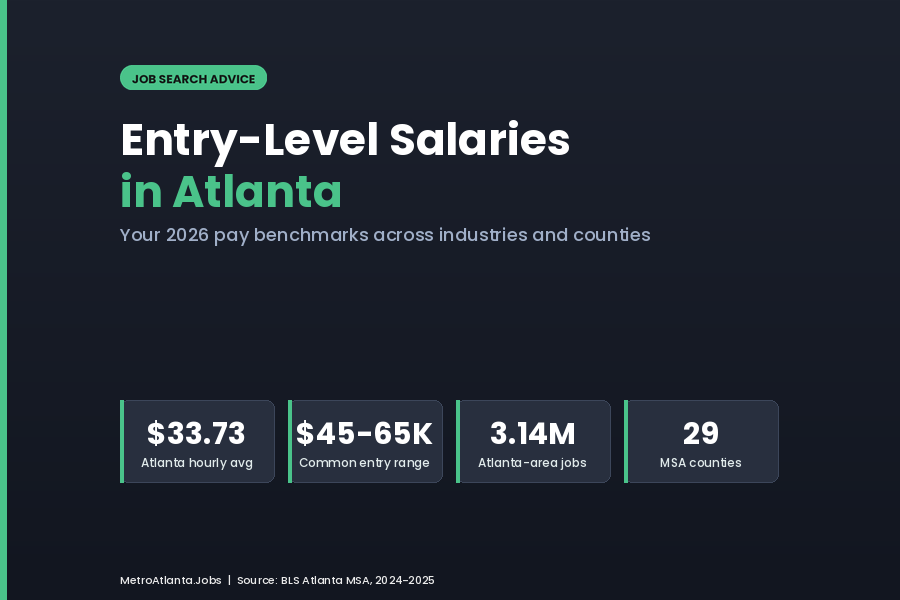
$33.73: Atlanta MSA mean hourly wage across all occupations, May 2024 (national average: $32.66) [1]
3.14 million: Total nonfarm jobs in the Atlanta-Sandy Springs-Roswell MSA, mid-2025 [2]
70%: Of organizations that include pay ranges in postings report receiving more applicants; 66% report better candidate quality [3]
29: Counties in the Atlanta MSA, with meaningful pay differences across submarkets
11.0%: Atlanta employment share in transportation and material moving (vs 8.9% nationally), one of the metro's largest entry-level employer categories [1]
5.9%: Atlanta employment share in healthcare practitioners and technical occupations, with a metro mean wage of $55.25 per hour [1]
What "Entry-Level" Actually Means in Atlanta in 2026
The term entry-level has shifted meaningfully since 2022. Historically, entry-level meant zero to two years of experience plus a relevant degree or certification. In 2026, the definition is wider in some directions and narrower in others.
The wider direction: skills-based hiring has expanded the entry-level candidate pool to include career switchers, bootcamp graduates, and candidates with non-traditional credentials. A growing share of Atlanta postings now screen on demonstrated skills rather than rigid years-of-experience requirements, opening the door to candidates who can prove competence through portfolios, certifications, or practical assessments. For Atlanta candidates moving between sectors, this is a meaningful shift; the Changing Careers in Atlanta guide covers the broader career-pivot playbook.
The narrower direction: some Atlanta employers, particularly in tech and finance, have re-tightened entry-level definitions to require a specific degree, a recognized internship, or a particular skill stack. New-grad rotational programs at major Atlanta employers like Delta, Home Depot, Cox Enterprises, and Truist often require a four-year degree and competitive GPAs. Entry-level in those contexts is closer to its traditional definition.
For practical purposes, entry-level Atlanta postings in 2026 typically fit one of three patterns: roles open to candidates with zero to two years of relevant experience, roles open to recent graduates of a specific program (BSN, MBA, accredited engineering degree), or roles open to anyone who can demonstrate the required skills through a portfolio, certification, or practical assessment.
Entry-Level Salary Benchmarks by Industry in Metro Atlanta
The widest single source of Atlanta wage data is the Bureau of Labor Statistics Occupational Employment and Wage Statistics survey, which reports mean and percentile wages across the Atlanta MSA. [1] The 10th and 25th percentile wages in OEWS data approximate what entry-level workers in each occupation typically earn. The benchmark ranges in this section blend three sources: BLS Atlanta MSA OEWS data, the Robert Half 2026 Salary Guide [4], and publicly available employer salary disclosures from Atlanta career pages. Ranges are presented as typical first-year compensation for the named role categories; specific offers vary meaningfully by employer size, role specialization, candidate background, and location within the metro.
Technology entry-level salaries
Atlanta's tech sector has been one of the fastest-growing in the Southeast, anchored by NCR Voyix, Global Payments, Mailchimp (Intuit), Salesforce Tower Atlanta, Microsoft's Atlanta hub, and a deep fintech cluster around Sandy Springs and Alpharetta. Entry-level software engineers, data analysts, and IT support roles typically range from $65,000 to $95,000 for first-year compensation, with major-employer rotational programs and fintech roles clustering at the higher end. Atlanta's mean wage for computer and mathematical occupations was $53.29 per hour in May 2024, slightly below the national mean of $56.16, reflecting Atlanta's lower cost of living. [1] Entry-level data analyst and IT support roles typically start in the $55,000 to $70,000 range. For the broader sector landscape, see the Tech Jobs in Atlanta guide.
Healthcare entry-level salaries
Healthcare practitioners and technical occupations command the largest pay premium in Atlanta relative to national averages. The Atlanta MSA mean wage in this group was $55.25 per hour in May 2024, compared to $50.59 nationally. [1] Entry-level registered nurses at the major Atlanta health systems (Emory, Piedmont, Northside, Wellstar, Grady) typically start between $70,000 and $85,000 in base pay, with shift differentials and sign-on bonuses pushing total first-year compensation higher for night, weekend, and specialty units. Entry-level allied health roles such as medical technologists, respiratory therapists, and pharmacy technicians range from $45,000 to $70,000. The Healthcare Jobs in Atlanta guide covers the major health systems and what each one is paying.
Logistics, warehouse, and supply chain entry-level salaries
Transportation and material moving occupations account for 11.0% of Atlanta employment, the metro's largest single occupational concentration relative to the national average of 8.9%. [1] Entry-level warehouse associates, fulfillment center workers, and delivery drivers in the Atlanta MSA typically earn $36,000 to $50,000 annually, with sustained demand driving pay above Georgia's statutory minimum. Hartsfield-Jackson, the South Fulton logistics corridor, the Henry County logistics hub, and the Stockbridge and McDonough warehouse clusters concentrate the largest share of entry-level logistics roles. Entry-level supply chain analyst and coordinator positions sit higher, typically $55,000 to $72,000. The Logistics Jobs in Atlanta guide maps the major logistics employer concentrations.
Finance, banking, and accounting entry-level salaries
Atlanta's financial services sector includes major operations from Bank of America, Wells Fargo, Truist, Synovus, Invesco, Global Payments, and the Federal Reserve Bank of Atlanta. Atlanta's mean wage for business and financial operations occupations was $45.05 per hour in May 2024, almost identical to the national mean. [1] Entry-level financial analyst and accountant roles in Atlanta typically range from $60,000 to $75,000 in base pay at major employers, with rotational programs at the largest banks clustering at the higher end. Entry-level loan officers and credit analysts run roughly $52,000 to $68,000. For broader compensation context across roles and tiers, see the Atlanta Salary Guide 2025.
Marketing, sales, and operations entry-level salaries
Atlanta's deep corporate base supports a large entry-level marketing, sales, and operations function across Fortune 500 HQs and the professional services firms serving them. Atlanta's mean wage for market research analysts and marketing specialists was $42.45 per hour in May 2024, with 18,020 jobs in the category. [1] Entry-level marketing coordinator, sales development representative, and operations analyst roles in the metro typically range from $50,000 to $68,000, with technology-sector SDR roles often including commission-based compensation that pushes total first-year earnings to $75,000 or more for top performers. Customer success and account management entry-level roles run $55,000 to $72,000 across most sectors.
How Atlanta Entry-Level Salaries Compare to Other Markets
A first-year software engineer offer in San Francisco is often reported in the range of $115,000 to $130,000 in base pay. The same role in Atlanta commonly comes in around $75,000 to $95,000. On paper, San Francisco wins by a wide margin. After adjusting for cost of living, the picture changes meaningfully.
Cost-of-living indices typically place Atlanta slightly above the national average, with most indices showing the metro around 2 to 5 percent higher overall, driven largely by housing in close-in neighborhoods. The same indices generally place San Francisco at roughly 70 to 85 percent above national average and New York City at roughly 60 to 70 percent above. Atlanta's median home price was in the low $400,000s as of mid-2025, compared to well over $1 million in San Francisco and the high $700,000s in Boston, based on commonly cited regional housing data. Georgia is in the middle of a multi-year transition from a six-bracket progressive system to a flat tax under HB 1437 (2022) and subsequent acceleration legislation, with the 2026 flat rate in the low 5 percent range and a legislated path toward 4.99 percent over the next several years. California's top marginal rate is 13.3 percent and New York's combined state-and-city top rate exceeds 14 percent, though entry-level workers in each state face much lower effective rates given their bracket position.
The practical takeaway for entry-level job seekers: a $90,000 Atlanta offer typically delivers comparable or better disposable income than a $120,000 San Francisco offer after taxes, rent, and routine cost-of-living differences are accounted for. Atlanta consistently sits in a regional sweet spot where major-employer corporate compensation runs at a discount to coastal market rates while cost of living runs at a meaningful further discount. For broader Atlanta market context, the Atlanta Job Market 2025-2026 report covers the full hiring picture.
Where Atlanta's Entry-Level Salaries Run Highest in Metro Atlanta
Pay varies meaningfully across the 29 counties of the Atlanta MSA. The highest entry-level salaries concentrate in the corporate corridors where Fortune 500 headquarters and major professional services firms cluster.
Fulton County anchors the metro's highest-paying entry-level concentration. Midtown, Buckhead, and the Perimeter area host the densest corporate HQ presence, including Coca-Cola, Delta, UPS, Truist, and Mercedes-Benz USA. Entry-level corporate, tech, and finance roles concentrate here. The Fulton County jobs guide covers the broader employer landscape.
Cobb County carries the metro's second-largest concentration of corporate HQs, including Home Depot's Vinings campus, The Weather Channel, and a deep cluster of professional services and finance firms. The Cobb County jobs guide maps the northwest corridor.
Gwinnett County has emerged as Atlanta's fastest-growing employment center, with NCR Voyix, Primerica, and a growing technology and logistics presence anchored by the Rowen development. The Gwinnett County jobs guide covers the northeast corridor employers.
DeKalb County carries Emory University and its associated health system, Children's Healthcare of Atlanta, and the Centers for Disease Control and Prevention. Healthcare and research entry-level roles concentrate here. The DeKalb County jobs guide covers the eastern corridor.
Forsyth County consistently ranks among Georgia's highest median household income counties and has a growing cluster of finance, professional services, and technology employers. Entry-level corporate roles in Forsyth often pay slightly above the broader Atlanta MSA average due to employer mix. The Forsyth County jobs guide covers the northern corridor.
Henry County and the southern logistics corridor concentrate the largest share of entry-level warehouse, fulfillment, and logistics roles. Pay in these roles is more uniform across the corridor but slightly below the Fulton and Cobb corporate cores. The Henry County jobs guide covers the southeast corridor.
Negotiating Your First Atlanta Salary
Entry-level candidates often assume there is no room to negotiate. The data says otherwise. Robert Half's 2026 Salary Guide reports that 88 percent of professionals feel confident negotiating salary offers. [4] Even at major employers with rotational programs and standardized starting bands, signing bonuses, start dates, relocation stipends, and education reimbursement are frequently negotiable. For non-rotational entry-level offers at mid-size Atlanta employers, base pay itself is often negotiable, with industry compensation surveys suggesting typical negotiation room of roughly 5 to 15 percent on initial offers.
Three moves consistently produce better entry-level outcomes for Atlanta candidates:
Anchor on real market data, not on what you hoped to earn. Bring specific numbers from the BLS OEWS Atlanta report and at least one independent salary survey for your sector to the conversation. Citing data shifts the negotiation from a personal ask to a market-rate discussion, and most hiring managers respond better to the latter.
Negotiate total compensation, not just base. Sign-on bonuses, relocation stipends, equity grants, education reimbursement, and start dates are often easier to move than base pay. A $5,000 sign-on bonus carries no future cost to the employer the way a permanent base increase does, which makes it more available.
Ask for the range, then negotiate within it. If a posting does not list a pay range, ask early in the interview process. SHRM research shows 70% of organizations that include pay ranges report receiving more applicants; many Atlanta employers now share ranges on request even when not legally required. [3] Knowing the band lets you target the upper end with specific evidence of why you fit there.
For the broader negotiation playbook, including scripts and counter-offer strategies, see the How to Negotiate Salary in Atlanta guide.
Frequently Asked Questions: Entry-Level Salaries in Atlanta
What is the average entry-level salary in Atlanta in 2026?
Entry-level salaries in Atlanta vary significantly by industry. Industry compensation surveys generally place a reasonable cross-industry average for entry-level office roles in 2026 in the range of $50,000 to $65,000, with technology and healthcare roles trending higher and retail, food service, and basic warehouse roles trending lower. The BLS reports Atlanta's overall mean hourly wage at $33.73 (approximately $70,158 annualized) across all experience levels and roles, with entry-level wages typically falling in the 10th to 25th percentile of that distribution for each occupation. [1]
Is $50,000 a good entry-level salary in Atlanta?
For many entry-level office roles, $50,000 is at the lower end of competitive but not unusual. Given Atlanta's cost of living, $50,000 supports a reasonable solo lifestyle in outer-suburb counties like Gwinnett, Cobb, and Henry, but covers less in Fulton or close-in DeKalb where housing costs run higher. Entry-level roles in technology, finance, healthcare, and engineering typically pay above $50,000 in Atlanta; entry-level roles in administrative support, customer service, retail, and food service typically pay at or below $50,000.
Which industries pay the highest entry-level salaries in Atlanta?
Technology, healthcare practitioners (especially nursing), finance and banking, and engineering consistently pay the highest entry-level salaries in Atlanta. The Atlanta MSA's largest pay premium relative to national averages is in healthcare practitioners and technical occupations, where Atlanta's mean wage of $55.25 per hour exceeds the national mean of $50.59. [1] Atlanta's strong corporate HQ density also makes finance, professional services, and tech-product roles competitive against national medians despite lower cost of living.
How does Atlanta's entry-level pay compare to Charlotte, Tampa, and Nashville?
Atlanta typically sits in the middle of the major Southeast metros for entry-level pay, with Charlotte generally reported as slightly higher for financial services and banking roles (driven by the Bank of America HQ presence and Truist's significant Charlotte operations), Tampa often lower for most sectors but with growing tech-sector parity, and Nashville generally lower for most sectors except healthcare administration (driven by HCA Healthcare HQ). Atlanta's deeper Fortune 500 base and larger tech sector tend to produce a wider distribution of high-paying entry-level options than the other three metros.
Do entry-level Atlanta employers list pay ranges in job postings?
Georgia does not have a state-level pay transparency law as of 2026, so Atlanta employers are not legally required to disclose pay ranges. In practice, the share of Atlanta postings with pay ranges has been growing steadily, with many multi-state employers defaulting to ranges across all postings for consistency with the growing number of states and Washington D.C. that have enacted disclosure requirements. SHRM research shows that 70% of organizations listing pay ranges receive more applicants and 66% report better candidate quality. [3] If a posting omits the range, ask early in the interview process; most Atlanta employers will share it on request.
What benefits should I look for in an entry-level Atlanta offer?
Beyond base salary, the highest-impact benefits to evaluate in an entry-level Atlanta offer include employer-paid health insurance (especially the employer share of the premium), 401(k) match (industry surveys commonly cite a strong match in the 4 to 6 percent range with immediate or short vesting), paid time off (industry surveys generally cite 3 to 4 weeks as competitive for entry-level), tuition reimbursement (especially valuable if you are considering graduate work), and any commuter or hybrid-work flexibility. For roles at large Atlanta corporate employers, equity grants in the form of RSUs or stock purchase plans can add meaningfully to total compensation; for healthcare roles, shift differentials and sign-on bonuses are often substantial. Robert Half's 2026 Salary Guide notes that 53 percent of workers would switch employers for better financial incentives at the same base pay, underscoring how meaningfully total compensation factors into job decisions. [4]
What are the highest-paying entry-level Atlanta jobs that don't require a four-year degree?
The highest-paying entry-level Atlanta roles open to candidates without a four-year degree concentrate in skilled trades, logistics operations, and specific technology roles. Industry compensation surveys generally place commercial truck drivers with a Class A CDL in the $55,000 to $75,000 range in their first year at major Atlanta carriers, often with sign-on bonuses. Apprentice electricians, plumbers, and HVAC technicians in the Atlanta area typically start in the $40,000 to $55,000 range with structured wage growth toward $70,000 to $90,000 once licensed, according to typical apprenticeship pay scales. IT support technicians and help desk roles often hire with industry certifications (CompTIA A+, Network+, Security+) rather than a degree, with Atlanta entry-level pay commonly reported in the $48,000 to $62,000 range. Coding bootcamp graduates have placed into Atlanta junior developer roles starting between roughly $55,000 and $80,000 depending on stack and employer.
How much do entry-level Atlanta salaries typically grow in the first three years?
Most Atlanta entry-level roles see meaningful base-pay growth in the first three years, driven by annual raises, promotion steps, and skill-based step increases. Industry compensation research generally places the typical three-year trajectory in technology, healthcare, and finance at roughly 25 to 40 percent above starting base, putting a $70,000 first-year role at roughly $90,000 to $98,000 by year three. In administrative, customer service, and logistics roles, three-year growth is more modest, commonly reported in the 12 to 20 percent range. Candidates who switch employers between year two and year three frequently capture a larger jump than internal promotion would deliver, since external offers tend to be benchmarked against current market rates rather than internal pay bands.
How do I find entry-level jobs in Atlanta that match my target salary?
The most effective Atlanta-focused approach combines a local job board built specifically for the 29-county metro with targeted networking and direct employer research. MetroAtlanta.Jobs covers the Atlanta MSA across 11 industry categories, distributes postings to the Google Jobs Network, and lets job seekers create a free job seeker profile to save searches, receive daily alerts, and apply to roles in one click. Combine the local search with direct research on the specific employers you are targeting, using their careers pages and any public compensation disclosures.
Find Your First Atlanta Role at the Right Pay
Entry-level salaries in Atlanta in 2026 reward candidates who do the data work before the conversation. The metro's 3.14 million-job base, deep Fortune 500 corporate concentration, and strong healthcare and technology sectors produce a wider range of competitive entry-level options than most candidates realize. Knowing the BLS benchmarks for your target occupation, understanding how cost of living shifts the math against coastal markets, and entering negotiations with real numbers consistently produces better first-job outcomes.
Start your search on a board built specifically for Metro Atlanta. MetroAtlanta.Jobs aggregates current openings across all 11 categories and 29 counties, with entry-level roles filterable across every major sector.
Get Started
- Create a Free Job Seeker Profile
- Browse All Metro Atlanta Jobs
- Get Daily Atlanta Job Alerts
- Atlanta Salary Guide 2025
- Atlanta Resume Tips for 2026
- How to Negotiate Salary in Atlanta