9 min read
Knowing how to negotiate salary in Atlanta is one of the highest-return skills a professional can develop. Only 39 percent of workers negotiated their salary for their current job, yet data consistently shows that those who do earn significantly more over time. The average amount left on the table by professionals who skip negotiation is $7,500 per year. Across a 30-year career, that single conversation compounds into hundreds of thousands of dollars. [1] This guide gives you the exact scripts, timing, and Atlanta-specific tactics to negotiate confidently at every stage of the hiring process in 2026.
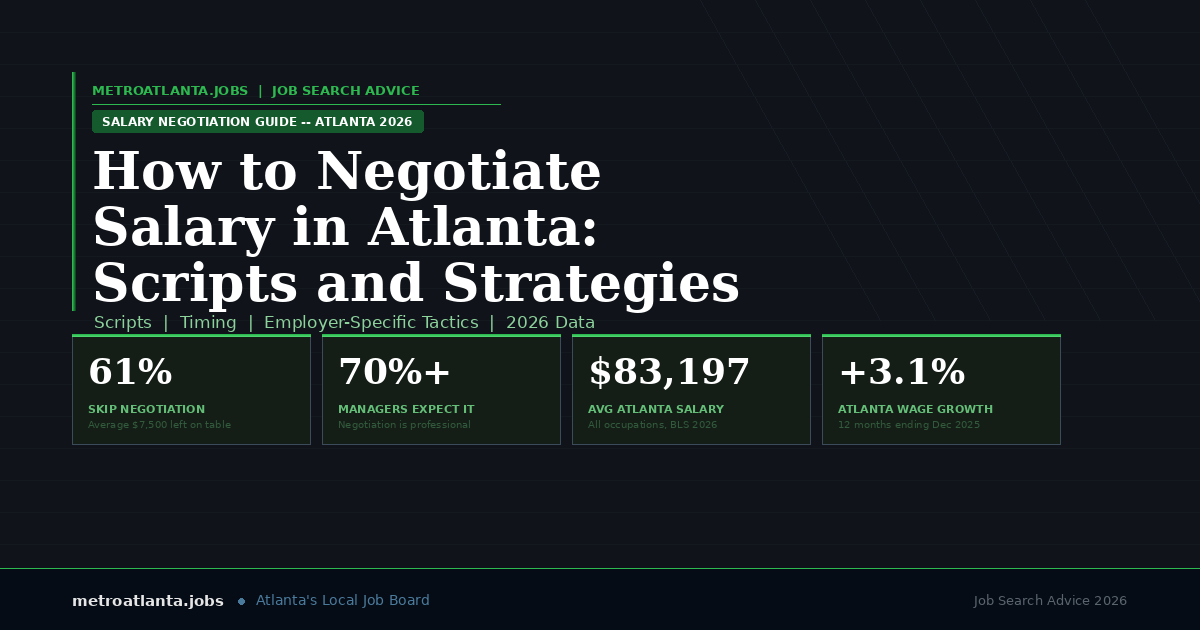
Atlanta's compensation market in 2026 gives candidates real leverage if they know how to use it. Compensation costs for private industry workers in the Atlanta area increased 3.1 percent in the 12 months ending December 2025, according to the Bureau of Labor Statistics Employment Cost Index. [2] That wage growth sits slightly below the national rate of 3.4 percent, but in a market where the average salary across all occupations is approximately $83,197, the absolute dollar value of effective negotiation is substantial. [3]
More importantly, Atlanta's employer culture generally rewards candidates who negotiate professionally. Over 70 percent of hiring managers expect candidates to negotiate salary after an offer is extended. [1] The expectation is there. The leverage is there. The gap is in execution.
Atlanta Salary Negotiation by the Numbers (2026):
- Workers who skip negotiation: 61% [1]
- Average left on the table annually: $7,500 [1]
- Hiring managers who expect candidates to negotiate: 70%+ [1]
- Atlanta compensation cost growth (12 months to Dec 2025): +3.1% [2]
- Average salary across all Atlanta occupations: $83,197 [3]
- Atlanta urban core average (Midtown, Buckhead, Perimeter): $94,200 [4]
- Georgia flat income tax rate in 2026: 5.49% (reducing to 4.99% by 2029) [4]
Why Atlanta Is a Good Market to Negotiate In
Atlanta's job market has several structural characteristics that work in a candidate's favor at the negotiating table.
A talent market, not a buyer's market. Despite some softening in national tech hiring in the prior two years, Atlanta's diverse economy spanning fintech, healthcare, logistics, education, and corporate services has kept demand for skilled professionals consistently high. The Atlanta unemployment rate held below the national average through 2026, and employers across major sectors report difficulty filling specialized roles. Tight supply in a specific skill set gives candidates negotiating leverage that a loose market does not.
Multiple competing employers in key corridors. The North Fulton tech corridor, the Cumberland corporate district in Cobb County, the Perimeter Center office market, and the Emory and Northside healthcare ecosystems all have multiple employers competing for similar talent profiles. If you have a job offer from one company in Alpharetta, there is a reasonable chance that two or three competitors in the same corridor also need someone with your skills. That competitive context is a legitimate and powerful negotiating tool.
Georgia's tax advantage is a real negotiating data point. Georgia's 2026 flat income tax rate of 5.49 percent, on a path to 4.99 percent by 2029, is significantly lower than California (up to 13.3 percent), New York (up to 10.9 percent), or even North Carolina (4.5 percent). If you are relocating from a high-tax state, your effective take-home on a given salary is meaningfully higher in Georgia. This is a legitimate point to acknowledge in negotiations with out-of-state employers establishing Atlanta operations. [4]
Salary transparency is becoming the norm. A growing number of Atlanta employers, particularly in technology and professional services, now include salary ranges in job postings. When a posting includes a range, the top of that range is almost always achievable for a well-qualified candidate. The listed range is the floor of the conversation, not a take-it-or-leave-it number.
The Timing of the Negotiation: When to Make Your Move
Timing is the single most important tactical variable in salary negotiation. Get the timing wrong and the best script in the world loses its power.
Before the Offer: Gather Information, Reveal Nothing
During interviews, avoid stating a specific salary expectation unless directly required. If asked early in the process, redirect with: "I am focused on finding the right fit. What is the budgeted range for this role?" This positions you to receive the first number rather than anchor yourself below the employer's ceiling.
If pressed for a number before an offer exists, give a range based on your research rather than a single figure. The lower end of your range should be above your true minimum. Never anchor low.
After the Written Offer: Your Maximum Leverage Point
Negotiate after you have received a written offer, not before. The moment an employer extends a formal offer, they have decided you are the right person for the role. Their investment in the process peaks at offer. Their motivation to close the deal peaks at offer. That is your moment of maximum leverage. [1]
Take at least 24 hours before responding to any offer. Saying "I am very excited about this opportunity. Can I have until [specific date] to review the full package?" is professional, expected, and gives you time to research, prepare, and approach the conversation with data rather than emotion.
During Annual Reviews: The Other Negotiation Window
New hires are not the only people who should negotiate. If you are a current employee at an Atlanta company, annual review cycles and post-project milestones are your primary windows. Prepare for a review negotiation the same way you would for an offer negotiation: research market rates, document your quantified contributions, and come with a specific number, not a vague request for "something more."
Do Your Research: What Atlanta Employers Actually Pay
Walking into a negotiation without market data is the most common reason Atlanta professionals undersell themselves. You need three specific data points before any conversation: the market rate for your role in Atlanta, the target employer's typical compensation range for the position, and your own documented value to the employer.
For Atlanta market rates by sector:
Tech roles in Atlanta average approximately $112,000 across all tech occupations, with AI engineers reaching $136,000 to $184,000 at mid and senior levels, and data engineers ranging from $107,000 to $162,000. The Motion Recruitment 2026 Atlanta Tech Salary Guide covers over 100 specific tech titles with local salary bands. [5]
Healthcare roles at Atlanta's major systems pay registered nurses $82,000 to $115,000 on average, with travel and specialty contract rates reaching $37 to $112 per hour depending on specialty and facility. [6]
Corporate and professional services roles across the Cobb and Fulton County corridors, where Fortune 500 companies like Home Depot, Truist, and Coca-Cola are headquartered, typically pay 10 to 15 percent above the Atlanta metro average for comparable titles.
Finance and fintech roles along Transaction Alley pay competitively with national markets while costing 30 to 40 percent less to live in than equivalent New York roles.
The BLS Occupational Employment and Wage Statistics for the Atlanta-Sandy Springs-Alpharetta MSA provides the most authoritative publicly available salary data by occupation code, updated annually. [7]
For employer-specific data:
For private companies, the Atlanta Fed Wage Growth Tracker, Randstad's 2026 Atlanta Salary Guide, and professional association salary surveys by sector are the most reliable sources. For publicly traded companies, proxy filings and compensation disclosures provide useful benchmark data for senior roles.
Preparation Checklist Before Any Salary Negotiation:
- Research the market rate for your exact role in the Atlanta market
- Identify three to five comparable employers in the same corridor paying similar rates
- Document three to five quantified achievements that justify your target number
- Know your true minimum (the lowest you will accept) and keep it to yourself
- Know your target (the number you will ask for, 10-20% above your minimum)
- Know your ceiling (the top of what the market supports for your level)
- Prepare your script word for word and practice it aloud at least twice
Scripts That Work With Atlanta Employers
Scripts matter because the language you use determines whether the conversation feels collaborative or adversarial. Atlanta's corporate culture, particularly at the major Cobb and Fulton County employers, responds well to preparation, directness, and professional warmth. What it does not respond to well is vagueness, emotional justification, or ultimatums.
The Initial Counter-Offer Script
Use this after receiving a written offer that is below your target:
"Thank you so much for the offer, I am genuinely excited about this role and the team. Based on my research into comparable roles at Atlanta companies in this sector and my experience delivering [specific result], I was expecting something closer to [your target number]. Is there flexibility to get to that range?"
Why this works: it opens positively, anchors to market data rather than personal need, names a specific number, and asks an open question that gives the employer room to respond.
When They Push Back on Base Salary
If the employer says base salary is fixed, the negotiation is not over:
"I understand. Given that, could we look at the total package? I would be interested in whether there is flexibility on a signing bonus, equity, an additional week of vacation, or an earlier performance review cycle."
Why this works: it accepts the constraint without conceding the outcome, and it shifts the conversation to the areas where employers typically have more room.
The Competing Offer Script
Only use this if you have a real competing offer. Never bluff:
"I want to be transparent with you. I do have another offer at [number] from [type of company, not necessarily the name]. You are my first choice, and I would rather be here. Is there anything you can do to close the gap?"
Why this works: it is honest, it flatters the target employer, and it creates a specific problem for them to solve rather than a vague demand to meet.
When You Are a Current Employee Asking for a Raise
Use this at or before an annual review:
"I wanted to talk about my compensation ahead of the review cycle. Over the past year I have [specific achievement with numbers]. Based on my research into Atlanta market rates for this role, comparable positions are paying between [range]. I would like to discuss getting to [target number]. Can we talk through what that would look like?"
Why this works: it frames the request in terms of market data and documented value, not tenure or personal need, which is exactly how Atlanta's data-driven corporate culture processes compensation decisions.
Negotiating at Atlanta's Major Employer Types
The script and strategy that works at a startup is not identical to what works at a WellStar or a Home Depot. Here is how to calibrate for Atlanta's major employment categories:
Fortune 500 and Large Corporate Employers (Home Depot, Delta, Coca-Cola, Truist)
Large Atlanta corporates typically have formal salary bands. The band usually has a midpoint, and offers to external candidates are often made at or slightly below midpoint. The top of the band is almost always reachable for well-qualified external hires.
Approach: research the company's compensation philosophy (many Fortune 500s publish this), ask directly whether the offer is at midpoint or above, and make your case for top-of-band based on your demonstrated qualifications. Focus on total compensation including bonus target, equity, benefits, and review cycle timing.
Healthcare Systems (WellStar, Northside, Emory, Piedmont)
Atlanta's major healthcare systems have clinical salary bands tied to specialty, certification level, and years of experience. There is typically less flexibility on base salary for clinical roles, but signing bonuses, shift differentials, continuing education allowances, loan forgiveness programs, and relocation assistance all have real dollar value.
Approach: lead with your specialty certifications and years of relevant experience to establish your position at the top of the clinical band. Then negotiate hard on the total package, particularly signing bonuses and loan forgiveness if applicable.
Technology and Fintech Employers (NCR Voyix, Global Payments, Salesforce, startups)
Tech employers in Atlanta, particularly those in the fintech sector, are accustomed to sophisticated, data-driven compensation conversations. Levels.fyi and sector-specific salary benchmarks are widely used and respected in these negotiations.
Approach: bring specific market data, know your competing offers if you have them, and negotiate on total compensation including equity, annual bonus targets, signing bonuses, and remote work flexibility. Startups in the Atlanta Tech Village ecosystem may have less cash but more equity flexibility. Know which you value more before the conversation.
Government and Public Sector (DeKalb County, Forsyth County, Atlanta city agencies)
Government roles in Georgia have published pay grades and steps. There is typically no base salary negotiation outside of hiring authorities agreeing to bring a candidate in above the minimum step for a grade.
Approach: negotiate step placement within the grade based on your years of directly applicable experience. Ask for the highest step within the hiring grade that your experience justifies. Also negotiate relocation assistance, signing bonuses where permitted, and flexibility on start date.
Education (GCPS, CCSD, Emory, Georgia State, Kennesaw State)
Public school districts in Georgia have published teacher salary schedules based on degree level and years of experience. Higher education institutions have more flexibility.
Approach: for K-12, the negotiation is primarily about correct placement on the published salary schedule (ensure all prior teaching experience is credited appropriately), and about supplemental pay for coaching, department chairs, or after-school programs. For higher education, negotiate startup funds, course load, research support, and benefits alongside base salary.
What Atlanta Employers Will and Will Not Negotiate
Understanding where Atlanta employers have flexibility is as important as knowing your scripts.
Employers typically have flexibility on:
- Signing bonuses (especially in healthcare and tech, where retention is difficult)
- Annual bonus targets and structures
- Equity vesting schedules at startups and public tech companies
- Vacation and PTO accrual rates
- Remote or hybrid work arrangements
- Start date (which can affect bonus eligibility timing)
- Relocation assistance
- Professional development and continuing education allowances
- Performance review cycle timing (asking for a six-month review instead of 12-month)
Employers typically have less flexibility on:
- Base salary at large companies with formal band structures
- Benefits plan design (these are group plans and not individually negotiable)
- Title (at large companies with strict title hierarchies)
- Base salary at public schools and government agencies with published pay grades
After the Negotiation: Get It in Writing
Any compensation commitment made verbally must be confirmed in writing before you resign from your current role, give notice, or take any other irreversible action. This is non-negotiable.
A professional, non-confrontational way to confirm: "Thank you so much, I am excited to move forward. Could you update the offer letter to reflect the revised base salary of [amount] and the signing bonus of [amount] so I can complete my review and sign?"
Hiring managers expect this request. It protects both parties and sets the professional tone for the relationship before day one.
Keep Exploring Atlanta Job Search Resources
MetroAtlanta.Jobs connects Atlanta job seekers with current openings across every industry and every county in the 29-county Metro Atlanta area.
Related Posts
Atlanta Resume Tips: Get Noticed by Employers in 2026
Healthcare Jobs in Atlanta 2026
Browse Jobs by County
Jobs in Fulton County (Atlanta, Alpharetta)
Jobs in Cobb County (Marietta, Kennesaw)
Jobs in Gwinnett County (Lawrenceville, Suwanee, Norcross)
Ready to find your next Atlanta role? Browse thousands of current openings across every industry and all 29 Metro Atlanta counties at MetroAtlanta.Jobs, Atlanta's dedicated local job board. New positions added daily.
Frequently Asked Questions About Salary Negotiation in Atlanta
Is it acceptable to negotiate salary in Atlanta?
Yes, and it is expected. Over 70 percent of hiring managers in the Atlanta market expect candidates to negotiate after receiving a formal offer. Candidates who negotiate professionally are viewed positively. The only risk in negotiating is doing it poorly, being unprepared, emotional, or vague. Candidates who come with data and a clear ask rarely face negative consequences.
How much can you negotiate salary in Atlanta?
Most candidates in Atlanta can reasonably negotiate 5 to 15 percent above an initial offer for private sector roles. Tech and fintech roles, where signing bonuses and equity are common, often have total compensation flexibility of 20 percent or more once all elements of the package are considered. Public sector and clinical healthcare roles have less base salary flexibility but significant room to negotiate signing bonuses, loan forgiveness, and supplemental pay.
When should you negotiate salary in Atlanta?
Negotiate after receiving a written offer, never before. Take at least 24 hours to review the full offer package before responding. For current employees, the annual review cycle and the period immediately after completing a significant project or taking on new responsibilities are the strongest negotiation windows.
What is the average salary in Atlanta in 2026?
The average salary across all occupations in Atlanta is approximately $83,197 per year based on BLS occupational employment data. The urban core average across Midtown, Buckhead, and the Perimeter is approximately $94,200. Tech roles average $112,000 and AI engineers reach $136,000 to $184,000 at mid and senior levels. The figure varies significantly by industry, corridor, and experience level.
Do Atlanta employers negotiate remotely or in person?
Both. Most initial offer and counter-offer conversations happen by phone or video call at Atlanta employers in 2026. Voice conversations are generally more effective than email for salary negotiation because tone, timing, and rapport are better communicated in real time. Follow up any verbal agreement with a written confirmation request before signing anything.
How do you negotiate salary at WellStar, Northside, or Emory?
Atlanta's major healthcare systems have clinical salary bands tied to specialty, certification, and experience. The most effective approach is to establish your position at the top of your clinical band by documenting your credentials and relevant years of experience, then negotiate the total package including signing bonuses, loan forgiveness, shift differentials, and continuing education allowances. Healthcare systems typically have more flexibility on signing bonuses and loan forgiveness than on base salary.
How do you negotiate salary at Home Depot, Delta, or other Atlanta Fortune 500 companies?
Large Atlanta corporates have formal salary bands. Research whether your offer is at, below, or above midpoint for the grade. Make a case for top-of-band placement based on your qualifications and market data. Also negotiate annual bonus target, equity or profit sharing, and performance review timing. Vague requests do not work at these employers. Come with a specific number and specific justification.
What if an Atlanta employer says the salary is non-negotiable?
Most employers who say salary is non-negotiable still have flexibility on the total compensation package. Shift the conversation to signing bonuses, additional vacation time, earlier review cycles, remote work arrangements, professional development budgets, or other elements of the offer. Something almost always moves. If nothing moves and the offer is below market, you have the data to make an informed decision about whether to accept or continue your search.
Should I mention competing offers when negotiating in Atlanta?
Only if you have a real competing offer. Bluffing about competing offers is one of the most damaging mistakes a candidate can make. Atlanta's professional networks are tight, and hiring managers talk. If you genuinely have a competing offer, it is one of your strongest negotiating tools and you should use it. State the offer clearly, confirm it is from a legitimate employer, and make clear that you prefer the target role but need to close the gap.
Sources
[1] RecruiterContacts -- Salary Negotiation Complete Guide 2026
[3] SalaryMetro -- Atlanta GA Salaries 2026
[4] University Magazine -- Average Salary in Georgia: 2026 Atlanta Pay Guide
[5] Motion Recruitment -- 2026 Atlanta Tech Salary Guide