9 min read
If you are seriously thinking about changing careers in Atlanta, you have picked a strong moment to do it. The Atlanta-Sandy Springs-Roswell metro area carried 3.14 million nonfarm jobs by mid-2025, has been named the best US city for launching a career for four straight years, and offers a deep employer concentration across healthcare, technology, logistics, and the public sector. [1][2] National data from a recent FlexJobs survey shows 43% of US workers actively looking to switch career fields this year. [3] The local pieces, free workforce training, growing sectors, and skills-based hiring, line up better here than they do in most major metros.
A career change is not a clean slate, though. It is a structured handoff of what you already know how to do into a role that pays for it differently. The pivots that work in 2026 lean on transferable skills, short credential programs, and target sectors where local demand is documented. The ones that stall usually skip those steps and apply broadly to roles that do not map to the candidate's actual experience.
This guide breaks down where the openings are in Metro Atlanta, what they pay, what credentials matter, and a five-step playbook for executing a clean pivot. Whether you are leaving a job that no longer fits, returning after time away, or moving toward something more aligned with your goals, the path is more navigable here than the noise online suggests.
Career Change in Atlanta by the Numbers (2026)
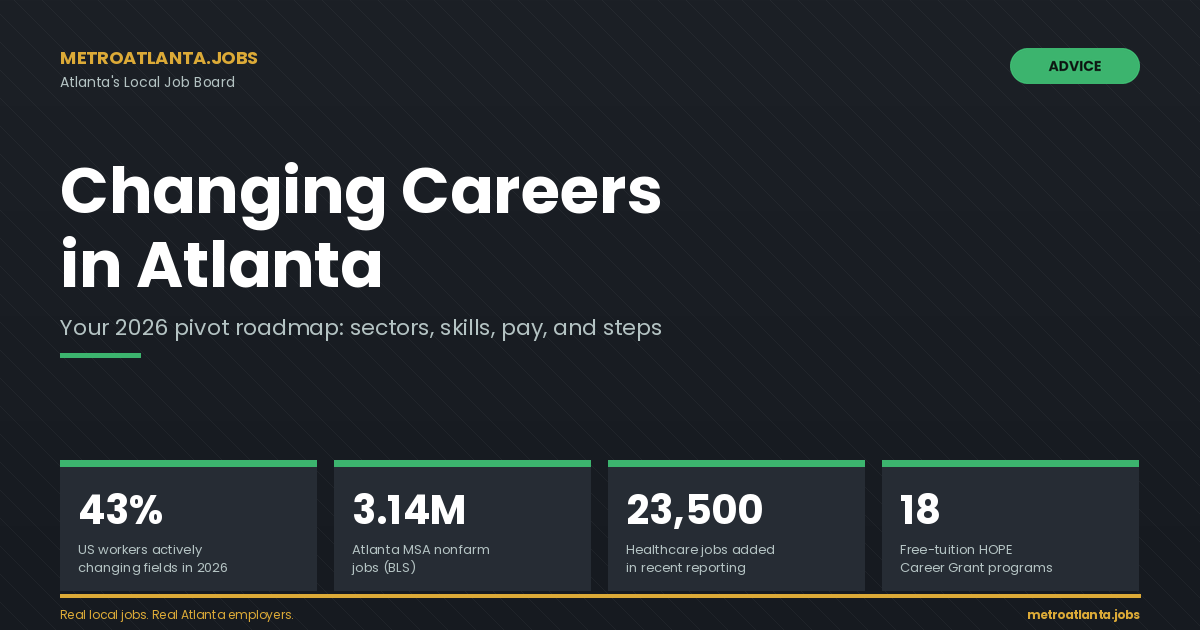
- 43% of US workers actively looking to change career fields in 2026 [3]
- 3.14 million nonfarm jobs in the Atlanta-Sandy Springs-Roswell MSA [1]
- 23,500 healthcare jobs added in Atlanta during the most recent reporting period [4]
- 18 high-demand programs offered free-of-tuition through Georgia's HOPE Career Grant [5]
Why 2026 Is a Strong Year to Pivot in Metro Atlanta
Atlanta has earned its reputation as a career launchpad. WalletHub named the city the best US city to start a career for the fourth straight year in 2026, with the analysis weighing 25 indicators across job market and socioeconomic conditions. [2] For someone changing careers, that ranking matters less than the underlying drivers: population growth, employer density, and a training infrastructure built specifically to move workers between sectors.
Population growth and employer concentration
Between 2024 and 2025, the Atlanta metro area added more than 64,000 new residents, posting a 2% growth rate that outpaces most peer regions. [6] Population growth at that scale generates downstream demand in every sector the new residents touch, including healthcare, education, housing, retail, food service, and public infrastructure. For career changers, that translates into hiring breadth: more roles open across more industries than would be available in a flat or shrinking market. Adjacent counties like Gwinnett, Cobb, and Forsyth are absorbing a meaningful share of that growth, which is part of why the Gwinnett County jobs guide and Cobb County jobs guide track distinct hiring patterns from the urban core.
Skills-based hiring is the new normal
Atlanta employers are leaning harder into skills-based hiring, screening candidates on demonstrable capabilities rather than degree pedigree or industry tenure. That shift favors career changers, because the question being asked has moved from "where did you come from" to "can you do this work." A 2026 ManpowerGroup survey found 69% of US employers reporting difficulty finding qualified talent, which has pushed many to widen their applicant pools and credit non-linear paths. [7] Local context for that broader trend is covered in the Atlanta Job Market 2025-2026 report.
Free and subsidized training is sitting on the table
Georgia maintains one of the most accessible workforce-training stacks in the country. The HOPE Career Grant covers full tuition in 18 high-demand programs across the Technical College System of Georgia (TCSG), spanning healthcare, advanced manufacturing, automotive technology, IT, logistics, and skilled trades. [5] More than 50,000 adult learners work with TCSG annually to build new skills aligned with current industry demand, with another 25,000 maintaining competitiveness through industry-specific bootcamps and continuing education. [8] For a working adult planning a pivot, that is a real subsidy to factor into the math.
The State of Career Changes in 2026
Career mobility is at a generational high. The FlexJobs survey covering more than 4,000 workers found 43% actively looking to switch career fields in 2026, and 66% said they had changed or considered changing fields in the previous year. [3] A separate ManpowerGroup Global Talent Barometer found 35% of workers globally considering a job change this year, with the figure climbing to 47% for workers aged 18 to 27. [7]
Wages and tenure data underscore the trend. National median tenure has dropped to roughly 3.9 years, the lowest level since 2002, and the average US worker now changes jobs about 12 times over a career. [9] In Atlanta specifically, compensation costs grew 2.5% over the year ending March 2026, slightly below the national 3.4% pace, which is a key piece of information for anyone weighing a pay cut to enter a new field. [10] Pay growth is moderate but steady; the bigger lever for changing earnings is the sector you pivot into.
Atlanta's Top Sectors for Career Changers in 2026
Five sectors in Metro Atlanta combine strong hiring volume, employer diversity, and entry points that do not require a four-year degree in the field. These are the highest-percentage targets for a 2026 pivot.
Healthcare and life sciences
Healthcare is Atlanta's fastest-growing sector. Education and health services added 23,500 jobs in the metro area during the most recent reporting period, with healthcare and social assistance accounting for 94% of that growth. [4] The sector spans entry-level patient-facing roles (medical assistants, patient access representatives, surgical techs), licensed clinical roles (RN, RT, lab tech), and a deep bench of non-clinical positions in revenue cycle, IT, supply chain, and administration that often go unnoticed by career changers. Coming from an unrelated field, the non-clinical track is usually the fastest entry point. A full breakdown of who is hiring lives in the Healthcare Jobs in Atlanta guide.
Technology, data centers, and cybersecurity
Atlanta's information sector added more than 1,500 jobs between 2024 and 2025, a 1.4% growth rate, and Georgia has surpassed Northern Virginia as the country's most active data center market. [6] The BLS projects 20% growth for computer and information research scientists, 29% for information security analysts, and 34% for data scientists between 2024 and 2034. [11] For career changers, the doorways that actually open are help desk and IT support, network operations technician, cloud support associate, junior data analyst, and security operations center (SOC) analyst, all of which accept entry-level certifications in lieu of a CS degree. More detail on the local landscape sits in the Technology Jobs in Atlanta guide.
Logistics, supply chain, and transportation
Hartsfield-Jackson Atlanta International Airport is the world's busiest passenger airport, Delta Air Lines is headquartered locally, and UPS runs one of its largest global hubs out of the metro. Transportation and material moving alone employs more than 305,000 workers across the region. [12] Pivot opportunities range from CDL driving and warehouse operations (often free training through HOPE Career Grant) into dispatch, logistics coordination, inventory management, procurement, and supply chain analyst tracks. The Logistics and Supply Chain Jobs in Atlanta guide covers corridor-by-corridor employer concentration.
Skilled trades and construction
HVAC, electrical, plumbing, welding, and commercial construction continue to face structural worker shortages, particularly as Georgia's data center construction pipeline accelerates and metro residential growth holds up. These are some of the fastest pivots financially because credential timelines are short (12 to 24 months for most apprenticeships), wages compound quickly with experience, and the HOPE Career Grant covers most program tuition. A career changer entering as an apprentice in 2026 is often earning competitive wages by year three.
Government and public sector
Federal, state, county, and municipal employers across the 29-county MSA are actively hiring, and the public sector has historically been a friendly landing spot for career changers because the application process is structured and transferable skills (writing, analysis, project management, customer service) are explicitly scored. Roles span Georgia state agencies, county governments, the City of Atlanta, MARTA, and federal employers including the CDC. Public-sector hiring also tends to provide the strongest benefits packages in the metro, which materially changes total compensation math against private-sector base pay.
Pay Ranges for Common Career Pivots in 2026
What you can earn after a pivot in Metro Atlanta depends heavily on the entry tier you target. Pay ranges below reflect 2026 Atlanta-area market data and are grouped by tier so you can match a path to your timeline.
Entry-tier pivots (0 to 12 months of training): A medical assistant in Atlanta typically earns $36,000 to $46,000, a pharmacy technician $34,000 to $44,000, a help desk technician $42,000 to $58,000, a CDL Class A driver $60,000 to $85,000 with experience and route premiums, and an HVAC apprentice $38,000 to $52,000 in the first year before rate steps. These are the fastest pivots in terms of credential-to-paycheck timeline.
Mid-tier pivots (1 to 2 years of training or relevant certification): A registered nurse (after an ADN program) earns $78,000 to $96,000 in Atlanta hospitals, a data analyst $68,000 to $92,000, a project coordinator transitioning into project management $65,000 to $88,000, a cybersecurity SOC analyst $72,000 to $98,000, and a licensed journeyman electrician $58,000 to $82,000. [13] These pivots usually require a credential plus measurable transferable skills.
Upper-tier pivots (2-plus years or licensure): Tech professionals in Atlanta average roughly $95,788 across roles and experience levels, with senior software engineering and cybersecurity engineering roles ranging $120,000 to $175,000. [6] Healthcare administration, finance and accounting management, and supply chain management positions in the metro range $95,000 to $145,000 depending on company size and scope. The full benchmark table by role and tier is in the Atlanta Salary Guide 2026.
Where the Jobs Are in Metro Atlanta
Geography matters in any Atlanta job search because the metro spans 29 counties and the commute math varies dramatically by sector and corridor.
Inside the Perimeter (Fulton and DeKalb): Heaviest concentration of healthcare systems (Emory, Piedmont, Grady, Children's Healthcare of Atlanta), financial services, professional services, media, and the public sector. Best for career changers targeting white-collar pivots, healthcare, or government. Detailed breakdowns sit in the Fulton County jobs guide and DeKalb County jobs guide.
Northwest corridor (Cobb and Cherokee): Strong concentration in aerospace and defense (Lockheed Martin), technology, healthcare (Wellstar), and skilled trades. Lower commute friction for residents already living north of the city.
Northeast corridor (Gwinnett and Forsyth): Fastest-growing population corridor in the metro, with diversified hiring across healthcare, logistics, manufacturing, and retail. Strong entry points for career changers because employer density is high and competition for entry-level roles is lower than inside the Perimeter.
Southern crescent (Clayton, Henry, Fayette): Logistics, aviation, and distribution dominate, anchored by Hartsfield-Jackson, the Atlanta tradeport, and Amazon's southern operations. CDL, warehouse, dispatch, and supply chain roles concentrate here.
Skills and Credentials That Move the Needle
Three categories of credentials carry weight with Atlanta employers in 2026, and which one to prioritize depends on your target tier.
For entry-tier pivots, the credentials that consistently move the needle are a CompTIA A+ (IT support), CDL Class A or B (transportation), CNA or Medical Assistant certificate (healthcare), HOPE Career Grant trade certificates (HVAC, electrical, welding), and Microsoft or Google IT support certificates. Most of these are 8 to 16 weeks of training, with HOPE Career Grant covering tuition for in-state students at TCSG colleges. [5]
For mid-tier pivots, the highest-leverage credentials are an Associate Degree in Nursing or BSN (healthcare), CompTIA Security+ or Network+ (IT and cybersecurity), Google Data Analytics or Tableau certifications (data roles), PMP or CAPM (project management), and an Associate Degree in a specific trade or technical field. These typically take 12 to 24 months and substantially expand the pay ceiling.
For all career changers, regardless of tier, transferable skills are the asset that gets you past the screening stage. Communication, project coordination, customer service, analysis, leadership, and problem-solving are the categories Atlanta hiring managers ask about, in those exact words, during interviews. The resume strategy that works is to reorganize the experience section to lead with the achievements that map to the target role, then add the new credential at the top.
How to Change Careers in Atlanta in 5 Steps
1. Audit your transferable skills before you pick a target
The most common mistake career changers make is picking a target sector first and then trying to retrofit their experience to it. Run it the other direction. List every skill you actually use in your current role: communication, project coordination, data analysis, customer service, training, scheduling, budgeting, escalation handling, vendor management, and so on. Then look at which Atlanta sectors pay for those skills at the level you want. The pivot is faster when the transferable-skill stack matches the target role, even if the industry is different.
2. Pick a target sector based on Atlanta demand, not national headlines
National "best careers" lists routinely mislead Atlanta career changers because the local mix is heavier on healthcare, logistics, data centers, and the public sector than the national average. Use BLS metro data, the local sector guides linked above, and active job count on local boards to confirm a sector has real openings before you invest in a credential. A target role with 200 open positions in Atlanta is meaningfully different from one with 20.
3. Close skill gaps with free or low-cost training
For most career changers, the credential gap is smaller than it feels. Audit which 1 to 2 certifications would unlock interviews in your target sector, then check whether they qualify for HOPE Career Grant funding, employer tuition reimbursement, or a short bootcamp under $2,000. Many TCSG programs run evenings and weekends specifically for working adults. The Georgia Quick Start program also delivers customized free training when career changers are hired into expanding employers, which is worth knowing if you are interviewing with companies actively scaling in Georgia.
4. Rebuild your resume around outcomes, not job titles
A career-change resume should lead with a summary that names the target role and the three to five transferable skills you bring to it. The experience section should reorganize bullets so the top item under each role is the achievement most relevant to the new field, not the most recent. Use numbers wherever possible, even rough ones: "trained 14 new hires," "managed $480K in vendor contracts," "reduced ticket-resolution time by 22%." Atlanta hiring managers read for outcomes; titles get them past the ATS, outcomes get them to the interview.
5. Network into the role, not around it
Roughly 70% of Atlanta hires happen through referrals or warm introductions, particularly for mid-career roles. Once you have your target sector and a credential plan, the highest-ROI activity is talking to 10 people doing the job you want. LinkedIn outreach with a specific ask ("I am moving from X into Y; could I ask three questions about how the work is structured?") converts better than open-ended coffee requests. Atlanta's industry meetups, professional associations, and chamber events are all real channels; the people running them know who is hiring before the postings go up.
Frequently Asked Questions
How long does it take to change careers in Atlanta?
For most career changers in Atlanta, the realistic timeline from decision to first day in the new role is 4 to 12 months, depending on credential requirements. Entry-tier pivots with short certificate programs (CDL, HVAC apprenticeship, IT support, medical assistant) can close in 4 to 6 months. Mid-tier pivots requiring an associate degree, BSN, or PMP certification typically run 12 to 24 months. The job-search phase itself usually takes 2 to 4 months once credentials are in hand.
What are the best industries to switch into in Atlanta in 2026?
The highest-percentage targets for career changers in Atlanta in 2026 are healthcare (23,500 jobs added in the most recent reporting period), technology and data centers (Georgia leads the nation in data center activity), logistics and supply chain (305,000+ workers in the sector), skilled trades, and government and public sector roles. All five combine high hiring volume with clear entry pathways for non-traditional candidates.
Do I need a college degree to change careers in Atlanta?
No. Many of the strongest career-change pathways in Atlanta in 2026 do not require a bachelor's degree. Skilled trades, IT support, medical assistant, pharmacy technician, CDL transportation, and pharmacy technician roles accept certificate-level credentials. Tech, healthcare, and project management roles increasingly hire on demonstrated skills and stackable certifications rather than four-year degrees, particularly given the 69% of US employers reporting difficulty finding qualified talent. [2]
How much will my salary drop when I change careers?
It depends on the pivot. Most career changers in Atlanta see a 0% to 15% short-term dip when moving into an entry-tier role in a new sector, with that gap typically closing or reversing within 18 to 36 months as they progress out of the entry rate. Pivots into healthcare clinical roles, skilled trades, and tech often pay competitively from day one because of structural local demand. Pay benchmarks by role and tier are in the Atlanta Salary Guide 2026.
What free training is available for career changers in Georgia?
Georgia offers tuition-free training in 18 high-demand programs through the HOPE Career Grant, available at any of the 22 TCSG colleges across the state. Programs span healthcare, IT, advanced manufacturing, logistics, automotive, and skilled trades. Georgia Quick Start, the state's customized workforce training program, has been ranked the No. 1 program of its kind in the US for 14 consecutive years and delivers free training when career changers are hired by qualifying employers expanding in Georgia. [5][8]
How do I list a career change on my Atlanta resume?
Lead with a professional summary that names the target role and the transferable skills you bring. Use a hybrid resume format that places a Skills section near the top, followed by a reverse-chronological experience section. Within each role, reorder bullets so the achievement most relevant to your target sector appears first. Quantify outcomes wherever possible, and add any new credentials, certifications, or relevant coursework at the top of the education section.
Is Atlanta a good city for a midlife career change?
Yes. The average age for a significant career shift in the US is 39, and Atlanta's combination of population growth, sector diversity, skills-based hiring, and free training infrastructure makes it one of the strongest US metros for midlife pivots. Atlanta was named the best US city to start a career for the fourth consecutive year in 2026 by WalletHub. [2]
What jobs are most in demand in Atlanta in 2026?
The most in-demand jobs in Atlanta in 2026 are registered nurses, medical assistants, CDL truck drivers, warehouse and logistics workers, IT support and cybersecurity specialists, HVAC and electrical trades, data center technicians, and customer service representatives. Healthcare and technology continue to outpace national growth rates, and skilled trades face structural worker shortages that are pushing wages and signing bonuses up.
How do I find Atlanta-specific job openings?
The strongest signal for Atlanta-specific hiring is a local job board that filters out remote postings and out-of-market roles. MetroAtlanta.Jobs is built specifically for the 29-county Metro Atlanta MSA. National boards mix local roles with remote postings from across the country, which makes it harder to gauge real local demand. Combine local board searches with targeted outreach to two or three employers in your target sector for the cleanest results.
What is the unemployment rate in Atlanta in 2026?
Metro Atlanta's unemployment rate has tracked below the national 4.3% to 4.4% range in 2026, supported by sustained population growth and diversified hiring across healthcare, technology, logistics, and the public sector. Local rates vary by county; inside-the-Perimeter counties typically post slightly higher rates than the northern suburbs, where employer density and commute friction work in candidates' favor. [1][14]
Start Your Atlanta Career Change Today
Changing careers in Atlanta in 2026 is a real, executable plan with a stronger setup than national headlines tend to convey. The sectors are hiring, the training is subsidized, and skills-based employers are actively widening their applicant pools. The candidates who land their pivots cleanly are the ones who audit their transferable skills first, pick a sector with documented local demand, close the credential gap efficiently, rebuild the resume around outcomes, and network directly into the target role.
Find your next opportunity on a job board built specifically for Metro Atlanta: MetroAtlanta.jobs.
Browse Jobs by Category
Technology, Engineering & Science Jobs
Transportation, Logistics & Supply Chain Jobs
Business, Finance & Administration Jobs
Sources
[3] The Independent / AOL. "Nearly half of US workers want to change jobs this year." March 2026.
[4] MetroAtlanta.Jobs. "Atlanta Job Market 2025-2026: What's Hiring & What to Expect." February 2026.
[5] Georgia Student Finance Commission. "HOPE Career Grant." 2025-2026 Award Year.
[6] IDR, Inc. "How the Atlanta Job Market Stacks Up in 2026." February 2026.
[7] ManpowerGroup / AOL. "One third of workers say they are considering a job change in 2025." 2025.
[8] Georgia Department of Economic Development. "Workforce & Education." 2026.
[9] Landbase. "Job Change Frequency Statistics: 30 Data-Driven Insights." January 2026.
[11] U.S. Bureau of Labor Statistics. "Employment Projections 2024-2034." 2025.
[12] Randstad USA. "Your Ultimate Guide for Top Jobs in Atlanta, Georgia." 2026.
[13] MetroAtlanta.Jobs. "Atlanta Salary Guide 2026." 2026.
[14] U.S. Bureau of Labor Statistics. "The Employment Situation: April 2026." May 2026.