11 min read
Licensed practical nursing is the fastest route from a one-year program to a licensed clinical job in metro Atlanta. LPNs in the metro average $64,890 a year, and the credential takes about twelve months, well short of any registered nursing degree path [1][2]. This guide covers LPN jobs in Atlanta in full: what the work pays by setting, what Georgia law actually lets an LPN do, every step of licensing through the Georgia Board of Nursing, and where the openings are. It sits under our guide to nursing jobs in Atlanta.
What do LPN jobs in Atlanta pay in 2026?
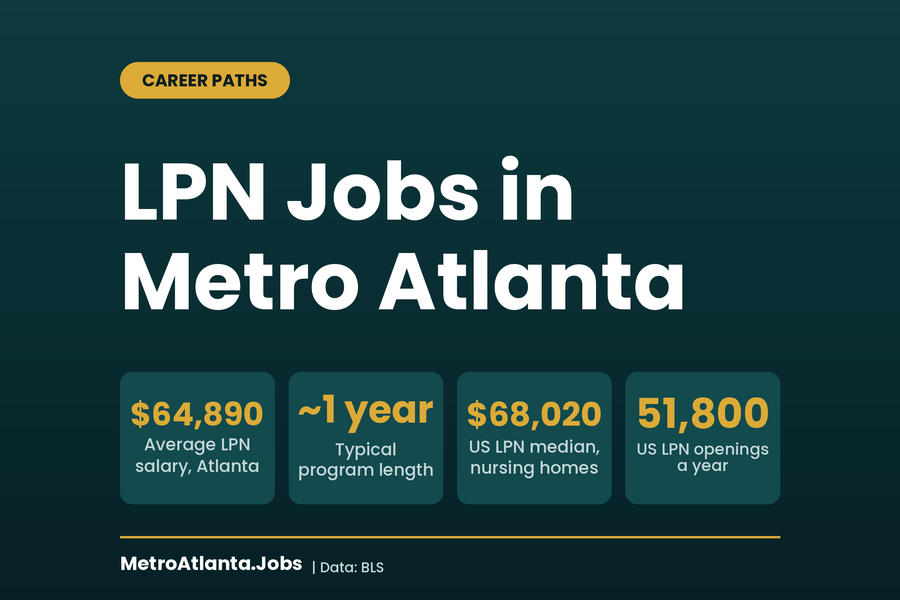
Licensed practical nurses in metro Atlanta average $64,890 a year, per the U.S. Bureau of Labor Statistics Occupational Employment and Wage Statistics program for May 2025 [1]. Nationally, per the U.S. Bureau of Labor Statistics, the LPN median is $64,400, or $30.96 an hour, with the bottom 10 percent under $49,740 and the top 10 percent above $83,440 as of May 2025 [2].
Setting moves LPN pay more than employer brand does, and the ranking surprises most people. Nationally in May 2025, LPN median pay ran $68,970 in government, $68,020 in nursing and residential care facilities, $63,580 in home healthcare, $61,160 in hospitals, and $59,520 in offices of physicians [2].
Read that again if you assumed hospitals pay best. For LPNs they do not. Skilled nursing and long-term care pay about $8,500 more at the median than physician offices, and about $6,860 more than hospitals. The reason is structural: hospitals have shifted most bedside tasks to registered nurses, so LPN roles there are fewer and narrower, while long-term care runs on LPN staffing and competes hard for it.
The setting gap is the most useful fact on this page. An Atlanta LPN who limits a search to hospital postings is applying to the smallest and lowest-paying slice of the market.
Ready to look? Browse current openings across all 29 metro counties on our healthcare and medical jobs page, then create a free job seeker profile so local employers can find you.
What does an LPN do in Georgia?
Scope of practice is set by state law, so what an LPN may do differs by state. In Georgia the Nurse Practice Act at O.C.G.A. Title 43, Chapter 26 defines it [3].
Georgia authorizes a licensed practical nurse to participate in the assessment, planning, implementation, and evaluation of health care delivery, and to perform specialized tasks when appropriately trained and consistent with Board rules [3]. Georgia LPNs provide direct patient observation, care, and assistance across hospitals, clinics, nursing homes, emergency treatment facilities, and other settings, in areas of practice that the statute names explicitly: coronary care, intensive care, emergency treatment, surgical care and recovery, obstetrics, pediatrics, outpatient services, and home health care [3]. Georgia LPNs may also participate in the management and supervision of unlicensed personnel delivering patient care [3].
Two limits matter. LPNs practice under the supervision of a registered nurse or physician, and the assessment role is participatory rather than independent. The Board publishes a Scope of Practice Decision Tree for judging whether a specific task falls inside your scope, and it is the document to consult before accepting an unfamiliar assignment [4].
Day to day, the U.S. Bureau of Labor Statistics describes LPN work as of 2025 as monitoring vital signs, providing basic patient care and comfort, changing dressings, discussing care with patients, reporting patient status to RNs and physicians, and documenting care [2].
Where do LPNs work in metro Atlanta?
Nationally in 2025, per U.S. Bureau of Labor Statistics data, nursing and residential care facilities employed 37 percent of LPNs nationally, hospitals 16 percent, home healthcare services 12 percent, offices of physicians 11 percent, and government 6 percent [2]. That distribution holds in metro Atlanta, where the employer base runs deep in exactly the settings that hire LPNs most.
Skilled nursing and long-term care. The largest single block of LPN jobs in the metro. PruittHealth alone employs 4,185 people across metro Atlanta in skilled nursing and senior care [5].
Home health and hospice. Aveanna Healthcare and dozens of smaller agencies staff LPN visits across the metro, with schedules that suit anyone who wants out of facility shift work [5].
Physician and specialty practices. Steady daytime hours, no nights or weekends, and the trade-off is the lowest median pay of the major settings [2].
Assisted living and memory care. Growing fastest in the outer-ring counties as those populations age.
Correctional health. County jails and state facilities across the metro contract LPN staffing, and these roles are consistently under-applied.
Hospitals. Fewer LPN roles than most candidates expect, concentrated in specific units rather than spread across the house.
Government and public health. County health departments and federal employers. The highest LPN median pay nationally, and the least visible postings [2].
How do you become an LPN in Georgia?
As of 2026 the Georgia Board of Nursing licenses LPNs through the Georgia Secretary of State's Professional Licensing Boards division. Everything runs through the GOALS portal, and paper applications are no longer accepted [6].
Education. Complete a Board-approved practical nursing program. These are certificate and diploma programs at community colleges and technical schools, and they typically take about one year [2]. In metro Atlanta they run through the Technical College System of Georgia. Confirm any program against the Board's approved program lists before enrolling, because an unapproved program will not qualify you to sit the exam [7].
Examination. Pass the NCLEX-PN.
Background check. Register with GAPS, the state's Applicant Processing Service run by Idemia, on the same day you submit your application. GAPS emails fingerprinting instructions once your registration processes, so registering late is the most common source of delay [6][8].
Fee. The LPN licensure application fee is $50 and is non-refundable [6].
Timeline. The Board typically reviews applications within fifteen business days of receiving all required documents. Prior discipline or criminal history extends that [8].
Endorsement. Already licensed elsewhere? Apply by endorsement rather than examination. Georgia requires recency: graduation from an approved program within the past four years, or verification of 500 hours of licensed practice in that same window [6].
Coming back after time away. If you cannot meet the recency requirement, Georgia requires a Board-approved reentry program before licensure, along with the Georgia LPN Jurisprudence Examination and current CPR certification [9].
Renewal, and this catches people out. Georgia LPN licenses renew every two years, but on a different calendar from RN licenses. The LPN renewal window runs January 1 through March 31 of odd-numbered years, with a late window of April 1 through April 30 [6]. Registered nurses renew on a January 31 deadline in even-numbered years, so an LPN who assumes the RN calendar applies will miss the date. If your license expires you are prohibited from practicing until it is reinstated [6].
The compact. Georgia belongs to the enhanced Nurse Licensure Compact, and it covers LPNs as well as RNs. If Georgia is your primary state of residence you can hold a multistate license valid across every compact jurisdiction. If you live in another compact state, your home-state license already lets you work in Georgia [10].
Hiring LPNs in metro Atlanta? Employers can post a job in a few minutes and reach candidates searching by role and county. See plans and pricing, and read our guide to writing a job posting that works in Atlanta first.
Is LPN a good career in Atlanta in 2026?
The honest answer is that it is an excellent entry point and a deliberate stepping stone, and the national numbers say so plainly.
Growth is modest. U.S. Bureau of Labor Statistics projections put LPN employment up 3 percent from 2025 to 2035, rising from 666,900 jobs to 686,700, which is about as fast as the average for all occupations [2].
Openings are not. About 51,800 LPN openings are projected each year nationally through 2035, most of them replacing people who move to other occupations or leave the workforce [2]. Slow growth with heavy turnover means the jobs are there even though the occupation is not expanding quickly.
The ladder is short and real. Many LPNs complete an LPN-to-RN bridge program, and registered nurses have a national median of $97,550, roughly $33,000 above the LPN median [2]. Most large Atlanta systems offer tuition assistance to employees pursuing it, so working as an LPN inside a system is often how the RN gets paid for.
Certification adds range. Optional credentials in gerontology, wound care, and IV therapy are available through professional associations and widen what you can be assigned [2].
One thing to go in with clear eyes about. LPNs have one of the highest rates of work-related injuries and illnesses of any occupation, largely from overexertion and exposure [2]. Body mechanics training and employer lift-equipment policies are worth asking about in an interview.
Which metro Atlanta counties hire the most LPNs?
LPN demand tracks skilled nursing beds, home health agencies, and physician practices rather than hospital campuses, which spreads it more evenly across the metro than RN demand.
Fulton and DeKalb Counties hold the most facilities overall. See our guides to Fulton County and DeKalb County.
Cobb and Gwinnett Counties combine large long-term care networks with dense physician practice bases. See our guides to Cobb County and Gwinnett County.
Cherokee, Forsyth, Henry, Paulding, Rockdale, Newton, and Coweta Counties are where LPN demand is growing fastest, because aging suburban populations drive skilled nursing and home health faster than they drive hospital construction. Competition is materially lower here. See our guides to Cherokee County, Forsyth County, Henry County, and Paulding County.
Clayton County adds correctional and occupational health demand. See our Clayton County jobs guide.
How do you get hired as an LPN in Atlanta?
Stop searching only hospitals. Hospitals employ 16 percent of LPNs nationally and pay below the LPN median, per May 2025 federal wage data [2]. Long-term care, home health, and government postings are more numerous and better paid.
Apply to skilled nursing directly. Facility staffing needs move week to week, and many roles are filled before they are widely advertised.
Look at correctional and county health. Both hire LPNs steadily across metro Atlanta and both draw far fewer applicants than clinical settings.
Work the outer ring. Cherokee, Forsyth, Henry, Paulding, and Coweta have growing demand and a fraction of the applicant volume inside the perimeter.
Get IV certified. In Georgia, specialized tasks are available to LPNs who are appropriately trained [3]. IV therapy, wound care, and gerontology credentials widen your assignments and your pay [2].
Plan the bridge from day one. If the RN is the goal, pick an employer with tuition assistance before you pick a starting salary. Our career pivot guide covers transferable skills.
Sharpen the application. Large systems screen through applicant tracking software before a human reads anything. Our Atlanta resume tips covers that, and our salary negotiation guide covers shift differentials.
Frequently asked questions about LPN jobs in Atlanta
How much do LPNs make in Atlanta?
Licensed practical nurses in metro Atlanta average $64,890 a year, per May 2025 federal wage data [1]. Nationally the LPN median is $64,400, or $30.96 an hour, with the bottom 10 percent under $49,740 and the top 10 percent above $83,440 [2]. Setting matters more than employer: nationally, LPN median pay runs $68,970 in government and $68,020 in nursing and residential care, against $61,160 in hospitals and $59,520 in physician offices [2].
How long does it take to become an LPN in Georgia?
A Board-approved practical nursing program in Georgia typically takes about one year [2]. These are certificate and diploma programs offered through community colleges and technical schools, including the Technical College System of Georgia across metro Atlanta. After graduating you pass the NCLEX-PN and apply to the Georgia Board of Nursing through the GOALS portal, and the Board typically reviews complete applications within fifteen business days [6][8].
What can an LPN do in Georgia?
Georgia law authorizes LPNs to participate in the assessment, planning, implementation, and evaluation of health care delivery, and to perform specialized tasks when appropriately trained [3]. The statute names coronary care, intensive care, emergency treatment, surgical care and recovery, obstetrics, pediatrics, outpatient services, and home health care as areas of practice, and Georgia LPNs may participate in supervising unlicensed personnel [3]. LPNs work under the supervision of a registered nurse or physician. The Board's Scope of Practice Decision Tree is the reference for judging a specific task [4].
Do LPNs in Atlanta make more in hospitals or nursing homes?
Nursing homes, by a clear margin. Nationally in May 2025, LPN median pay was $68,020 in nursing and residential care facilities against $61,160 in hospitals [2]. Hospitals have shifted most bedside tasks to registered nurses, which leaves fewer and narrower LPN roles, while skilled nursing runs on LPN staffing and competes for it. Metro Atlanta LPNs who search only hospital postings are looking at the smallest and lowest-paid part of the market.
When do Georgia LPN licenses renew?
Georgia LPN licenses renew every two years, with the renewal window running January 1 through March 31 of odd-numbered years and a late window of April 1 through April 30 [6]. This differs from the registered nurse calendar, which uses a January 31 deadline in even-numbered years, so LPNs should not assume the RN dates apply. If an LPN license expires, practicing is prohibited until it is reinstated [6].
Can I work in Atlanta with an LPN license from another state?
Yes, if that license is a multistate license from another Nurse Licensure Compact state and your primary residence remains there [10]. Georgia belongs to the enhanced Nurse Licensure Compact and it covers LPNs as well as RNs. If you are moving to Georgia permanently, or you are licensed in a non-compact state, apply for Georgia licensure by endorsement. Endorsement requires graduation from an approved program within the past four years or 500 hours of licensed practice in that window [6].
Is it hard to find LPN jobs in Atlanta?
Openings are steady rather than scarce. Nationally about 51,800 LPN openings are projected each year through 2035, most of them replacing workers who leave the occupation rather than newly created positions [2]. In metro Atlanta the demand concentrates in skilled nursing, home health, correctional health, and physician practices, and it is growing fastest in the outer-ring counties. Candidates who search across settings rather than only hospitals find considerably more.
Can an LPN become an RN in Georgia?
Yes, and it is the most common next step. LPN-to-RN bridge programs give credit for practical nursing coursework and clinical hours, shortening the associate degree path. Graduates then pass the NCLEX-RN and apply for Georgia RN licensure [2][6]. The pay difference is substantial: the national RN median is $97,550 against $64,400 for LPNs [2]. Most large metro Atlanta systems offer tuition assistance to employees, so choosing an employer with that benefit is often how the degree gets funded.
What certifications help an LPN in Atlanta?
Optional certifications in gerontology, wound care, and IV therapy are available through professional associations and demonstrate advanced knowledge in a specific area [2]. In Georgia these matter more than in some states, because the Nurse Practice Act ties specialized tasks to being appropriately trained [3]. Many employers also require or prefer CPR or basic life support certification [2].
How do I find LPN jobs near me in metro Atlanta?
Search the healthcare and medical jobs page, which covers all 29 metro counties rather than just the city of Atlanta. Create a free job seeker profile so local employers can reach you directly, and turn on daily job alerts so new postings in your county arrive before the applicant pile builds.
Get started on your Atlanta LPN job search
Browse LPN and Nursing Jobs: search current openings across all 29 counties on the healthcare and medical jobs page.
Create a Free Job Seeker Profile: set up your job seeker profile so metro Atlanta employers can find you.
Get Daily Atlanta Job Alerts: turn on job alerts so new roles in your county reach you first.
See the Full Nursing Ladder: LPN is one rung in our guide to nursing jobs in Atlanta.
Compare Healthcare Pay: see how LPN pay stacks up against every other clinical role in healthcare salaries in Atlanta vs the U.S.
Tighten Your Application: get past applicant tracking software with our Atlanta resume tips for 2026.
Hiring LPNs in metro Atlanta?
Post an LPN Job: reach local candidates searching by role and county. Post a job.
See Plans and Pricing: single postings and multi-job plans for employers who hire year-round. View pricing.
Write a Posting That Works: name the setting, the shift, the ratio, and whether IV certification is required. Read how to write a job posting in Atlanta.
New to Posting Locally: where to post, what to include, what it costs. Read how to post a job in Atlanta.
Sources
3. Georgia Board of Nursing, Nurse Practice Act, O.C.G.A. Title 43 Chapter 26
4. Georgia Board of Nursing, Scope of Practice Decision Tree
5. Metro Atlanta Chamber, 2025 Metro Atlanta Top Employers Survey
6. Georgia Secretary of State, How to Guide: Licensed Practical Nurse (LPN)
7. Georgia Board of Nursing, Nursing Education, approved pre-licensure program lists
8. Georgia Secretary of State, FAQs for Nursing
9. Georgia Board of Nursing, LPN reentry packet
10. Georgia Board of Nursing, enhanced Nurse Licensure Compact FAQs