12 min read
Most advice on how to write a job posting was written for nowhere in particular. It tells you to list responsibilities, add a company blurb, and hit publish. That advice will not help you hire a warehouse supervisor in Henry County or a medical assistant in Gwinnett. Metro Atlanta is a 29-county region where a candidate in Cherokee and a candidate in Clayton are 60 miles and a very different commute apart, where salary transparency is optional and therefore a competitive advantage, and where the phrase "Atlanta, GA" tells an applicant almost nothing. This guide covers how to write a job posting for this market specifically: what to say about pay, how to write location so people can actually judge it, which requirements quietly shrink your applicant pool, and what to cut. After 20 years in recruitment, the patterns are consistent, and most of them are fixable in an afternoon.
Why most Atlanta job postings underperform
A weak posting rarely fails because it is badly written. It fails because it withholds the two or three facts a candidate needs to decide whether to apply, and because it asks for things the job does not actually require.
Think about what happens on the other side of the screen. Someone in Marietta sees your opening. They want to know three things immediately: what does it pay, where exactly is it, and could I plausibly get hired. If your posting answers none of those, they keep scrolling, because six other postings will. The candidate is not being difficult. They are triaging.
Everything below is built around answering those three questions faster and more honestly than the posting next to yours.
Post the pay range, because in Georgia you do not have to
This is the single biggest lever available to Atlanta employers, and it exists precisely because Georgia does not force your hand.
A growing number of states, among them California, Colorado, Illinois, Maryland, New York, and Washington, plus the District of Columbia, now require employers to disclose pay ranges, in many cases in the job posting itself. Georgia is not among them [6]. There is no statewide pay transparency law here, so private employers in metro Atlanta may include a range or leave it out. The City of Atlanta did move on the adjacent issue: on February 18, 2019 the city removed the salary history question from its own employment applications, verbal interviews, and screenings, a policy that binds city agencies and not private businesses [1].
Here is why that matters strategically. In California or Colorado, posting a range is table stakes. Everyone does it because everyone must, so it distinguishes no one. In Georgia, where it is optional and many employers still skip it, posting a real range makes your listing visibly different from the one below it. You are choosing to answer the first question every candidate has. That choice reads as confidence, and it filters your applicant pool before anyone wastes an interview.
There is a right and a wrong way to do it.
Make the range narrow and real. New research published in 2026 and covered by Harvard Business Review analyzed nearly 10 million job postings and found that women disproportionately avoid jobs with wide salary ranges, driven partly by greater aversion to financial uncertainty, and that those who do apply then negotiate less assertively and accept lower starting pay [2]. A range of $55,000 to $95,000 is not transparency. It is a shrug. It tells a candidate you have not decided what the job is worth, and it quietly narrows who applies.
Add one sentence of context. The same research found that pairing a range with a simple statement about how the offer is determined substantially reduces those effects [2]. That sentence costs you nothing:
"This role pays $62,000 to $68,000. Starting pay depends on years of direct experience and certification, and most new hires start near the midpoint."
That is more useful than the range alone, and it is more useful than silence.
Benchmark before you publish. Do not invent the number. Federal wage data for the Atlanta metropolitan area gives you the local mean and median for hundreds of occupations, which is the honest starting point for setting a competitive range [3]. Our Atlanta Salary Guide and entry-level salaries guide translate that data into practical bands.
Quick read on pay: Georgia does not require a salary range in job postings, which is exactly why including one sets you apart. Keep the range tight, add one sentence explaining how starting pay is set, and benchmark against local wage data before you publish.
Write location like someone who has driven here
"Atlanta, GA" is the laziest line in most local postings, and it costs employers real applications.
The Atlanta-Sandy Springs-Roswell metro spans 29 counties. The city of Atlanta holds a small fraction of the region's population. When a posting says only "Atlanta," a candidate in Woodstock cannot tell whether the job is 15 minutes away or 75, and this is a metro where that distinction decides careers. Metro Atlanta commuters average 31.2 minutes each way, eighth worst among the 50 largest U.S. metros, and that is the average, not the I-285-at-5pm reality [4].
So write the location the way a person who lives here would describe it. On MetroAtlanta.Jobs, as on most boards, there is one location line and then the open body you write yourself. There is no separate county field, so the county goes wherever you put it: in the location line, in your title, or in the first sentence of the description. That is a feature, not a limitation, because it means you decide how specific to be.
- Work the county and nearest corridor into the location line or the opening line of the post. "Duluth, GA, Gwinnett County, near Gwinnett Place off I-85 at Pleasant Hill Road" beats "Atlanta, GA" every time.
- State the schedule honestly. Onsite, hybrid, or remote. If hybrid, say how many days and which ones. "Hybrid" with no number is a red flag to experienced candidates.
- Mention transit if it is genuinely relevant. If you are near a MARTA station, say so, because a meaningful slice of the workforce plans around it. If you are not, do not pretend.
- Say something about the commute if it works in your favor. A job in Alpharetta that lets someone in Forsyth County skip the perimeter entirely is a selling point. Say it.
If you are hiring in a specific part of the metro, our county guides describe the local labor market employers are actually competing in, including Fulton, Gwinnett, Cobb, DeKalb, Cherokee, and Henry County.
Write requirements that do not screen out the people you want
Most requirement lists are wish lists, and wish lists cost you candidates. Worse, some of the language commonly used can create legal exposure.
The EEOC is explicit that it is illegal to publish a job advertisement showing a preference for, or discouraging, applicants on the basis of protected characteristics. It offers a pointed example: an ad seeking "recent college graduates" may discourage applicants over 40 and may violate the law [5]. "Digital native," "young and energetic," and "recent grad" all belong in the same bin. So does a hard degree requirement on a job that has never actually needed one.
A practical way to write this section:
Separate must-have from nice-to-have, and be ruthless about the first list. If a person could learn it in the first month, it is not a requirement. If you would hire someone excellent who lacked it, it is not a requirement.
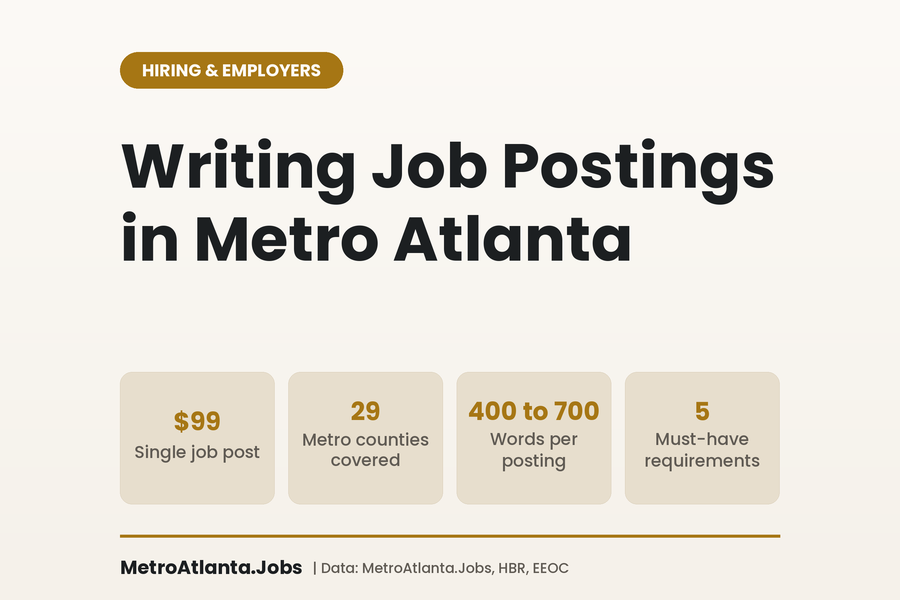
Cap the must-haves at five. Long requirement lists disproportionately deter candidates who read them literally and self-select out. The candidate who applies to everything regardless is not the one you were trying to reach.
State experience in ranges, not floors. "Three to five years" invites a strong four-year candidate. "Minimum five years" turns them away.
Name the license or certification precisely. In healthcare, logistics, and the trades, specificity is a feature. A CDL Class A requirement is clear. "Valid license" is not.
Describe the work, not the person. "Reconciles month-end close for three entities" tells a real accountant whether they can do this job. "Detail-oriented self-starter" tells them nothing and appears in every posting they have read this week.
Before and after: three rewrites
The gap between a weak posting and a strong one is usually a few sentences.
Title. Before: "Rockstar Sales Ninja Wanted!!" After: "Outside Sales Representative, Building Products (Marietta, Cobb County)". Candidates search for the real title. Nobody searches "ninja."
Location and schedule. Before: "Atlanta, GA. Some flexibility." After: "Onsite in Norcross (Gwinnett County), off I-85 at Jimmy Carter Blvd. Monday through Friday, 7am to 3:30pm, with Fridays remote after 90 days."
Pay and requirements. Before: "Competitive salary. 5+ years experience required. Bachelor's degree preferred. Must be a self-starter." After: "$58,000 to $64,000, based on years of direct experience; most new hires start near the midpoint. Three to five years in a similar role. Degree not required. You will own the weekly production schedule for two lines and train two junior techs."
Nothing in the rewrites is clever. They are just answerable.
What to include, in order
A posting that works in this market usually runs 400 to 700 words and covers these, roughly in this sequence.
The real job title, the kind a person would type into a search bar. Add the county in parentheses if space allows.
The pay range, with one sentence on how starting pay is determined.
Location and schedule, specific enough to calculate a commute.
A two or three sentence summary of what the person will actually do and why the role exists.
Day-to-day responsibilities, five to eight bullets, written as verbs and outcomes rather than vague ownership language.
Must-have qualifications, five at most, followed by a short nice-to-have list clearly labeled as optional.
Benefits and total compensation. Health coverage, retirement match, paid time off, shift differentials, tuition assistance. In tight-margin roles these often matter more than base pay, and candidates rarely assume you offer them.
A short, honest company paragraph. Where you are, what you do, how big the team is. Skip the mission statement.
One clear apply step, with a realistic note on what happens next and when. "We respond to every applicant within a week" is a differentiator, if it is true.
An equal opportunity statement. Standard, expected, and easy.
Common mistakes worth fixing today
Publishing a job with no pay information at all. In an optional-disclosure state, this is where you are quietly losing to the employer next to you.
Reusing a decade-old internal job description. Internal descriptions are legal and HR artifacts. Job postings are marketing. They are not the same document, and pasting the first into the second reads exactly like what it is.
Burying the apply link. If a candidate has to hunt, you have lost the ones with options.
Writing for yourself instead of the reader. "We are seeking a highly motivated individual to join our dynamic team" describes nobody and appeals to no one. Cut it and start with the work.
Ghosting applicants. It is not part of writing the posting, but it destroys the reputation the posting was meant to build. Metro Atlanta's industries are smaller than they look, and word travels.
Ignoring what your competitors pay. Candidates in this market compare. Our industry guides on healthcare, tech, logistics, and education show what the local market pays and who is hiring. Assume your candidate has already read them, and remember they will also have read our salary negotiation guide before your first call.
Where you post matters as much as what you write
A well-written posting on the wrong board reaches the wrong people. National boards put your Douglasville warehouse role in front of applicants in three states, most of whom will never make the drive. You pay for that reach whether or not it helps you.
MetroAtlanta.Jobs was built for one region: the City of Atlanta and all 29 counties of the metro. Every candidate who searches here is looking for work in this metro, which means the applications you receive come from people who can actually get to the job. That is the entire point of a hyperlocal board.
Listings are one-time purchases, not subscriptions. A single job post is $99, with multi-job packs at $249 for three, $349 for five, and $889 for fifteen, so there is no recurring cost to forget about and no contract to cancel.
If you hire more than once, and most employers do, the multi-job packs are the better value, because the per-post price drops as the pack gets larger. A single post is $99. A 3-pack is $249, which works out to $83 a post. A 5-pack is $349, or about $70 each. A 15-pack is $889, roughly $59 a post, nearly 40 percent below the single rate. Pack credits are good for six months, so they fit an employer with a real hiring run ahead of them: several roles this quarter, or the same warehouse and clinic positions you know will reopen before summer. The larger packs also add featured placement, a logo on the home page, and a company career page. You can compare all four options on our pricing page, create an employer account, or go straight to posting a job. If you want a hand writing or placing the listing, contact us and we will walk through it with you. Our step-by-step guide to how to post a job in Atlanta covers the mechanics.
For a sense of what candidates in this metro are seeing when they search, browse current openings across all 29 counties and read a few postings in your own industry. The good ones will be obvious. So will the gap.
Get started hiring in metro Atlanta
Post a Job: publish your opening to a metro-only audience on the post a job page.
See Pricing: one-time listings from $99 for a single post down to about $59 a post in the 15-job pack, on our pricing page.
Create an Employer Account: set up your company profile at employer registration.
Benchmark Your Pay Range: check local wage data in the Atlanta Salary Guide.
Read the Posting Walkthrough: step-by-step mechanics in how to post a job in Atlanta.
Reach out to Us: questions about a listing or a hiring push, reach us at contact us.
Frequently asked questions
How do you write a job posting that actually gets applications?
Answer the three questions every candidate asks first: what it pays, exactly where it is, and whether they could realistically be hired. Include a narrow pay range with a sentence on how starting pay is set, name the city and county, and limit must-have requirements to five. Then describe the actual work rather than the ideal person.
Do Georgia employers have to include a salary range in job postings?
No. Georgia has no statewide pay transparency law, so private employers are not required to disclose salary ranges in postings or during hiring [6]. The City of Atlanta stopped asking applicants for salary history in its own hiring in 2019, but that policy applies to city agencies, not private employers [1].
Should I post a salary range even though Georgia does not require it?
In most cases, yes. Because disclosure is optional here, a posted range makes your listing stand out rather than blend in. It also filters out candidates whose expectations do not match, which saves interview time on both sides.
How wide should a posted salary range be?
Narrow. Research published in 2026 found that very wide ranges disproportionately deter women from applying and lead those who do apply to negotiate less assertively [2]. Pair a tight range with one sentence explaining how the starting figure is determined.
What should the location line say in an Atlanta job posting?
Work the city and county into the location line or the opening line of the description, plus a nearby corridor or landmark. There is no separate county field on most boards, including ours, so you add it in the text yourself. "Atlanta, GA" alone is ambiguous across a 29-county metro where the average commute already runs 31.2 minutes each way [4]. Specify onsite, hybrid, or remote, and if hybrid, say how many days.
What job posting language can create legal risk?
Language showing preference for or discouraging applicants based on protected characteristics. The EEOC specifically cites ads seeking "females" or "recent college graduates" as examples that may discourage men and applicants over 40 and may violate the law [5]. Avoid age-coded phrases and unnecessary degree requirements.
How long should a job posting be?
Usually 400 to 700 words. Long enough to cover pay, location, responsibilities, and requirements with specificity, short enough that a candidate reads it on a phone during a lunch break.
How many requirements should a job posting list?
Five must-haves at most, with anything else clearly labeled as preferred. Long requirement lists disproportionately deter qualified candidates who read them literally and decide not to apply.
Where should Atlanta employers post jobs?
Somewhere the audience matches the commute. A metro-focused board reaches candidates who can actually reach the job, which is why MetroAtlanta.Jobs covers the City of Atlanta and all 29 metro counties. Listings are one-time purchases starting at $99.
How much does it cost to post a job in metro Atlanta?
On MetroAtlanta.Jobs, a single job listing is a one-time $99. Multi-job packs lower the per-post cost: $249 for three posts, $349 for five, and $889 for fifteen, which brings the largest pack to about $59 a post. Pack credits are good for six months, and there is no subscription.
Sources
4. Atlanta News First, "Metro Atlanta 8th worst city for traffic, study says," May 21, 2026
6. Jackson Lewis, "Navigating 2026: Pay Transparency Laws and Employer Obligations," January 2026