14 min read
If you are figuring out how to post a job in Atlanta in 2026, the playbook has shifted. National boards have gotten louder, applicant quality has gotten thinner, and the average US cost-per-hire is now $5,475 for non-executive roles. [1] Atlanta employers competing for the same candidate pool as Charlotte, Tampa, and Dallas need their postings to do more work: rank for local search, reach the right candidates, and convert the right applicants into hires. This guide breaks down where to post, what to include, what it costs, and how to set up a job posting in Metro Atlanta that actually produces interviews.
How to post a job in Atlanta depends on three things: how fast you need to fill the role, what your budget is, and how local the hire actually needs to be. For most Atlanta-area employers in 2026, the math has tightened. 69% of US employers report difficulty finding qualified talent, average time-to-fill sits at roughly 44 days, and remote-friendly national postings continue to crowd out genuinely local roles on the big aggregators. [1][2] The fix is targeted distribution: post where local candidates are actually looking, write a posting that ranks and converts, and combine it with a short-list sourcing strategy.
This guide is for hiring managers, HR generalists, in-house recruiters, and small-business owners doing the work themselves. It covers everything from where to post a job in Metro Atlanta to how to write a posting that converts, what the cost ranges look like, and how to source candidates beyond the posting itself.
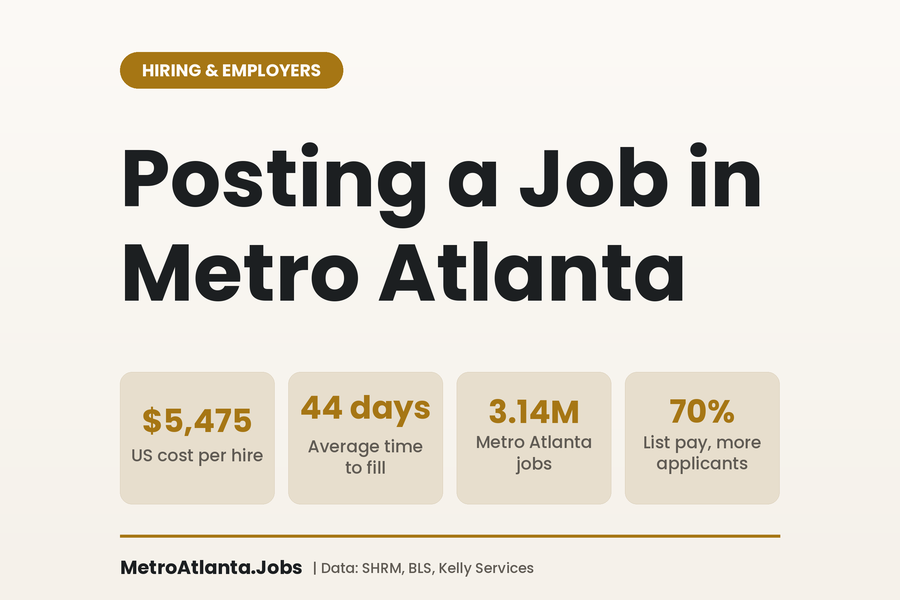
Hiring in Atlanta by the Numbers (2026)
$5,475: US average cost-per-hire for non-executive roles (SHRM 2025 Benchmarking Report) [1]
44 days: average US time-to-fill, with screening and interviewing each averaging 8 to 9 days [1]
70%: of organizations that include pay ranges in postings report receiving more applicants; 66% report better candidate quality [3]
3.14 million: nonfarm jobs in the Atlanta-Sandy Springs-Roswell MSA, the candidate pool you are recruiting from [4]
69%: of US employers report difficulty finding qualified talent in 2026 [2]
30%: of US job postings now require specific years of experience, down from 40% in 2022, as skills-based hiring expands [5]
Why Where You Post Matters in Atlanta in 2026
Posting a job is the easy part. Getting the right candidates to see it is the hard part. In 2026, three forces have changed how Atlanta employers should think about where they post.
Atlanta's hiring math has tightened
The Atlanta-Sandy Springs-Roswell MSA carried 3.14 million nonfarm jobs by mid-2025. [4] That sounds like a deep candidate pool, and it is. But strong markets attract national competition. Atlanta employers are no longer competing only with each other. They are competing with remote-first employers based in San Francisco, New York, and Austin who are willing to pay above local market. SHRM's 2025 data shows roughly 20 requisitions per recruiter in mid-market organizations, with hiring managers reporting structural difficulty filling roles despite a slightly cooler national labor market. [6] The candidates exist; reaching them efficiently is the new bottleneck.
National boards are loud, but not always local
The big national aggregators do reach scale, but they also mix local Atlanta roles into a pool that includes thousands of remote postings from across the country. For employers paying per-application or per-click, that means a meaningful share of applicants live nowhere near Atlanta. For local Atlanta employers who genuinely need on-site or hybrid hires, that creates two costs: the platform cost and the recruiter time burned screening out non-local candidates. A local job board built specifically for the 29-county Metro Atlanta MSA filters that noise upstream. MetroAtlanta.Jobs is built that way, and the Atlanta Job Market 2025-2026 report covers the broader trend in detail.
Self-serve is faster than agencies for most roles
For senior or specialized roles, an agency or executive search firm may still be the right move. For everything else, the self-serve model has gotten meaningfully faster and more cost-efficient. SHRM's 2025 benchmark shows the screening and interviewing stages each take an average of 8 to 9 days; getting the posting in front of qualified candidates faster cuts the total funnel timeline. [1] Most Atlanta employers hiring for individual-contributor, supervisor, and mid-management roles will do better with self-serve job boards, structured employee referrals, and targeted outreach than with retainer-based search.
What a High-Performing Atlanta Job Posting Includes
The components of a job posting that ranks well on local search, makes it past AI screening systems, and converts qualified candidates into applicants have changed substantially since 2022. Six elements consistently move the needle in 2026.
A clear, search-friendly job title
The single most important field is the job title. Atlanta candidates search the way Google searches: short, specific, role-driven. "Senior Software Engineer" outperforms "Software Engineering Ninja." "Registered Nurse, ICU" outperforms "RN, Critical Care Unit Caregiver." Avoid internal job codes, level numbers, and creative titles in the posting headline. Use the title candidates actually type into search bars. If the role is hybrid or fully on-site, the city or county can be appended ("Registered Nurse, ICU, Marietta GA") to capture local search intent.
An honest pay range
Georgia does not have a state-level pay transparency law as of 2026, but the data is unambiguous: SHRM research shows 70% of organizations that list pay ranges report receiving more applicants and 66% report better candidate quality. [3] National candidates increasingly filter out postings without ranges, and many multi-state employers default to including ranges across all postings to maintain consistency with the 16 states and D.C. that do require disclosure. [7] For Atlanta employers, the practical move is to include a defensible range that reflects what you would actually pay. For pay benchmarks across roles and tiers, see the Atlanta Salary Guide 2026.
Real location detail
Atlanta is 29 counties, multiple commute corridors, and a wide range of cost-of-living submarkets. A posting that says "Atlanta, GA" tells candidates almost nothing. A posting that says "Marietta, GA, with hybrid option (2 days remote)" tells candidates everything they need to self-qualify. Specificity reduces drop-off in the application funnel because candidates who would not consider the commute do not apply, and candidates who fit do. For county-by-county hiring context, the Cobb County jobs guide, Fulton County jobs guide, Gwinnett County jobs guide, and Henry County jobs guide map employer concentrations across the metro.
A tight requirements section
Only 30% of US job postings now require specific years of experience, down from 40% in 2022, as skills-based hiring expands across most sectors. [5] Atlanta employers competing for healthcare, technology, logistics, and skilled trades talent should explicitly evaluate which requirements are genuinely needed and which are inherited from older templates. Every additional "must have" filters out qualified candidates whose path looked slightly different. The candidates moving between sectors in 2026 include 43% of US workers actively considering a career change, and structured screening on demonstrable skills rather than rigid credentials expands the pool meaningfully. [8] For context on that candidate flow, see the Changing Careers in Atlanta guide.
Specific benefits and culture signals
Benefits are no longer table stakes; they are differentiators. Posting "competitive benefits" tells candidates nothing. Posting "100% employer-paid medical, 5% 401(k) match with immediate vesting, 4 weeks PTO, and a $1,500 annual professional development stipend" tells candidates exactly why your offer is worth their time. The same applies to culture signals: name the things that actually differentiate your environment, whether that's a hybrid schedule, sustained no-layoff history, or a specific commitment to internal mobility. Healthcare employers competing for clinical talent should reference specific shift premiums, sign-on bonuses, and tuition reimbursement; the Healthcare Jobs in Atlanta guide breaks down what local healthcare systems are offering.
Application instructions that work
Drop-off in the application funnel is highest at the apply step. Every additional field, login, or required document reduces completion rate. The 2026 standard is a one-click apply where possible, with required fields limited to name, email, resume, and a small number of structured questions tied to qualifying criteria. Long, multi-page application forms are correlated with lower-quality candidate pools because the candidates with the most options walk away from them first.
Where to Post Jobs in Atlanta in 2026
Four categories of channels matter for Atlanta employers. Most hires come from a combination, not a single source.
Local job boards
A local board built specifically for Metro Atlanta filters out remote postings and out-of-market candidates by design. MetroAtlanta.Jobs covers the 29-county Atlanta MSA, distributes postings into the Google Jobs Network, and sends a job alert to subscribers each time a new role goes live. For employers who genuinely need local hires, this is the channel that delivers the highest signal-to-noise ratio.
National aggregators
The big national boards (and the meta-aggregators that scrape them) deliver scale. Scale is useful when you have a very high-volume role with broad geographic flexibility, or when you have a niche role that is difficult to source locally. For most Atlanta mid-market employers, paying per-click or per-application on national boards is more expensive per qualified local applicant than self-serve local posting. National boards are best used in combination with local channels, not as a substitute.
Niche and industry-specific boards
For specialized roles, industry-specific boards can outperform general boards. Examples include nursing-specific boards for clinical healthcare roles, defense-cleared boards for cleared engineering and IT, and union-specific boards for skilled trades. Costs vary widely; some are free, others charge premium per-post rates. Niche boards are worth the spend when your candidate pool is genuinely niche and the board has demonstrable reach in that specific community.
Your career page and social channels
Your own career page should be the destination for every posting. Even when candidates discover the posting on another channel, the apply experience should land on your domain (or a hosted page that reads as yours). Professional social channels and employer brand accounts are highest-ROI for warm candidates already familiar with your organization. Plan to share each posting once on your primary professional network, once via internal referral channels, and consider a small paid boost for mid-management and above roles.
How Much Does Posting a Job in Atlanta Cost in 2026?
The full cost of hiring is meaningfully larger than the job-board fee. SHRM's 2025 benchmarking data puts the average US cost-per-hire at $5,475 for non-executive roles, climbing to $35,879 for executive roles, the latter up 21% from 2022. [1] That total includes recruiter time, hiring manager time, advertising spend, background checks, technology, and external agency fees. Mid-market companies with 100 to 999 employees typically see a cost-per-hire range of $2,500 to $4,500 for mixed hiring plans. [9]
The job-board portion of that total is usually a relatively small line item, but it has outsized impact on candidate quality. Posting on a local board built specifically for Atlanta typically costs an order of magnitude less than aggressive paid placement on national platforms. MetroAtlanta.Jobs posting rates for 2026 are structured in four self-serve tiers and an enterprise option. Every tier is a one-time purchase, not a subscription.
Single Job Posting: $99, billed once. One job post, used within 45 days of purchase and live for 30 days. Includes a job alert sent to subscribers, distribution into the Google Jobs Network, and social sharing buttons on your listing. Best for one-off hiring needs.
3 Job Postings: $249, billed once. Everything in Single, plus three posts used within six months, each live for 30 days, featured placement for the first 7 days, and promotion across our social channels. That works out to about $83 a post. Best for steady or repeat hiring.
5 Job Postings: $349, billed once. Everything in the 3-pack, plus five posts used within six months, featured placement for the first 14 days, your company logo on the home page, and a hosted company career page. About $70 a post. Best for small expanding teams.
15 Job Postings: $889, billed once. Everything in the 5-pack, plus fifteen posts used within six months, each live for 45 days rather than 30, and featured placement pinned to the top of the board. About $59 a post, nearly 40 percent below the single rate. Best for larger organizations with sustained hiring volume.
Enterprise. Custom pricing with volume-based discounts, enhanced visibility, and priority customer support. Recommended when hiring across multiple business units or posting at a volume the 15-pack does not cover. See pricing details or contact us for enterprise quotes.
For Atlanta employers running the math: a single $99 posting that reaches qualified local candidates produces a meaningfully lower cost-per-hire than $400 to $800 in national-board click spend that delivers a mixed bag of local and out-of-market applicants.
How to Post a Job on MetroAtlanta.Jobs in 5 Steps
The self-serve posting flow is designed to take under 10 minutes for a clean, search-ready posting.
1. Create your employer account
Start at the Post a Job page or go directly to employer registration to create an employer account. Your account holds all your postings, candidate applications, and company profile in one place. New employer accounts can be created in under two minutes; existing employers sign in to access their posting history and resume database.
2. Choose your posting tier
Select Single, the 3-pack, the 5-pack, the 15-pack, or contact us for Enterprise. The selection is driven by hiring volume and timeline. Most one-off hiring needs use the single posting; teams with several roles ahead of them save substantially with a pack, since credits are good for six months and the per-post cost drops as the pack gets larger. All tiers include a job alert to subscribers and distribution into the Google Jobs Network.
3. Write the posting
Use the elements from the "What a High-Performing Atlanta Job Posting Includes" section above. Lead with a clear, search-friendly job title. Include a defensible pay range. Specify the exact city or commute corridor. Keep requirements tight and focused on demonstrable skills. Name specific benefits. Set application instructions for a clean, one-click apply where possible. Most strong postings come in between 300 and 600 words; longer is not better.
4. Set your category and location
Select the right category from the 11 site categories so the posting appears in the correct browse paths and category-specific alerts. Set the location to the actual work location, not the headquarters address. For hybrid roles, name the office city and the hybrid schedule explicitly in both the location field and the body of the posting.
5. Publish, monitor, and adjust
Once published, the posting goes live within minutes and begins distributing into the Google Jobs Network. Monitor early application volume against your hiring funnel benchmarks; if you are seeing fewer than expected applicants within the first 5 to 7 days, the most common levers are the job title (too internal or creative), the pay range (missing or below market), or the location field (too generic). The platform also supports edits to live postings, so iterate based on early signal.
Sourcing Strategies That Move the Needle Beyond the Post
The strongest hiring funnels combine inbound applications from the posting with outbound sourcing. Three sourcing strategies consistently outperform passive posting alone for Atlanta employers in 2026.
Employee referrals. Internal referrals continue to deliver higher-quality candidates at meaningfully lower cost. Set a structured referral incentive, communicate every open role to the team within 24 hours of posting, and follow up with referring employees on candidate status. Referrals typically convert at 3 to 5 times the rate of cold applicants.
Re-engage past applicants. Your employer account holds every application you have received. Candidates who were strong but lost out on an earlier role are the warmest pool you have, and they have already demonstrated interest in your company and your commute. Before a new posting goes live, reread the last two rounds of applicants for adjacent roles and reach out directly to anyone who nearly made it.
Targeted networking and community channels. Atlanta's industry associations, professional meetups, and chamber events all generate warm candidate flow. The Atlanta Tech Village, Atlanta Society for Human Resource Management, regional chamber of commerce events, and county-level economic development organizations are all sources of pre-qualified candidate connections that posting alone will not capture.
Frequently Asked Questions: Posting a Job in Atlanta
How much does it cost to post a job in Atlanta in 2026?
On MetroAtlanta.Jobs, a single 30-day posting is $99, billed once. Multi-post packs are also one-time purchases: $249 for three, $349 for five, and $889 for fifteen, which works out to about $59 a post. Pack credits are good for six months, and the 15-pack extends each posting to 45 days. Enterprise pricing is available for higher volume. There is no subscription.
Where is the best place to post a job in Atlanta?
For employers who genuinely need local hires, a job board built specifically for Metro Atlanta delivers the highest signal-to-noise ratio because it filters out remote-only postings and out-of-market candidates. MetroAtlanta.Jobs covers the 29-county Atlanta MSA, distributes to the Google Jobs Network, and sends a job alert to subscribers on each new posting. National boards work best in combination with local channels rather than as a substitute, particularly for high-volume roles or very specialized hires.
How long does it take to fill a job in Atlanta?
Average US time-to-fill in 2025 was approximately 44 days, with screening and interviewing each averaging 8 to 9 days, according to SHRM's 2025 Benchmarking Report. [1] In Atlanta specifically, time-to-fill varies meaningfully by sector. Healthcare clinical roles, skilled trades, and technical engineering roles typically take longer; entry-level roles in logistics, warehouse operations, customer service, and retail can fill in 2 to 3 weeks when the posting and pay are competitive.
Do I have to list a salary range in an Atlanta job posting?
Georgia does not have a state-level pay transparency law as of 2026. Atlanta employers are not legally required to disclose pay ranges in postings unless they operate in or recruit candidates from one of the 16 states (plus Washington D.C.) that do require disclosure. [7] That said, SHRM research shows 70% of organizations that list pay ranges receive more applicants and 66% report better candidate quality, and many multi-state employers default to listing ranges on all postings for consistency. [3] The practical recommendation is to include a defensible range that reflects what you would actually pay.
What makes a job posting rank well on Google for Atlanta searches?
Google's job search ranking favors postings with clean structured data, a clear job title that matches how candidates search, specific location detail, a defined posting date, and substantial body content that includes responsibilities, qualifications, and compensation information. Job boards like MetroAtlanta.Jobs handle the structured-data implementation server-side, so the employer's job is to write the human-readable content well. Use a search-friendly title, specify the exact city or commute corridor, name the salary range, and include responsibilities and qualifications in the format candidates expect.
How do I attract qualified candidates faster in Atlanta?
The fastest improvements typically come from three changes: tightening the job title to match how candidates actually search, adding or widening the pay range, and specifying location with real detail. Beyond the posting itself, the highest-leverage activities are employee referral programs, direct outreach to candidates in the resume database, and warm-network outreach through industry associations. For benchmarks on what Atlanta candidates expect in compensation, see the Atlanta Salary Guide 2026.
How long should an Atlanta job posting stay live?
Postings on MetroAtlanta.Jobs run 30 days on the Single, 3-pack, and 5-pack tiers, and 45 days on the 15-pack. Thirty days aligns with the typical 44-day average time-to-fill, leaves room for a final round of interviews and offer negotiation, and matches how Google's job search treats freshness. The longer 45-day window on the 15-pack is useful for harder-to-fill roles where the funnel realistically runs past a month. If a posting has not produced enough qualified applicants in the first 7 to 10 days, the leverage is in editing it rather than waiting longer, and the usual culprits are the job title, the pay range, the location detail, or an overlong requirements list.
What is the average cost-per-hire in 2026?
SHRM's 2025 Benchmarking Report puts the average US cost-per-hire at $5,475 for non-executive roles and $35,879 for executive roles, the latter up 21% from 2022. [1] Mid-market companies with 100 to 999 employees typically see a per-hire range of $2,500 to $4,500 for mixed hiring plans, with role mix moving the figure materially. [9] Cost-per-hire includes recruiter time, hiring manager time, advertising spend, background checks, technology, and external agency fees, and the job-board line item is usually a small fraction of that total.
Can I post a job on MetroAtlanta.Jobs without creating an account?
No. An employer account is required to publish a posting and manage the applications that come in. Creating one is free and takes under two minutes, and you only pay when you actually publish. Every tier is a one-time purchase, so there is nothing recurring attached to the account itself. The 5-pack and 15-pack also include a hosted company career page, which gives candidates one place to browse all of your open roles.
How do I find qualified local candidates beyond posting?
The strongest sourcing combinations for Atlanta employers include: employee referral programs with structured incentives and rapid internal communication of new roles; re-engaging strong candidates from your own past applicant pool for adjacent roles; and targeted networking through Atlanta industry associations, chamber events, and professional meetups. For sector-specific candidate context, the Healthcare Jobs in Atlanta guide, county-level guides, and the Changing Careers in Atlanta guide map where qualified candidate flow is concentrated.
Start Hiring Atlanta Talent Today
Posting a job in Atlanta in 2026 is a meaningfully different exercise than it was three years ago. The winning combination is a clear, search-optimized posting on a board built for local Atlanta hiring, paired with structured outreach through employee referrals and your own network. The cost-per-hire math favors employers who post local, write tight, and source actively rather than passively.
MetroAtlanta.Jobs is built specifically for the 29-county Metro Atlanta MSA. Single postings are $99, billed once, and the multi-post packs bring that down to roughly $83, $70, and $59 a post as the pack size grows. Every tier is a one-time purchase with no subscription, and pack credits stay good for six months, so you can buy once and draw down as roles open.
Get Started
Post a Job on MetroAtlanta.Jobs
Contact Us for Enterprise Pricing
Browse the Atlanta Salary Guide 2026
Read the Atlanta Job Market 2025-2026 Report
Sources
[2] ManpowerGroup. "2026 U.S. Talent Shortage Survey." February 2026.
[3] Kelly Services. "Pay Transparency Laws: What Employers Need to Know in 2026." April 2026.
[6] SHRM. "2025 Recruiting Executives Benchmarking: Insights to Maximize Recruitment." January 2026.
[7] Paycor. "2026 Pay Transparency Laws by State." January 2026.
[8] The Independent / AOL. "Nearly half of US workers want to change jobs this year." March 2026.
[9] Teamed. "Cost Per Hire Calculator: SHRM Formula and Benchmarks." April 2026.