10 min read
Education jobs in Atlanta run far deeper than the classroom. Across the 29-county metro, public school districts, colleges and universities, technical colleges, and a wide network of support and education-adjacent employers make education one of the region's largest and steadiest sources of work. If you are searching for education jobs in Atlanta, the short version is this. The biggest employers are the large suburban school districts, certified teaching roles pay on a predictable state schedule with local supplements added on top, and hiring demand is strongest in a handful of hard-to-staff subjects. This guide breaks down who is hiring, what the work pays, which roles are most in demand, and exactly how to get certified and start applying.
How big is Atlanta's education sector
Education is a major share of the metro economy, not a niche. In the Atlanta-Sandy Springs-Roswell metropolitan area, which the U.S. Bureau of Labor Statistics defines across 29 counties, educational instruction and library occupations make up about 5.4 percent of all jobs [1]. That puts education roughly in line with healthcare practitioners as a share of local employment, and ahead of fields like legal, community and social service, and the sciences [1]. The sector is also unusually stable. Schools and colleges hire on a predictable annual cycle, the work is spread across every county rather than concentrated downtown, and much of it is benefits-eligible public employment. For a job seeker, that combination of scale, geographic spread, and steadiness is exactly what makes education worth a serious look.
The sector is also structurally deep. It is not one employer but many overlapping ones: more than two dozen independent public school districts, a large public university system, private colleges, technical colleges, and a network of regional education agencies and specialized programs. That fragmentation works in a candidate's favor, because openings appear across many separate hiring systems rather than funneling through a single gatekeeper. It also means pay, supplements, and working conditions vary from one district or campus to the next, so where you apply matters as much as the role itself.
What education jobs in Atlanta pay
Pay in education spans a wide range, from hourly support roles to senior faculty and administrators. The most useful way to read it is in layers, from the local metro benchmark to the national picture to how Georgia teacher pay specifically works.
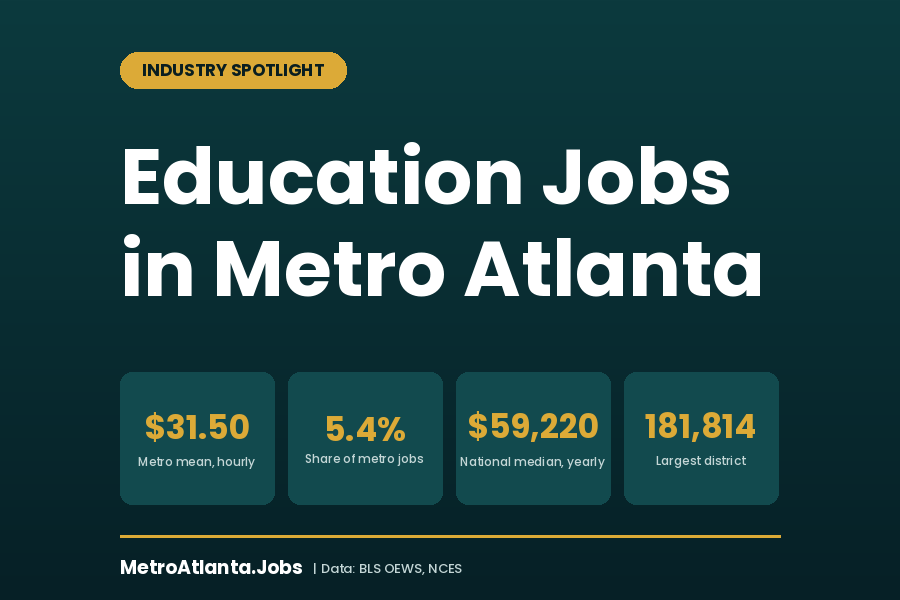
The metro benchmark, all education roles combined. BLS puts the mean wage for the educational instruction and library group in metro Atlanta at $31.50 per hour in its May 2025 estimates [1]. Two cautions matter here. This is a group average that blends K-12 teachers, college instructors, librarians, and teaching assistants, so no single role sits exactly at that number. And most teaching roles run on roughly 10-month contracts, so an hourly mean does not translate cleanly into a 12-month salary.
The national field benchmark. Nationally, the median wage for the same education group is $59,220 per year [2], above the $49,500 median for all occupations, with the group projected to grow more slowly than the average job over the 2024 to 2034 decade [2]. In metro Atlanta the group's median runs a little higher, at about $62,210 a year [1]. Growth is modest, but the openings are steady, because so much hiring replaces people who leave rather than filling brand-new positions.
What teachers specifically earn. The National Education Association puts the average U.S. public school teacher salary at $74,495 for the 2024-25 year, and the average starting salary at $48,112 [3]. Higher education faculty average more, at $105,657 nationally [3]. Georgia teachers, though, are not paid off a single national average. They are paid off a state schedule, which is worth understanding before you compare offers.
Quick read on pay: the metro education group averages about $31.50 an hour, the national field median is $59,220 a year, and the average U.S. teacher earns $74,495. These measure different things. Treat them as a range, not a single salary, and always compare total compensation for a specific role and district.
How Georgia teacher pay actually works
Georgia sets a statewide teacher salary schedule. The State Board of Education publishes a base salary determined by your certificate level, such as a bachelor's-level T-4 or a master's-level T-5, and your years of creditable experience [8]. That state figure is only the floor. Local districts then add a local supplement on top, and in higher-cost or higher-demand metro Atlanta districts those supplements can be substantial, which is why two teachers with identical certificates and experience can earn meaningfully different totals depending on the county [8]. The state budget for FY2026 funded another raise on the schedule, and certified educators participate in the Teachers Retirement System of Georgia, a defined-benefit pension [8]. The practical takeaway for a job seeker is simple. Compare total compensation, meaning state base plus local supplement plus any stipends, rather than the headline number alone. Benefits add real value on top of salary as well. Certified public-school employees participate in the Teachers Retirement System of Georgia and are eligible for the State Health Benefit Plan, which together make a public-school offer worth more than the schedule figure alone suggests [8].
Who is hiring: the biggest education employers in metro Atlanta
Education hiring in Atlanta comes from three broad sources: public school districts, colleges and universities, and a wide band of support and education-adjacent roles.
Public school districts, the anchor employers
In most metro counties, the local school district is among the very largest employers of any kind. Metro Atlanta is home to several of the biggest districts in the state. Gwinnett County Public Schools is the largest district in Georgia, enrolling 181,814 students across about 140 schools [4]. Cobb County follows at 106,703 students, then DeKalb County at 92,368, Fulton County at 89,935, Forsyth County at 54,077, Clayton County at 52,186, Atlanta Public Schools at about 50,325, Henry County at 43,417, and Cherokee County at 41,891 [4]. Statewide, Georgia enrolls roughly 1.7 million public school students across 227 districts, at an average student-teacher ratio of about 14.5 to 1 [4]. Districts of this size employ thousands of teachers plus a deep bench of support staff, and they hire every year simply to keep pace with turnover. If you are targeting a specific county, our local guides cover the wider job market in Gwinnett, Cobb, DeKalb, Fulton, Clayton, Cherokee, Forsyth, and Henry County.
Colleges and universities
Higher education is the second pillar, and metro Atlanta is one of the South's largest college regions, with more than 70 institutions. Georgia State University, with more than 50,000 students, is the largest in-person university based in Georgia [7]. Georgia Tech is the University System of Georgia's largest institution by total enrollment [7], and Kennesaw State University, in Cobb County, enrolls more than 45,000 students [7]. Emory University anchors private higher education and, together with Emory Healthcare, ranks among the metro's largest employers overall. The Atlanta University Center, home to Spelman College, Morehouse College, and Clark Atlanta University, adds a nationally significant cluster of historically Black institutions. Below the four-year schools sit Georgia Gwinnett College, Clayton State University, and the technical colleges, including Atlanta Technical, Chattahoochee Technical, and Gwinnett Technical. Each of these institutions employs not only instructors but advisers, administrators, researchers, and student-services staff.
Beyond the classroom
Education hiring reaches well past lead teachers. Districts and schools also hire paraprofessionals and teaching assistants, substitute teachers, school counselors, media specialists, instructional coaches, special education staff, school psychologists, and school nurses, a role that overlaps with our health care jobs in Atlanta guide. There is also a growing layer of education-adjacent work. Instructional designers and education-technology roles pair naturally with the metro's tech sector, covered in our tech jobs in Atlanta guide, and corporate training, private and charter schools, early childhood and Pre-K programs, and tutoring and test-prep companies all hire steadily. If you have a degree but not a teaching background, several of these paths are open to you without a classroom certificate.
Private and independent schools, a growing public charter sector, and Georgia's state-funded Pre-K and early childhood programs widen the field further. These employers hire teachers, aides, and administrators on their own calendars and with their own requirements, which sometimes differ from the public-district certification path. For candidates who are flexible about setting, that variety is another way into the sector.
The roles in demand right now
Demand in education is uneven, and that is useful information for a job search. Nationally, the most commonly reported teacher shortage areas are special education, science, and math [6], a pattern that has held for decades, and roughly 90 percent of annual hiring demand comes from attrition rather than growth, meaning schools are mostly replacing people who leave [6]. Georgia mirrors that national picture, reporting persistent high-need areas that include special education, mathematics, the sciences, and world languages. For a job seeker, the signal is straightforward. Candidates certified in a shortage field tend to find openings faster, carry more leverage in hiring, and sometimes qualify for incentives or federal loan forgiveness tied to high-need subjects. If you are weighing a switch into one of these fields from another career, our Atlanta career change guide walks through how to make the pivot.
It is worth noting that the field's slow projected growth understates how much hiring actually happens. Because the large majority of openings come from replacing people who leave rather than from net new positions [6], schools post far more jobs each year than the modest growth rate implies [2]. In practical terms, that means steady, recurring demand: even a field that is not expanding quickly still needs a constant supply of new hires, which is good news if you are entering the profession now.
How to get hired in education in Atlanta
Get certified, or use an alternative route
Most lead teaching roles in Georgia public schools require state certification, which is handled by the Georgia Professional Standards Commission [5]. The traditional path is a bachelor's degree plus a state-approved educator preparation program with student teaching, then passing the relevant GACE content assessment and the Georgia Educator Ethics Assessment, which leads to an entry-level Induction certificate [5]. After three years of experience you can upgrade to a Professional certificate, with Advanced and Lead tiers above that [5]. Georgia also offers reciprocity for teachers already licensed in another state [5].
If you already hold a bachelor's degree in another field, you do not have to go back for a second degree. Georgia's main alternative route, the Georgia Teacher Academy for Preparation and Pedagogy, known as GaTAPP, lets career-changers teach under a provisional certificate while completing preparation requirements, usually within three years [5]. This route is popular with people moving into teaching from industry, and it is especially practical in the shortage subjects above.
Roles that do not require a teaching certificate
Plenty of education jobs do not require a teaching certificate at all. Paraprofessional and teaching-assistant roles, substitute teaching, many support and operations positions, higher-education staff and administrative roles, instructional design and education technology, and tutoring are all open without classroom certification. These can be strong entry points, and some districts help paraprofessionals work toward full certification over time.
Run a focused search
Once you know your target, a focused search beats a scattered one. Browse current education and school openings across metro Atlanta and filter by location and role. Create a job seeker profile so employers can find you and you can apply faster across all 29 counties. Turn on a daily job alert so new postings reach you first. Before you apply, tighten your resume for the applicant tracking systems most districts and universities use, which our Atlanta resume tips for 2026 covers, and benchmark pay with our entry-level salaries in Atlanta guide and the broader Atlanta Salary Guide. When an offer comes, our guide to negotiating salary in Atlanta helps, since even step-and-lane schedules leave room around supplements, stipends, and experience credit. For the wider hiring backdrop, see our Atlanta job market and hiring trends breakdown.
Get started on your Atlanta education job search
Create a Free Job Seeker Profile: set up your job seeker profile to apply faster and let employers find you.
Browse All Metro Atlanta Jobs: search current openings across all 29 counties on the jobs page.
Get Daily Atlanta Job Alerts: turn on daily job alerts so new education roles reach you first.
Atlanta Salary Guide: benchmark your pay with the Atlanta Salary Guide.
Atlanta Resume Tips for 2026: tighten your application with our Atlanta resume tips.
How to Negotiate Salary in Atlanta: prepare for your offer with our salary negotiation guide.
Frequently asked questions
How much do education jobs in Atlanta pay?
Pay spans a wide range. The educational instruction and library group in metro Atlanta averages about $31.50 per hour, blending teachers, college instructors, and support roles [1]. Nationally the field's median is $59,220 per year [2], and the average U.S. public school teacher earns $74,495 [3]. Actual pay depends on the role, your certificate level and experience, and the specific district's local supplement.
How do I become a certified teacher in Georgia?
The traditional path is a bachelor's degree plus a state-approved educator preparation program with student teaching, then passing the GACE content assessment and the Georgia Educator Ethics Assessment to earn an Induction certificate from the Georgia Professional Standards Commission [5]. You upgrade to a Professional certificate after three years of experience [5].
Can I teach in Georgia without an education degree?
Yes. If you already hold a bachelor's degree in another field, Georgia's GaTAPP alternative route lets you teach under a provisional certificate while you complete preparation requirements, typically within three years [5]. It is a common path for career-changers, especially in shortage subjects.
Which Atlanta school districts are the biggest employers?
Gwinnett County Public Schools is the largest district in Georgia at 181,814 students, followed by Cobb (106,703), DeKalb (92,368), Fulton (89,935), Forsyth (54,077), Clayton (52,186), Atlanta Public Schools (about 50,325), Henry (43,417), and Cherokee (41,891) [4]. In most counties, the school district is among the largest single employers.
What teaching subjects are most in demand?
Special education, science, and math are the most commonly reported shortage areas nationally [6], and Georgia reports the same high-need fields along with world languages. Certification in one of these areas generally means faster hiring and more leverage.
Do all education jobs require a teaching certificate?
No. Paraprofessional and teaching-assistant roles, substitute teaching, support and operations jobs, higher-education staff and administrative positions, instructional design and education technology, and tutoring do not require classroom certification.
What are the largest university employers in metro Atlanta?
Georgia State University, with more than 50,000 students, is the largest in-person university based in Georgia [7]. Georgia Tech is the University System of Georgia's largest institution by total enrollment, Kennesaw State enrolls more than 45,000 [7], and Emory University is a leading private research employer.
How does Georgia teacher pay work?
The state sets a base salary schedule by certificate level and years of experience, and local districts add a supplement on top [8]. Two teachers with the same certificate and experience can earn different totals depending on the district, so always compare total compensation, not just the state base [8].
How do I start an education job search in Atlanta?
Search local listings in one place, create a free job seeker profile, turn on daily alerts, tighten your resume for applicant tracking systems, and benchmark pay before you negotiate. Targeting a shortage subject or a fast-growing county can speed up the search.
Sources
3. National Education Association, Educator Pay Data 2026 (2024-25)
4. National Center for Education Statistics, Common Core of Data, 2024-25
5. Georgia Professional Standards Commission, certification and routes
6. Learning Policy Institute, An Overview of Teacher Shortages: 2025
7. University System of Georgia, enrollment reports
8. Georgia Department of Education and TeachGeorgia, teacher salary and benefits