10 min read
If you are looking for jobs in Clayton County, Georgia, you are searching one of the busiest and most strategically located job markets in the entire Atlanta region. Clayton County sits directly south of the city, borders the world's busiest airport, and runs on a logistics and supply chain engine that keeps freight, people, and packages moving every hour of the day. That means Clayton County jobs span everything from warehouse and aviation roles to public service, healthcare, education, retail, and skilled trades. This guide walks through who is hiring, which industries dominate, what local roles tend to pay, and exactly how to start applying for Clayton County jobs today.
Why Clayton County is one of metro Atlanta's busiest job markets
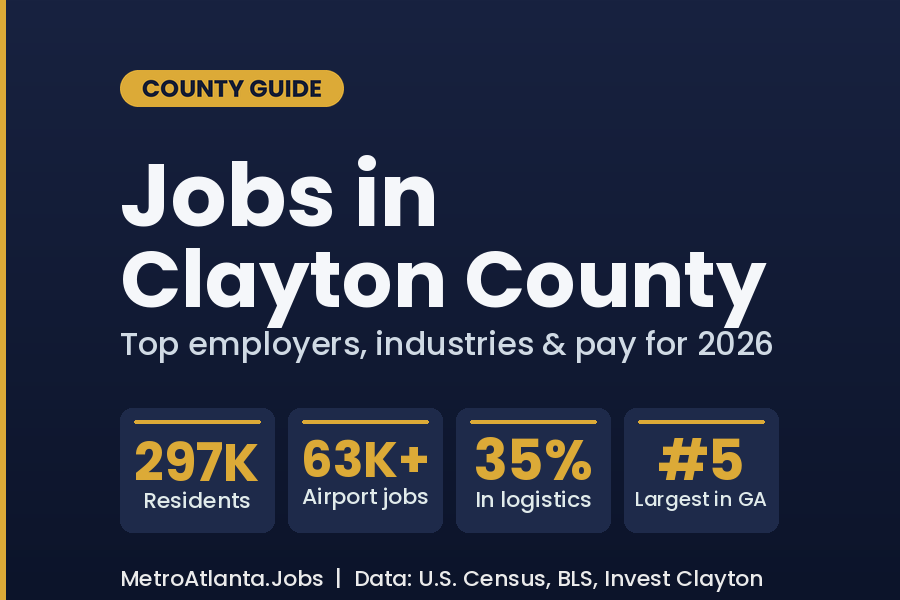
Clayton County is Georgia's fifth largest county by population, home to roughly 297,700 residents as of the U.S. Census Bureau's 2024 estimate [2]. It covers about 144 square miles of south metro Atlanta and includes seven cities, with the county government describing the area as a place where products are "moved and made" [4].
The reason for that nickname is geography. Clayton County offers access to more than 11 interchanges across four major interstates, including I-75, I-85, I-285, and I-675 [4], along with rail connections and direct proximity to Hartsfield-Jackson Atlanta International Airport. For job seekers, that location does two things at once. It concentrates a huge volume of transportation, warehousing, and distribution work inside the county, and it puts the rest of the metro Atlanta job market within a short commute. If you live in Clayton County, you are within easy reach of opportunities in Fulton County, DeKalb County, and Henry County as well.
The Clayton County economy at a glance
Clayton County's economy is built around movement. Its position next to the airport and at the crossroads of several interstates has made it a magnet for logistics, distribution, aviation support, and advanced food processing. The county also works to attract logistics, distribution, and processing investment. Its development authority, Invest Clayton, highlights a Tier 1 job tax credit designation [3], the state ranking that carries Georgia's highest per-job credit, when recruiting employers, and the Georgia Department of Community Affairs sets those tiers annually [6]. For job seekers, the practical point is that the county is actively courting new facilities, and new facilities mean new openings. Federal data points to real momentum as well: among Georgia's largest counties, Clayton recorded the biggest year-over-year employment increase from mid-2022 to mid-2023 [5].
The county is anchored by several established communities. Jonesboro serves as the county seat, while Forest Park is the largest city and a longtime commercial and industrial hub. Riverdale, Morrow, Lake City, Lovejoy, and a portion of College Park round out the local map. Morrow is also home to Clayton State University and the National Archives at Atlanta [4], which adds higher education and federal employment into the mix.
Quick snapshot: Clayton County is Georgia's fifth largest county, sits next to the world's busiest airport, and counts supply chain and logistics as its single biggest source of jobs. If you want work that involves moving goods, supporting travel, or serving a large south metro population, this is one of the strongest markets to search.
Hartsfield-Jackson and the aviation engine next door
You cannot talk about Clayton County jobs without talking about Hartsfield-Jackson Atlanta International Airport. The airport and its supporting businesses employ more than 63,000 people and represent the single largest source of employment in the state of Georgia, generating an estimated 35 billion dollars in economic impact across metro Atlanta [3]. Many of those workers live across the south metro, including in and around Clayton County.
Airport-related work is far broader than pilots and flight attendants. It includes ground operations, baggage and ramp handling, aircraft fueling and maintenance, catering and in-flight meal production, customer service, security screening, concessions and food service, cargo and freight handling, facilities, and administration. Delta Air Lines, which uses the airport as its primary hub, is among the county's top private employers and one of its largest taxpayers [3]. For job seekers, the takeaway is simple. You do not need an aviation degree to build a career in this ecosystem. Many roles start at entry level and offer clear paths into logistics, operations, and management over time.
The biggest industries hiring in Clayton County
Clayton County's hiring is concentrated in a handful of large, stable sectors. Knowing where the volume is helps you focus your search.
Logistics, warehousing, and supply chain
Supply chain and logistics make up the largest single share of jobs in Clayton County, around 35 percent by industry [3]. Warehouses, distribution centers, freight forwarders, and third-party logistics operators cluster here precisely because of the interstate access and airport cargo capacity. Common roles include warehouse associates, forklift and material handling operators, inventory and shipping clerks, dispatchers, truck drivers, logistics coordinators, and operations supervisors. If logistics is your focus, our logistics jobs in Atlanta guide for 2026 breaks down employers, certifications, and pay across the metro.
Aviation and transportation
Beyond the airport itself, Clayton County supports a deep network of aviation services, ground transportation, and transportation equipment work. These roles often pair well with logistics experience and can serve as a strong entry point for workers without a four-year degree.
Public sector, education, and government
As in many metro Atlanta counties, the public school system is the largest single employer, educating more than 50,000 students each year [3]. County government, municipal governments across the seven cities, Clayton State University, and federal operations such as the National Archives at Atlanta add many more stable, benefits-eligible positions in administration, instruction, public safety, and skilled trades.
Healthcare
Clayton County residents are served by hospitals and a wide network of clinics, outpatient centers, and senior care facilities, and healthcare hiring remains steady across the south metro. Demand spans nursing, medical assisting, technicians, support staff, and administration. To see which systems are hiring and what clinical roles pay across the region, read our healthcare jobs in Atlanta guide.
Retail, hospitality, and food service
With a large resident population and a constant flow of airport travelers, retail, hospitality, and food service generate a steady stream of openings across Clayton County, from entry-level positions to store and restaurant management.
Technology and professional roles
While Clayton County is not a tech hub the way some northern metro counties are, technology and professional roles still show up across logistics operations, healthcare systems, government, and education. Workers open to a short commute can also tap the broader metro technology market covered in our tech jobs in Atlanta guide.
What jobs in Clayton County pay
Pay figures in this guide are drawn from the U.S. Bureau of Labor Statistics Occupational Employment and Wage Statistics program for the Atlanta-Sandy Springs-Roswell metro area, May 2024 release, the most recent available [1]. Because that program publishes wage data at the metropolitan level rather than the county level, the figures below reflect the broader Atlanta metro and serve as a reliable benchmark for Clayton County roles. Annual estimates assume a 2,080-hour work year, and actual pay varies by employer, shift, experience, and certifications.
Across all occupations, the Atlanta metro mean wage was 33.73 dollars per hour, or roughly 70,200 dollars per year. The two largest occupational groups locally line up closely with Clayton County's economy. Office and administrative support roles, the single largest group at about 11.9 percent of metro employment, averaged 23.67 dollars per hour, or roughly 49,200 dollars per year. Transportation and material moving roles, the second largest group at about 11.0 percent of employment and the heart of Clayton's logistics base, averaged 27.30 dollars per hour, or roughly 56,800 dollars per year.
Higher-paying groups stretch the range considerably. Management occupations averaged 70.80 dollars per hour, or roughly 147,300 dollars per year, and healthcare practitioners and technical roles averaged 55.25 dollars per hour, or roughly 114,900 dollars per year. In the middle tier, installation, maintenance, and repair roles averaged 29.66 dollars per hour, or roughly 61,700 dollars per year, while sales and related roles averaged 27.06 dollars per hour, or roughly 56,300 dollars per year. On the entry end, production roles averaged 22.60 dollars per hour, or roughly 47,000 dollars per year, and food preparation and serving roles averaged 15.38 dollars per hour, or roughly 32,000 dollars per year.
For a fuller breakdown of metro pay by role and how to benchmark an offer, see our Atlanta Salary Guide and, if you are early in your career, our entry-level salaries in Atlanta guide.
Jobs by city in Clayton County
Clayton County's seven cities each bring a slightly different flavor to the local job market.
Forest Park is the county's largest city and is long known as a center for commerce, warehousing, and distribution, which makes it a strong target if you want logistics or industrial work. Jonesboro, the county seat, combines government employment with retail and small business and carries a well-known historic identity. Riverdale, located just south of the airport, is the county's second largest city and offers a mix of retail and service employment. Morrow is home to Clayton State University and the National Archives at Atlanta and anchors a well-known retail corridor, which makes it a center for education, federal, and customer-facing work. Lake City, Lovejoy, and the Clayton County portion of College Park add additional retail, service, and community-based openings.
How to find and land a job in Clayton County
A focused search beats a scattered one. Here is a practical path to follow.
First, search local listings in one place. You can browse current Clayton County and metro Atlanta openings on MetroAtlanta.Jobs and filter by location, industry, and role.
Second, create a free profile so employers can find you and so you can apply faster. Setting up a job seeker profile takes a few minutes and lets you save searches across all 29 metro counties.
Third, turn on daily alerts. New Clayton County roles, especially in logistics and aviation, can fill quickly, so a daily job alert gives you a head start the moment a match is posted.
Fourth, sharpen your resume for the roles you want. Logistics, warehouse, and operations employers scan for specific skills and certifications, so tailoring matters. Our Atlanta resume tips for 2026 covers formatting, keywords, and applicant tracking systems.
Fifth, prepare to talk pay with confidence. Once you have an offer, knowing the local benchmark helps. Walk through our guide to negotiating salary in Atlanta before you respond.
Sixth, lean on professional networking. Industry associations, alumni groups from Clayton State University, employer resource groups, and local professional events can surface roles before they are widely advertised. If you are considering a shift into logistics, aviation, or healthcare from another field, our Atlanta career change guide maps out how to make the pivot.
Commuting and getting to work in Clayton County
Clayton County's interstate access cuts both ways: it brings jobs in, and it makes commuting out manageable. The county also belongs to the MARTA transit system, after residents voted in 2014 to fund service, and it is served by several MARTA bus routes, some of which connect to downtown Atlanta and to Hartsfield-Jackson, with a bus rapid transit expansion planned for the corridor [7]. That can be a real advantage for workers who prefer not to drive. If you are weighing a role here against one in a neighboring county, factor in commute time alongside pay. A slightly lower wage close to home can outperform a higher wage with a long daily drive once you account for fuel and time. For a wider view of how the regional market is moving this year, see our Atlanta job market hiring trends.
Frequently asked questions about Clayton County jobs
What are the biggest employers in Clayton County?
The public school system is the largest single employer, educating more than 50,000 students each year. The Hartsfield-Jackson airport ecosystem, including Delta Air Lines and many supporting logistics and aviation businesses, is the largest overall source of employment in the area and across the state.
What industries are hiring most in Clayton County?
Supply chain and logistics lead by a wide margin, making up roughly 35 percent of jobs in the county by industry. Aviation and transportation, public sector and education, healthcare, and retail and hospitality round out the strongest hiring sectors.
Do you need to work at the airport to find a good job in Clayton County?
No. While the airport is the largest employment engine, Clayton County offers strong opportunities in warehousing and distribution, government, education, healthcare, retail, and skilled trades that are not tied to aviation at all.
What is the largest city in Clayton County?
Forest Park is the largest city in Clayton County and a major commercial and industrial center. Riverdale is the second largest city.
What is the county seat of Clayton County?
Jonesboro is the county seat. It combines government employment with retail and small business activity and carries a recognizable historic identity.
How much do jobs in Clayton County pay?
Pay varies widely by field. Using Atlanta metro benchmarks, transportation and material moving roles average roughly 56,800 dollars per year, office and administrative support roles average roughly 49,200 dollars per year, and the overall metro average is roughly 70,200 dollars per year. Management and healthcare roles pay well above those figures.
Is Clayton County a good place to find logistics and warehouse jobs?
Yes. Clayton County is one of the strongest logistics markets in metro Atlanta because of its interstate access, rail service, and airport cargo capacity. Warehouse, distribution, and freight roles are consistently among the most available positions.
How do I search for Clayton County jobs on MetroAtlanta.Jobs?
Browse the jobs page, filter by location and industry, and create a free job seeker profile to save searches and apply quickly. Turning on daily alerts will notify you when new Clayton County roles are posted.
What other metro Atlanta counties should I look at near Clayton?
Because of Clayton County's central location, neighboring markets are easy to reach. Many job seekers also search Fulton County, DeKalb County, and Henry County, all of which border or sit close to Clayton.
Get started on your Clayton County job search
Create a Free Job Seeker Profile: set up your job seeker profile to apply faster and let employers find you.
Browse All Metro Atlanta Jobs: search current openings across all 29 counties on the jobs page.
Get Daily Atlanta Job Alerts: turn on daily job alerts so new Clayton County roles reach you first.
Atlanta Salary Guide 2025: benchmark your pay with the Atlanta Salary Guide.
Atlanta Resume Tips for 2026: tighten your application with our Atlanta resume tips.
How to Negotiate Salary in Atlanta: prepare for your offer with our salary negotiation guide.
Sources
2. U.S. Census Bureau QuickFacts, Clayton County, Georgia
3. Invest Clayton (Development Authority of Clayton County), Major Employers
4. Clayton County Government, Economic Development
5. U.S. Bureau of Labor Statistics, County Employment and Wages in Georgia
6. Georgia Department of Community Affairs, Job Tax Credits
7. Invest Clayton (Development Authority of Clayton County), Commuting Patterns