11 min read
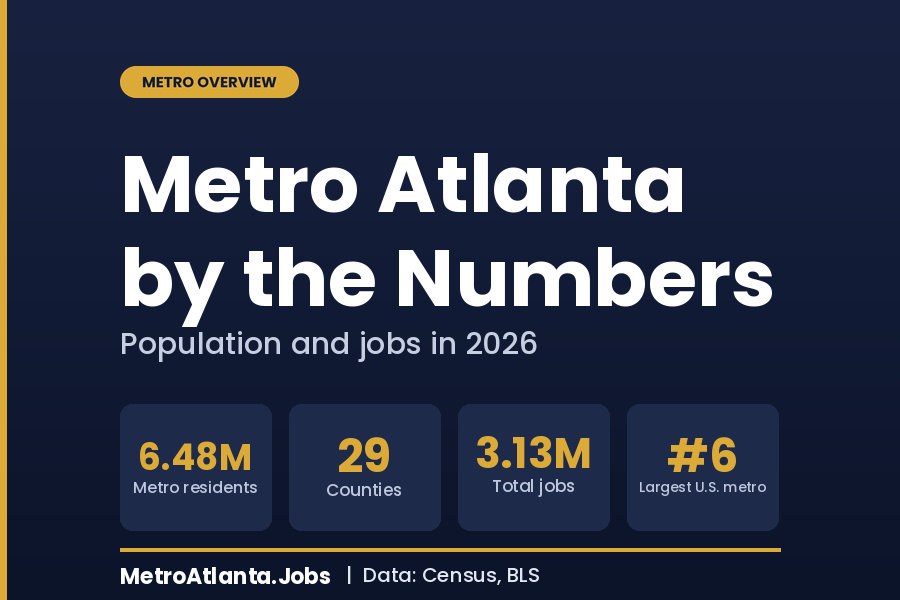
The Atlanta metro population reached about 6.48 million people in 2025, spread across a 29-county region that keeps growing even as national growth slows. That scale is the reason Atlanta is one of the country's most active job markets: more people means more workers, more employers, and more openings across a wider geography than almost any other metro in the Southeast. This guide explains what "metro Atlanta" actually means, how big and how fast-growing the Atlanta metro population really is, and, most importantly for a job seeker, what all those people do for work. Population is the lens here. Careers are the point.
How big is the Atlanta metro population?
The short answer is about 6.48 million, but the number depends entirely on where you draw the line.
The federal government defines the region as the Atlanta-Sandy Springs-Roswell, GA Metropolitan Statistical Area, a 29-county area, and the U.S. Census Bureau's 2025 vintage estimates put its population at 6,482,182 as of July 1, 2025 [1][2]. That is the figure this guide uses, because those 29 counties are the region MetroAtlanta.Jobs covers.
It helps to understand the three common ways people describe the region, because they produce very different numbers:
- The city of Atlanta is small by comparison, home to well under a tenth of the metro. Most of the region's people, and most of its jobs, are outside the city limits.
- The 29-county metro area (MSA) is the standard federal definition and the one used throughout this guide, at about 6.48 million people [1].
- The 11-county ARC planning region is what the Atlanta Regional Commission formally plans for. It is a smaller core, so its population figure is lower than the full 29-county metro [2].
When a job posting, a news story, or a salary report says "metro Atlanta," it usually means the 29-county MSA. That is the version worth anchoring to.
Atlanta metro population by county
The 29 counties vary enormously in size, from Fulton's more than a million residents to Heard County's roughly 12,000. The four core counties alone, Fulton, Gwinnett, Cobb, and DeKalb, hold about 57 percent of the metro's entire population, and the twelve largest hold more than 84 percent. Here is every county in the Atlanta metropolitan area, ranked by population, using the Census Bureau's 2025 vintage estimates as compiled by the Atlanta Regional Commission [2].
- Fulton County: 1,098,791
- Gwinnett County: 1,018,099
- Cobb County: 793,345
- DeKalb County: 774,394
- Cherokee County: 299,273
- Clayton County: 297,471
- Forsyth County: 282,805
- Henry County: 264,922
- Paulding County: 190,996
- Coweta County: 160,240
- Douglas County: 154,293
- Carroll County: 131,036
- Newton County: 125,583
- Fayette County: 125,156
- Bartow County: 120,800
- Walton County: 112,696
- Barrow County: 99,773
- Rockdale County: 98,416
- Spalding County: 70,775
- Pickens County: 37,167
- Lumpkin County: 36,178
- Dawson County: 35,365
- Haralson County: 33,066
- Butts County: 27,127
- Morgan County: 21,940
- Meriwether County: 21,439
- Pike County: 20,669
- Jasper County: 18,218
- Heard County: 12,149
Together these 29 counties add up to the region's total of about 6.48 million. The concentration in the core, combined with faster growth on the edges, is exactly why a job search here has to start with a decision about which part of the metro you are targeting.
How fast is metro Atlanta growing?
Steadily, and faster than the country as a whole, even in a slower year.
Between July 2024 and July 2025, the region added just under 62,000 people, a growth rate of about 0.96 percent [1][2]. For comparison, the U.S. as a whole grew about 0.52 percent over the same period, so metro Atlanta expanded at nearly twice the national pace [1]. That was actually a slowdown from the prior year, when the region added roughly 75,000, but the direction has held for well over a decade [2].
The growth is uneven across the region, and that geography matters for a job search:
- The urban core of Fulton, Gwinnett, Cobb, and DeKalb added the largest raw numbers of people, but grew more slowly in percentage terms, under 1 percent [2].
- The outer ring grew faster in percentage terms, in the 1 to 3 percent range, with the fastest growth at the periphery in counties like Dawson [2].
- One notable reshuffle: Cherokee County passed Clayton County to become the region's fifth most populous county in 2025 [2]. No county in the 29-county metro lost population that year [2].
For a job seeker, that pattern is a map. Population is flowing outward to the suburban and exurban edges, and jobs, housing, and new employers tend to follow. The counties growing fastest today are often where tomorrow's openings appear.
Quick snapshot: The 29-county Atlanta metro population was about 6.48 million as of July 2025, making it the sixth-largest metro area in the United States. It grew by roughly 62,000 people in a year, nearly twice the national rate. The region supports about 3.13 million jobs, and healthcare is by far its fastest-growing employment sector.
Where metro Atlanta ranks
Metro Atlanta is one of the largest metros in the country, though its exact rank moves around.
Based on the Census Bureau's 2025 vintage estimates, the Atlanta Regional Commission describes the region as the sixth most populous metro area in the United States [2]. The ranking has shifted in recent years, partly because the Census Bureau revised how it measures international migration, which changed population estimates for many metros at once [1]. So depending on the data vintage and the source, you may see Atlanta listed anywhere from sixth to eighth. What is not in dispute is that it is the largest metro in Georgia and the second-largest in the Southeast, behind only greater Washington, D.C.
For a job seeker, the rank itself matters less than what it signals: a labor market with the depth of a top-tier American metro, major corporate headquarters, and the full range of industries that come with that scale.
Scale also compounds. A larger population supports more hospitals, more schools, more retail, more restaurants, and more of the local services every community needs, which in turn creates more jobs and draws still more people. That feedback loop is why metro Atlanta has posted over-the-year employment gains for most of the past 15 years and why it continues to rank among the largest job markets in the country even in slower years.
What all those people do: metro Atlanta's job base
This is where population turns into paychecks. A region of 6.48 million people supports a very large and diverse job base.
As of May 2026, total nonfarm employment in the metro Atlanta area stood at 3,126,000 jobs, essentially unchanged over the year, according to the U.S. Bureau of Labor Statistics [3]. Here is how those jobs break down by major industry supersector, which is the clearest way to see what the region actually does for work [3]:
Trade, transportation, and utilities is the single largest, at about 646,600 jobs. This is the sector anchored by Hartsfield-Jackson Atlanta International Airport and the region's role as a logistics and distribution hub [3].
Professional and business services is close behind at about 562,400 jobs, reflecting Atlanta's base of corporate offices, consulting, legal, and administrative work [3].
Education and health services employs about 479,200, and it is the region's growth engine, more on that below [3].
Government accounts for about 360,200 jobs across federal, state, and local agencies plus public education [3].
Leisure and hospitality employs about 324,900, spanning restaurants, hotels, and entertainment [3].
Financial activities adds about 209,000 jobs, and manufacturing about 176,300 [3].
Construction employs about 154,900, other services about 107,800, and information about 102,400 [3].
That spread is the practical meaning of a large population. Nearly every major industry is represented at scale, which is exactly why the region draws job seekers from across the Southeast.
Who is hiring in metro Atlanta right now
Total job numbers describe the region's size. The year-over-year changes describe its momentum, and lately it has concentrated in one place.
Healthcare is the clear hiring leader. Education and health services added about 17,700 jobs, over the year to May 2026, a 3.8 percent increase and by far the largest gain of any industry supersector [3]. It is the one part of the metro economy adding people at a meaningful clip. If you are looking for the part of the Atlanta metro economy that is actively adding people, this is it. Our healthcare jobs in Atlanta guide and healthcare salaries guide go deep on where those roles are and what they pay.
A couple of sectors posted small gains. Financial activities added about 1,700 jobs over the year, and leisure and hospitality about 1,000 [3]
Most other sectors were flat or down. Trade, transportation, and utilities lost about 4,600 jobs over the year, professional and business services about 4,100, government about 3,300, and manufacturing about 3,100 [3]. The trade and transportation slippage reflects real disruption in logistics, even though it remains the region's largest employer by headcount. Our logistics jobs in Atlanta guide covers how that shakeout is playing out.
The takeaway for a job seeker: the region is large and stable overall, growth is uneven by sector, and healthcare is where the hiring energy is concentrated right now. Match your search to where the momentum actually is. For the fuller picture, see our Atlanta job market and hiring trends breakdown.
The airport effect: why logistics defines the region
No single fact shapes metro Atlanta's job base more than its airport.
Hartsfield-Jackson Atlanta International Airport is one of the world's busiest, and its presence is a big part of why trade, transportation, and utilities is the region's largest employment sector. According to the Bureau of Labor Statistics, metro Atlanta had about 313,910 jobs in transportation and material moving occupations as of May 2025, which was 10.9 percent of all local employment, well above the 8.8 percent national share [4]. This is a genuinely distinctive feature of the local economy, not a rounding difference.
It pays a premium here, too. The average hourly wage for that transportation and material moving group was $28.64 in metro Atlanta, compared with $23.96 nationally [4]. The larger detailed occupations include laborers and freight and material movers (about 78,460 jobs), stockers and order fillers (about 50,970), and heavy and tractor-trailer truck drivers (about 41,830) [4]. For a job seeker without a four-year degree, this cluster is one of the largest and best-paying entry points in the entire region. Our logistics jobs in Atlanta guide covers it in depth.
The airport also explains the geographic shape of the job market. The heaviest concentration of logistics and distribution work sits on the south side of the metro near the airport and along the interstate corridors, while corporate offices cluster north. Knowing that map is half of an efficient job search in a region this large.
What a big metro means for your job search
A region this size changes how you should look for work, in a few concrete ways.
Geography is a strategy, not an afterthought. With 6.48 million people spread across 29 counties, "Atlanta" is not one job market but many overlapping ones. A role in Alpharetta and a role in Newnan can be 60 miles and a very different commute apart. Deciding which parts of the metro you will actually work in narrows a huge market down to a searchable one. Our county guides break the region down one county at a time, including Fulton, Gwinnett, Cobb, DeKalb, and the fast-growing suburbs like Cherokee, Forsyth, Henry, and Paulding.
Depth means options. Because nearly every major industry operates here at scale, career changers have room to pivot without leaving the region. If you are weighing a move between fields, our career change guide walks through how to do it.
Competition means preparation. A big, growing metro draws job seekers from across the Southeast, so applications matter. Tighten yours with our Atlanta resume tips for 2026, benchmark your pay with the Atlanta Salary Guide and entry-level salaries guide, and prepare for the offer with our salary negotiation guide.
Start local. The advantage of a hyperlocal job board in a region this size is that every listing is actually in metro Atlanta. Browse current openings across all 29 counties and create a free job seeker profile so employers can find you.
Get started on your metro Atlanta job search
Create a Free Job Seeker Profile: set up your job seeker profile to apply faster and let employers find you.
Browse All Metro Atlanta Jobs: search current openings across all 29 counties on the jobs page.
Get Daily Atlanta Job Alerts: turn on daily job alerts so new roles reach you first.
Explore by County: start with the local market where you want to work, from Fulton to Paulding.
Atlanta Salary Guide: benchmark your pay with the Atlanta Salary Guide.
Atlanta Resume Tips for 2026: tighten your application with our Atlanta resume tips.
Frequently asked questions
What is the Atlanta metro population in 2025?
The 29-county Atlanta-Sandy Springs-Roswell metropolitan area had a population of 6,482,182 as of July 1, 2025, according to the U.S. Census Bureau's 2025 vintage estimates [1][2]. That makes it the most populous metro area in Georgia.
How many counties are in metro Atlanta?
The federal metropolitan statistical area includes 29 counties [3]. A smaller 11-county core is what the Atlanta Regional Commission formally plans for, which is why you sometimes see a lower county count and population figure depending on the source [2].
Is metro Atlanta still growing?
Yes. The region added just under 62,000 people between July 2024 and July 2025, a growth rate of about 0.96 percent, nearly twice the national pace [1][2]. No county in the 29-county metro lost population that year [2].
Where does metro Atlanta rank in population?
The Atlanta Regional Commission describes it as the sixth most populous U.S. metro area based on 2025 estimates, though recent Census methodology changes mean you may see it ranked anywhere from sixth to eighth depending on the source and year [1][2]. It is the largest metro in Georgia.
How many jobs are in metro Atlanta?
Total nonfarm employment was about 3,126,000 in May 2026, the most recent monthly reading, according to the U.S. Bureau of Labor Statistics [3]. The largest employment sector is trade, transportation, and utilities, at roughly 646,600 jobs [3].
Which counties have the largest population in metro Atlanta?
Fulton County is the largest at about 1.1 million, followed by Gwinnett at about 1.0 million, Cobb at 793,000, and DeKalb at 774,000 [2]. These four core counties together hold roughly 57 percent of the metro's population.
What is the largest industry in metro Atlanta?
By employment, trade, transportation, and utilities is the largest supersector at about 646,600 jobs, anchored by Hartsfield-Jackson Atlanta International Airport and the region's logistics role [3]. Professional and business services is second at about 562,400 [3].
What industry is growing fastest in metro Atlanta?
Healthcare. Education and health services added about 17,700 jobs over the year to May 2026, a 3.8 percent increase and the largest gain of any industry supersector [3].
Why is metro Atlanta's population spread across so many counties?
Georgia has more counties than any state except Texas, and metro Atlanta developed as a decentralized region with many separate city and county governments rather than one dominant central city [2]. That is why the metro population is distributed across 29 counties and why job markets vary so much from one part of the region to another.
What is the difference between the city of Atlanta and metro Atlanta?
The city of Atlanta is a single municipality with well under a tenth of the region's people. Metro Atlanta refers to the surrounding 29-county region of about 6.48 million, where the large majority of the population and jobs are located [1][2].
How do I search for jobs across metro Atlanta?
Decide which parts of the 29-county region you are willing to work in, then browse the jobs page and filter by location and role. Create a free job seeker profile and turn on daily alerts so new listings reach you first.