11 min read
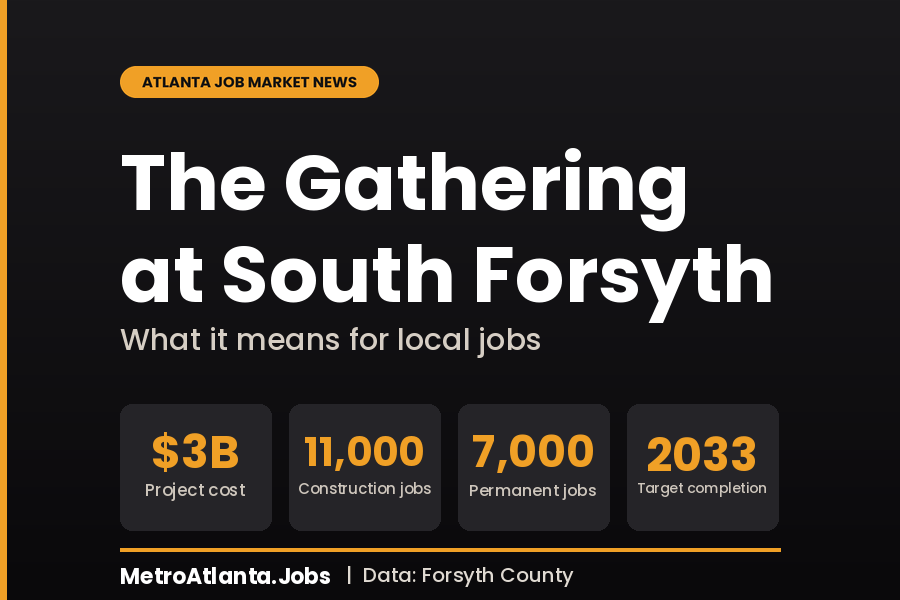
The Gathering at South Forsyth is one of the largest development projects underway in metro Atlanta, a roughly $3 billion mixed-use district planned for 100 acres in south Forsyth County, and it could meaningfully reshape the local job market. According to Forsyth County's own feasibility study, The Gathering at South Forsyth is projected to create about 11,000 construction jobs and 7,000 permanent jobs once built, most of them filled by county residents. There is one large asterisk, and this guide is honest about it: the project's centerpiece is an NHL-ready arena, and much of the public financing behind it depends on a professional hockey decision that has not happened yet. Here is the who, what, when, where, why, and how, and what it realistically means for work.
What is The Gathering at South Forsyth?
The Gathering at South Forsyth is a planned mixed-use entertainment district modeled on The Battery Atlanta, the Cobb County development anchored by the Atlanta Braves' Truist Park. The idea is the same: build a walkable district of homes, hotels, restaurants, shops, and offices around a major venue, so the venue drives foot traffic and the surrounding businesses stay busy year round.
As currently master planned by the design firm NELSON Worldwide, the 100-acre district is set to include 2,400 residential units, 500 hotel rooms, and 1.6 million square feet of office and retail space, plus open greenspaces, water features, and walking trails [1]. The centerpiece is an 18,500-seat arena built to host professional hockey, concerts, and other major events [1].
The scale is what makes it a jobs story. At roughly $3 billion in total cost, with about $1 billion of that in the arena alone, this is one of the most significant single developments in the northern suburbs, and building it and then running it requires a large workforce.
Who is behind it, and where it stands in 2026
The developer is Vernon Krause, an Atlanta-area car dealership entrepreneur and CEO of Krause Sports and Entertainment, who already owns the 100-acre site. His team has assembled a roster of specialist firms, including NELSON Worldwide as master planner and SCI Architects on the arena, and in March 2024 selected ASM Global, one of the world's largest venue operators, to run the proposed arena.
The public partner is Forsyth County. The project has cleared a series of government hurdles in order:
- Spring 2023: Krause announced the project.
- November 2024: Forsyth County voters approved a referendum allowing the county to create a Tax Allocation District to help finance the arena [2].
- June 2025: the county, school board, and development authority approved the project's central agreements, covering the arena operating plan, the Tax Allocation District, and the financial mechanics needed to move the 100-acre project forward [3].
- Mid-2026: county leadership has described the site as shovel-ready, the developer has secured county permitting to begin site work, and reporting indicates construction on the broader district could begin soon [3].
In short, after three years of approvals, the project is closer to breaking ground than it has ever been. What is still unresolved is the arena's marquee tenant.
Where it is, and why Forsyth County
The Gathering sits on a 100-acre tract at the intersection of Ronald Reagan Boulevard and Union Hill Road, just off Georgia 400 in south Forsyth County near the Fulton County line. The mailing address is in Alpharetta, which tells you how close it is to the Forsyth-Fulton border and the GA-400 job corridor. The site is also positioned near a new McGinnis Ferry Road interchange and is planned to connect to the Big Creek Greenway.
The location is not an accident. Forsyth County has been one of the fastest-growing counties in Georgia for two decades, with NELSON noting a population increase of 132 percent from 2000 to 2019 [1]. The specific parcel had been zoned for a regional mall nearly 15 years ago, but that plan never materialized and the land sat empty. Turning a long-vacant, mall-zoned tract into a working district is a large part of the county's argument for the project. For a fuller picture of the local labor market this development would plug into, see our Forsyth County jobs guide, and for the neighboring market just across the line, our Fulton County guide.
Why it matters: the NHL question
The reason this project gets national attention is hockey. The arena is designed to lure a National Hockey League expansion franchise back to metro Atlanta, which has been without an NHL team since the Atlanta Thrashers relocated in 2011. Supporters point out that Atlanta is one of only a couple of top-ten U.S. markets without an NHL team.
Here is the honest catch, and it matters for every job number in this article. The NHL has not opened a formal expansion process or awarded a franchise. NHL Commissioner Gary Bettman told the Toronto Star in 2024 that no expansion beyond the league's current 32 teams was on the horizon, despite documented interest in metro Atlanta and Houston [4]. A competing Atlanta-area proposal at North Point Mall in Alpharetta, roughly six miles away, is pursuing the same prize [3]. That rival bid is real and advancing: in February 2026 the City of Alpharetta approved its own tax allocation district to clear the way for a competing multibillion-dollar mixed-use development anchored by a professional hockey arena [5]. Because the NHL would award at most one metro Atlanta franchise, the two projects are effectively competing for a single prize that may never be created. So the arena, and the team it is built for, are not guaranteed.
That uncertainty is written directly into the financing, which is the key thing a job seeker should understand next.
How it is financed, and what that means for the jobs
The developer is expected to privately finance the residential, hotel, office, and retail portions of The Gathering, along with several site improvements [3]. The public money is narrower and conditional. Forsyth County agreed to contribute up to $225 million toward the arena, but that contribution can be activated only after the NHL awards a franchise to the project [3][4]. The county's share is funded through the Tax Allocation District approved by voters, which uses the new property tax revenue the development itself generates rather than a tax increase, and which is projected to repay the county in 12 to 15 years before sending an estimated $40 million a year to the county and its schools [2][4].
The practical takeaway is a split between what is contingent and what is not:
- The arena and its NHL-dependent jobs are conditional. No team, no county money for the arena, and a much smaller pool of the highest-profile event jobs.
- The surrounding district is not tied to the same trigger. Because the homes, hotels, offices, retail, and restaurants are privately financed, construction on that broader mixed-use district can proceed while the hockey decision is still pending. The developer has said the project would continue even without a team [3].
That distinction is why the construction jobs and much of the permanent hospitality and retail workforce are more insulated from the NHL outcome than the arena itself.
What The Gathering means for the local job economy
Forsyth County's feasibility study estimated that the project would create about 11,000 construction jobs and 7,000 permanent jobs, most of which would be filled by county residents [2]. Those are projections tied to full build-out, not guarantees, and they will arrive in two very different waves.
The construction wave
Building a $3 billion district is a multiyear construction program, and it comes first. The roughly 11,000 construction jobs span the full range of the building trades: site work and grading, concrete and steel, framing and carpentry, electrical, plumbing, and HVAC, along with heavy equipment operators, laborers, surveyors, and the project managers and superintendents who coordinate them. Arena construction in particular draws specialized structural, mechanical, and electrical trades.
These jobs are temporary by nature, lasting the length of the build, but a project of this size sustains them for years, and it hires steadily as phases come online. Completion of the full district is currently targeted for 2033, with earlier phases opening before then, so the construction hiring is a long runway rather than a single spike. If you are in or considering the trades, our Atlanta career change guide walks through how to move into credentialed trade work, which is where the pay in construction concentrates.
The permanent wave
Once the district is operating, the roughly 7,000 permanent jobs are spread across the businesses that fill it. Based on the announced components, the categories are straightforward to map:
- Venue and events: if the arena opens, event staff, guest services, security, ticketing, concessions, and facility operations and maintenance, plus technical and audiovisual roles. A professional operator like ASM Global staffs these.
- Hospitality: with 500 hotel rooms planned, front desk, housekeeping, food and beverage, and hotel management roles.
- Food and dining: cooks, servers, bartenders, and restaurant managers across the district's dining venues.
- Retail: sales associates and store managers across the retail square footage.
- Office and professional: the roles that come with whichever employers lease the office space, which are not yet known.
- Residential operations: property management and maintenance for 2,400 residential units.
The important nuance for a job seeker: many of these permanent roles are entry-level and mid-skill positions in hospitality, food service, and retail, the same categories that already anchor a lot of suburban hiring. To benchmark what those roles pay across the metro before you apply or negotiate, use our Atlanta Salary Guide and our entry-level salaries guide.
How this compares to other metro megaprojects
The Gathering is not the only large district reshaping the region's edges. It follows the template of The Battery Atlanta in Cobb County, and it runs parallel to other big suburban bets, including the Rowen research district in Gwinnett County, which is pursuing a very different, research-and-innovation kind of employment base. The common thread is that metro Atlanta's job growth is increasingly happening at the suburban and exurban edges, not just in the urban core. For the wider view of where hiring is heading across the region, see our Atlanta job market and hiring trends breakdown.
How to position yourself for jobs at The Gathering
You cannot apply to most of these jobs yet, because the buildings do not exist. But you can get ready, and the timing rewards people who prepare early.
If you want construction work, start now. Site work and early phases are the first hiring, and general contractors and trade subcontractors staff up before and during the build. Credentials are the lever: a specific trade license or certification moves you from general labor rates to skilled-trade pay.
If you want a permanent role, track the openings, not the headlines. Hotel operators, restaurant groups, retailers, and the arena operator typically hire in the months right before opening, not years ahead. Set up alerts so you see those postings when they appear rather than after they fill.
Benchmark and sharpen before you apply. Tighten your resume with our Atlanta resume tips for 2026, and when an offer comes, our salary negotiation guide helps you make the case.
Watch the county, not just the developer. Because the arena and public money hinge on an NHL decision, the surest near-term hiring is in construction and in the privately financed parts of the district. Follow those.
To get in front of employers across the region in the meantime, browse current openings across metro Atlanta and create a free job seeker profile so employers can find you.
Hiring for a project like this? If you are an employer staffing a build or a new venue and want to reach the local workforce, our guide to how to write a job posting covers what actually gets applications in this market.
Get started on your Forsyth County job search
Create a Free Job Seeker Profile: set up your job seeker profile to apply faster and let employers find you.
Browse All Metro Atlanta Jobs: search current openings across all 29 counties on the jobs page.
Get Daily Atlanta Job Alerts: turn on daily job alerts so new Forsyth County roles reach you first.
Explore Forsyth County Jobs: see who is hiring locally in our Forsyth County jobs guide.
Atlanta Salary Guide: benchmark your pay with the Atlanta Salary Guide.
Atlanta Resume Tips for 2026: tighten your application with our Atlanta resume tips.
Frequently asked questions
What is The Gathering at South Forsyth?
It is a planned $3 billion, 100-acre mixed-use entertainment district in south Forsyth County, modeled on The Battery Atlanta and anchored by a proposed 18,500-seat arena built for professional hockey, concerts, and events [1]. The plan also includes 2,400 residential units, 500 hotel rooms, and 1.6 million square feet of office and retail space [1].
How many jobs will The Gathering at South Forsyth create?
Forsyth County's feasibility study estimated about 11,000 construction jobs during the build and 7,000 permanent jobs once the district is operating, most filled by county residents [2]. Those figures are projections tied to full build-out, not guarantees.
Where is The Gathering at South Forsyth located?
At the intersection of Ronald Reagan Boulevard and Union Hill Road, off Georgia 400 in south Forsyth County near the Fulton County line, with an Alpharetta mailing address [3][4]. The site is near a new McGinnis Ferry Road interchange and is planned to connect to the Big Creek Greenway.
Who is developing The Gathering at South Forsyth?
Vernon Krause, an Atlanta-area car dealership entrepreneur and CEO of Krause Sports and Entertainment, who owns the land. NELSON Worldwide is the master planner, and ASM Global was selected to operate the proposed arena [1][3].
Is The Gathering at South Forsyth getting an NHL team?
Not yet, and it is not guaranteed. The NHL has not opened a formal expansion process, and Commissioner Gary Bettman said in 2024 that no expansion beyond the league's 32 teams was on the horizon [4]. The arena is built for a team, and Forsyth County's public contribution is unlocked only if a franchise is awarded [3][4].
When will The Gathering at South Forsyth be built?
The project cleared its central county approvals in June 2025 and, as of 2026, county leaders describe the site as shovel-ready with site work permitting secured [3]. Full completion of the district is currently targeted for 2033, with earlier phases opening before then [1].
Will there be jobs even if the NHL says no?
Likely, yes, for a large share of them. The homes, hotels, offices, retail, and restaurants are privately financed and can be built without a hockey team, and the developer has said the project would continue regardless [3]. The arena and its NHL-specific jobs, along with the county's $225 million contribution, are the parts that depend on a franchise [3][4].
How is the project being paid for?
Most of it is privately financed by the developer. Forsyth County agreed to contribute up to $225 million toward the arena through a voter-approved Tax Allocation District, which uses the development's own new property tax revenue rather than a tax increase, but only if an NHL team is secured [2][4].
What kinds of jobs will The Gathering offer?
During construction, the building trades: concrete, steel, carpentry, electrical, plumbing, HVAC, equipment operators, laborers, and project management. Once open, venue and event staff, hotel and restaurant workers, retail associates, office roles tied to future tenants, and residential property management [1][2].
How can I find jobs at The Gathering at South Forsyth?
Most roles cannot be applied to yet, since construction is just beginning. Watch for contractor and trade hiring first, then venue, hotel, restaurant, and retail hiring closer to opening. Create a free job seeker profile and turn on daily alerts so new Forsyth County listings reach you first.
Sources
1. NELSON Worldwide, The Gathering at South Forsyth project page (master plan and components)