14 min read
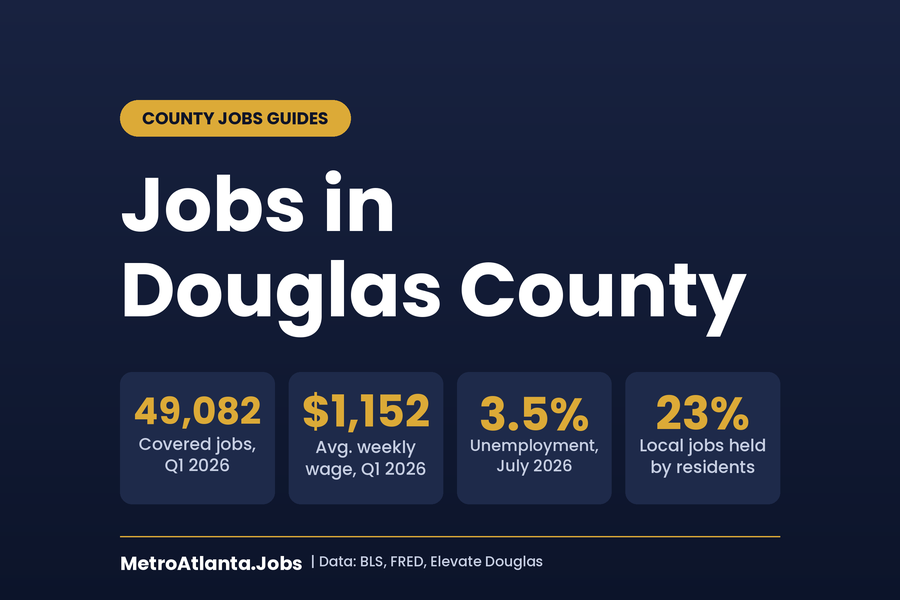
Most jobs in Douglas County GA sit in three places: the data center and distribution corridor along Thornton Road and Riverside Parkway in Lithia Springs, the retail and healthcare cluster around Arbor Place Mall and Hospital Drive in Douglasville, and the public sector. The county counted 49,082 covered jobs in March 2026 at an average weekly wage of $1,152 [1]. If you are looking for jobs in Douglas County GA in 2026, the fastest-moving part of that picture is the data center corridor, where a single announced project carries a planned investment of at least $5 billion [4].
Douglas County is Metro Atlanta's western gateway, the first county west of Fulton on I-20, and it holds a bigger share of the region's data center capacity than its size suggests. It is 201 square miles, borders Cobb, Fulton, Carroll, and Paulding, and has grown from 144,237 residents in 2020 to an estimated 154,293 in 2025.
Douglas County by the Numbers
- Covered employment: 49,082 jobs across 3,449 establishments as of March 2026 [1]
- Average weekly wage: $1,152, roughly $59,900 annualized, against $1,539 statewide and $1,654 nationally [1]
- Unemployment rate: 3.5 percent in July 2026, not seasonally adjusted [2]
- Population: 154,293 in 2025, up about 7 percent from the 2020 census count of 144,237 [3]
- Median household income: $77,821, just under Georgia's $79,991 and the national $81,604 [7]
- Mean travel time to work: 33.2 minutes, about 25 percent longer than the national average of 26.4 minutes [7]
Two of those numbers tell you most of what you need to know before you start applying. The first is the wage gap. Douglas County's average weekly wage of $1,152 sits well below neighboring Cobb at $1,717 and Fulton at $2,355, and below the Georgia average of $1,539 [1]. That is not a sign of a weak economy. It reflects what the county's job base is made of: warehousing, fulfillment, retail, food distribution, and building products, all of which pay less per hour than the finance, corporate headquarters, and professional services concentrations that pull Fulton's average up.
The second is the commute. At a mean travel time to work of 33.2 minutes, the average Douglas County resident spends longer getting to work than the average resident of Georgia or of the country [7]. That figure is the tell. A large share of people who live in Douglas County work somewhere else, and a large share of people who work in Douglas County live somewhere else. Elevate Douglas Economic Partnership reports that only 23 percent of the people who work in Douglas County also live there [6]. If you live in the county and want to work in it, you are competing for those jobs against candidates driving in from Carroll, Paulding, Cobb, and south Fulton.
Where in Douglas County Are the Jobs
Lithia Springs and the Thornton Road corridor
Lithia Springs is unincorporated, having voted to dissolve as a city in 2000, but it is the county's employment center. As of its 2025 annual report, Elevate Douglas counted eight data centers inside the Riverside and Thornton Road industrial corridor, with more coming online in 2026 and others under construction [4]. The same corridor carries the county's fulfillment and distribution footprint. If you are searching for warehouse, forklift, inventory, maintenance technician, or facilities jobs, this is the zip code to filter on first.
The corridor's advantage is geographic. Lithia Springs sits where I-20 meets Thornton Road, roughly fifteen miles from downtown Atlanta with straight-line access to I-285. That puts a truck on the perimeter in under twenty minutes off-peak, which is why national distributors keep choosing it.
Douglasville
Douglasville is the county seat and the largest city, and it is where the service economy concentrates. Arbor Place Mall anchors a retail corridor along Douglas Boulevard and Chapel Hill Road that runs from I-20 south, and the healthcare cluster sits a few minutes away on Hospital Drive. Retail management, customer service, food service, banking, insurance, and clinical support roles cluster here. The county's government offices, courthouse complex, and school system administration are also in and around Douglasville, which makes it the center of public sector hiring.
Winston, Villa Rica, and the west county
West of Douglasville the county thins out. Winston is an unincorporated community along Bankhead Highway, and the eastern portion of Villa Rica sits in Douglas County, with its western portion in Carroll. Job density drops sharply out here. What exists is small business, trades, construction, and healthcare tied to the Villa Rica medical facilities. West county residents typically commute east into Douglasville or Lithia Springs, or west into Carrollton.
The I-20 spine
Almost every employment node in Douglas County hangs off I-20, and county boundaries mean little to a commuter on that corridor. From a Douglasville address the job market realistically extends east into south Cobb County and south Fulton County, and north into Paulding County. If you search only inside the Douglas County line, you are seeing a fraction of what you can reach.
Top Employers in Douglas County
Elevate Douglas publishes a top ten employer list with approximate headcounts. It excludes the Douglas County School System, Douglas County Government, the City of Douglasville Government, and the Wellstar hospital, all of which are large enough to sit near the top on their own [5]. Here is the published private-sector list, with headcounts as posted by Elevate Douglas [5]:
- Cornerstone Building Brands, about 1,000
- Stitch Fix, about 700
- McMaster Carr, about 600
- Home Chef, about 500
- Medline Industries, about 400
- Gordon Food Service, about 400
- Google, about 350
- KeHE, about 350
- Southwire, about 350
- Sam's Club E-commerce, about 250
Those ten add to roughly 4,900 jobs, about one in ten of the county's covered employment [1]. That spread is the point: Douglas County has no single dominant private employer the way some metro counties do. It has a broad middle.
Data centers and technology
Google opened a data center in Lithia Springs in 2003, and the county has been adding capacity ever since [4]. PricewaterhouseCoopers opened a data center on Rock House Road in 2009, Digital Realty opened one on Aquila Way in 2012, and in 2017 Switch announced a $2.5 billion development called The Keep in Lithia Springs [4]. Amazon Web Services has since announced data center campuses in the county representing a planned investment of at least $5 billion and more than 250 new full-time jobs in data center operations, engineering, and security, described by Elevate Douglas as the largest capital investment in the county's history [4].
Microsoft is building here too. The company confirms it is developing datacenters in Douglasville alongside sites in Palmetto and East Point [12]. Microsoft reports that its Georgia datacenter work has generated roughly 900 construction jobs a year and $600 million in labor income since 2019, and projects about 1,000 local jobs in 2026 rising to 2,000 in 2027 [13]. Read those figures carefully: they cover South Fulton and Douglas counties together, not Douglas alone [13].
The nuance for job seekers is scale versus headcount. Data centers are capital-intensive, not labor-intensive. Elevate Douglas projects total job uplift from the corridor's data centers exceeding 700 jobs, plus support for more than 4,200 independent contractors [4]. Those contractor roles, in electrical work, fiber, mechanical systems, security, and construction, are where the near-term hiring volume sits. Our Atlanta tech jobs guide covers what employers across the metro ask for in technical roles.
Distribution, fulfillment, and food logistics
Four of the county's ten largest private employers are distribution operations: Home Chef in meal-kit fulfillment, Gordon Food Service and KeHE in food distribution, and Sam's Club E-commerce [5]. Stitch Fix runs apparel fulfillment in Lithia Springs, and McMaster Carr distributes industrial supply [5]. Medline Industries adds medical supply distribution [5].
This is the county's volume hiring category. Openings run continuously in picking, packing, receiving, inventory control, forklift operation, sanitation, quality control, and shift supervision, and most operations run multiple shifts. Our Atlanta logistics jobs guide covers what these employers screen for and how the shift structures differ.
Healthcare
Wellstar Douglas Medical Center on Hospital Drive in Douglasville is the county's hospital anchor. It is a non-profit 108-bed community hospital, founded in 1974, offering interventional cardiology, maternity care with a level II neonatal intensive care unit, hyperbaric wound care, rehabilitation therapy, robotic surgery, and a dedicated pediatric emergency department [10]. In 2025 it became the first business in Douglas County to receive the Georgia Oglethorpe Award for performance excellence [10].
Around the hospital sits the usual cluster of physician practices, imaging, outpatient rehabilitation, urgent care, home health, and long-term care. Tanner Health System also serves county residents from Villa Rica. Nursing, medical assistant, phlebotomy, radiologic technology, patient access, and revenue cycle roles turn over steadily. Our Atlanta healthcare jobs guide covers systems, specialties, and what pay looks like across the metro.
Public sector and education
The Douglas County School System serves about 25,800 students across 36 schools and programs and employs more than 3,300 people, which makes it the county's largest employer [11]. That is why Elevate Douglas lists it separately from the private top ten [5]. Roughly 70 percent of its employees live in Douglas County [11], a far higher share than the countywide figure, so it is one of the few large employers here that genuinely hires local. Beyond classroom teaching, school systems this size hire paraprofessionals, bus drivers, nutrition staff, custodial and maintenance workers, IT support, and administrative staff, and those roles carry benefits and a schedule that a warehouse shift does not.
Douglas County Government and the City of Douglasville add public safety, public works, transit operations, parks, courts, and administrative hiring [5]. Douglas County also hosts a West Georgia Technical College campus and a Mercer University regional academic center in Lithia Springs.
Manufacturing and building products
Cornerstone Building Brands, the county's largest private employer, produces building products; its Silver Line window and door operation is the local presence long associated with the county [5]. Southwire, which makes wire and cable, is also on the top ten list [5]. Elevate Douglas found that advanced manufacturing employment in the county grew 7 percent between 2017 and 2022, outpacing the 3 percent growth in the surrounding thirteen-county labor shed [6].
Fastest-Growing Job Categories in Douglas County
The clearest growth signal in Douglas County is technical trades attached to data center construction and operation. Elevate Douglas has built workforce programming specifically around it: a Career Ready Training Program run with West Georgia Technical College and the school system, and a construction pathway launched with Construction Ready, Goodwill of North Georgia, and the West Georgia Chapter of The Links, with a stated goal of training 200 new trades professionals by the end of 2027 [4]. The program added AWS fiber optic fusion splicing certification to its curriculum in 2025 [4]. That pipeline widened again in 2026. On May 20, Microsoft opened Datacenter Academy training facilities at West Georgia Technical College, which has a Douglas County campus, and at Atlanta Technical College [14]. The curriculum covers datacenter operations, networking, cybersecurity, IT infrastructure, cloud technologies, and energy and systems management, and a scholarship program covers tuition, books, and fees [14].
The second signal is healthcare and life sciences. Elevate Douglas found life sciences and healthcare employment grew 188 percent in the county between 2017 and 2022, and that the county's concentration of life sciences jobs runs at a location quotient of 3.98, nearly four times the national average [6]. Location quotients that high off a small base can move sharply, so treat the percentage as direction rather than a forecast. The underlying point holds: this is a sector the county's economic development strategy is actively targeting.
Third, distribution and fulfillment continue to expand with the corridor. This category is the most accessible to entry-level candidates and the least stable in individual employer terms, since fulfillment operations scale up and down with consumer demand.
Fourth, film and production work. Elevate Douglas names media and entertainment as one of its four target sectors, alongside advanced manufacturing, life sciences and healthcare, and technology and professional services [6]. Production work here is project-based rather than salaried.
One category worth naming for what it is not: the data center announcements do not translate into hundreds of permanent software jobs. The permanent roles are facilities, operations, and security. The construction and contractor volume is where the numbers are, at least through the build-out.
What Jobs Pay in Douglas County
Detailed occupational wage data for the Atlanta metro is not publicly retrievable at the level this guide would need, so the figures below are national medians from the Bureau of Labor Statistics Occupational Employment and Wage Statistics survey for May 2025 [8]. Use them as a reference point, not a local quote. Douglas County's overall average weekly wage of $1,152 runs about 30 percent below the national average of $1,654, so local offers for many of these roles will land below the national median [1].
National annual mean wages, May 2025 [8]:
- Registered nurses: $101,420
- Network and computer systems administrators: $103,680
- Electricians: $71,490
- Elementary school teachers, except special education: $72,650
- Licensed practical and licensed vocational nurses: $67,050
- First-line supervisors of retail sales workers: $53,380
- Bookkeeping, accounting, and auditing clerks: $53,560
- Construction laborers: $52,030
- Shipping, receiving, and inventory clerks: $46,810
- Customer service representatives: $46,590
- Medical assistants: $46,120
- Nursing assistants: $42,700
- Security guards: $42,470
For an entry-level anchor grounded in the county itself, Elevate Douglas reported average starting wages of $18.25 an hour for its summer 2025 Career Ready cohort and $18.51 for the fall 2025 cohort [4]. One participant who completed the fiber optic splicing certificate was hired as a fiber technician at $31 an hour [4]. That gap between $18 and $31 is the practical argument for a certificate in this county.
Two things to keep in mind when you evaluate an offer here. First, employer-entered salary ranges do not always appear on job postings, and syndicated feed listings frequently arrive with no pay information at all, so an absent number is not a signal about the job. Second, negotiating matters more when the local average sits below the state and national averages, because the spread between a first offer and a fair offer is proportionally wider. Our salary negotiation guide for Atlanta walks through how to handle that conversation, and the Atlanta salary guide and entry-level salary guide give you the regional comparison points.
Working in Douglas County: What to Know
Commute and transit
The average Douglas County commute is 33.2 minutes, longer than the Georgia average of 28.3 and the national average of 26.4 [7]. I-20 is the whole story. Eastbound mornings into Atlanta and westbound evenings out are the pressure points, and an accident on I-20 inside I-285 backs up traffic well past Thornton Road.
There is a transit alternative for downtown and Midtown workers. Xpress Route 463 runs weekdays from the West Douglas Park-and-Ride on Douglas Boulevard and the Douglas County Multi-Modal Transportation Center on Dorris Drive to Downtown and Midtown Atlanta [9]. There are three morning departures and three afternoon returns. The first bus leaves West Douglas at 5:20 AM and reaches Spring Street in Midtown at 6:21 AM, about an hour. The 7:20 AM departure arrives at 8:46 AM, closer to an hour and a half. Route 463 is a Green Zone route: $3 one way, $5 round trip, $25 for ten trips, and $100 for a 31-day pass [9].
Inside the county, Connect Douglas operates fixed-route bus service and ADA paratransit through the Douglas County Department of Transportation. Coverage is real but limited, so confirm your specific worksite is on a route before you count on it for a job that starts at 6:00 AM.
Hybrid and remote norms
Douglas County's employment base is heavily weighted toward roles that cannot be done from home. Warehouse, fulfillment, manufacturing, data center operations, healthcare delivery, retail, school system, and public safety work is all onsite by definition. Remote and hybrid arrangements in this county are found mostly among residents who work for employers headquartered elsewhere in the metro, which is part of why the mean commute figure and the 23 percent live-and-work figure both point the way they do [6] [7].
If remote work is a requirement rather than a preference, search by employer rather than by geography, and expect the competitive set to be metro-wide or national.
Cost of living context
The trade-off Douglas County offers is housing. The median value of owner-occupied housing in the county is $331,700, below the Georgia median of $343,300 and the national median of $360,600 [7]. Median household income is $77,821, close to but slightly under the state figure [7]. In practical terms, a household earning near the county median has more housing options in Douglasville than the same income would buy in north Fulton or east Cobb, and the price of that is the commute.
Educational attainment matters here too. About 29.3 percent of county residents hold a bachelor's degree or higher, against 36.3 percent statewide [7]. That explains why the county's workforce programming leans toward certificates and trades rather than degree pipelines. For the wider regional picture, see our Atlanta metro population and jobs guide.
Frequently asked questions
What is the biggest employer in Douglas County, GA?
The Douglas County School System, with more than 3,300 employees across 36 schools and programs [11]. Among private employers, Elevate Douglas lists Cornerstone Building Brands at the top with about 1,000 employees, followed by Stitch Fix at about 700 and McMaster Carr at about 600 [5].
How many jobs are there in Douglas County, GA?
Douglas County had 49,082 covered jobs across 3,449 establishments as of March 2026, according to the Bureau of Labor Statistics Quarterly Census of Employment and Wages [1]. Covered employment counts workers covered by unemployment insurance, so it excludes most self-employed people and independent contractors.
What is the unemployment rate in Douglas County, GA?
The Douglas County unemployment rate was 3.5 percent in July 2026, not seasonally adjusted [2]. It has moved in a narrow band through 2026, from 3.1 percent in April to 3.8 percent in June [2].
What is the average salary in Douglas County, GA?
The average weekly wage in Douglas County was $1,152 in the first quarter of 2026, which annualizes to roughly $59,900 [1]. That sits below the Georgia average of $1,539 and the national average of $1,654 [1]. The gap reflects the county's industry mix, which is weighted toward distribution, retail, and building products rather than finance and professional services.
Are the data centers in Douglas County actually hiring?
Yes, but the shape of the hiring surprises people. Amazon Web Services announced more than 250 new full-time jobs alongside a planned investment of at least $5 billion, and Elevate Douglas projects total job uplift across the corridor's data centers exceeding 700 jobs plus support for more than 4,200 independent contractors [4]. The permanent positions are concentrated in operations, engineering, and security. The larger volume is contractor and construction work in electrical, fiber, and mechanical trades.
What certifications help most for Douglas County jobs?
For the data center corridor, electrical and fiber credentials carry the most weight. Elevate Douglas added a two-day AWS fiber optic fusion splicing certificate to its free Career Ready Training Program in 2025 [4]. For distribution work, a forklift certification and a clean record are usually enough to start. For healthcare support roles, certified nursing assistant and phlebotomy certificates are the standard entry points. West Georgia Technical College has a campus in the county and opened a Microsoft Datacenter Academy training facility in May 2026, with scholarships covering tuition, books, and fees [14].
Can I commute from Douglas County to downtown Atlanta without a car?
Yes, on weekdays. Xpress Route 463 runs three morning trips and three afternoon trips between the West Douglas and Douglas MMTC park-and-rides and Downtown and Midtown Atlanta [9]. Trip times run roughly one hour to an hour and a half depending on departure. A 31-day Green Zone pass costs $100 [9]. There is no weekend or late-evening service, so shift work outside standard business hours will still need a car.
Is Douglas County a good place to look for entry-level work?
It is a reasonable market for entry-level work, particularly in fulfillment, food distribution, retail, and healthcare support. The county's Career Ready cohorts reported average starting wages of $18.25 and $18.51 an hour in 2025 [4]. Understand that you are competing with candidates from four adjacent counties, since only 23 percent of the people who work in Douglas County also live there [6]. A clean, targeted application matters here. Our Atlanta resume tips guide covers the basics.
Which counties border Douglas County, GA?
Douglas County borders four counties: Cobb to the northeast, Fulton to the southeast, Carroll to the west, and Paulding to the northwest. The Chattahoochee River forms the eastern and southeastern boundary. For a commuter on I-20, the practical job market spans Douglas, south Cobb, south Fulton, and Paulding.
Is construction hiring in Douglas County?
Yes. The data center build-out is the primary driver, and Elevate Douglas is partnering with Construction Ready to train 200 new trades professionals by the end of 2027 to meet that demand [4]. Residential and commercial construction also tracks the county's population growth, which added roughly 10,000 residents between 2020 and 2025 [3]. Our Atlanta construction jobs guide covers trades demand across the metro.
Get started
- Create a free job seeker account at MetroAtlanta.Jobs registration
- Browse current openings on the metro atlanta job board
- Sharpen your application with our Atlanta resume tips guide
- Prepare for the offer conversation with our salary negotiation guide
- Understand the county's biggest hiring category in our Atlanta logistics jobs guide
- Hiring in Douglas County? Post your opening through employer registration
Sources
1. U.S. Bureau of Labor Statistics, County Employment and Wages in Georgia, First Quarter 2026.
2. U.S. Bureau of Labor Statistics via FRED, Unemployment Rate in Douglas County, GA.
3. U.S. Census Bureau via FRED, Resident Population in Douglas County, GA.
4. Elevate Douglas Economic Partnership, 2025 Annual Report.
5. Elevate Douglas Economic Partnership, In Good Company.
6. Elevate Douglas Economic Partnership, Why We Don't Recruit Every Business.
7. Census Reporter, Douglas County, GA profile, American Community Survey.
8. U.S. Bureau of Labor Statistics, Occupational Employment and Wage Statistics, Table 1, May 2025.
9. Xpress, Route 463 West Douglas / Douglas MMTC to Downtown / Midtown.
10. Wellstar Douglas Medical Center.
11. Douglas County Chamber of Commerce, Douglas County School System member profile.
13. Microsoft, Datacenter Economic Impact in Georgia, November 2025.
14. Microsoft Local, Expanding Workforce Pathways Through Microsoft Datacenter Academy in Georgia.