14 min read
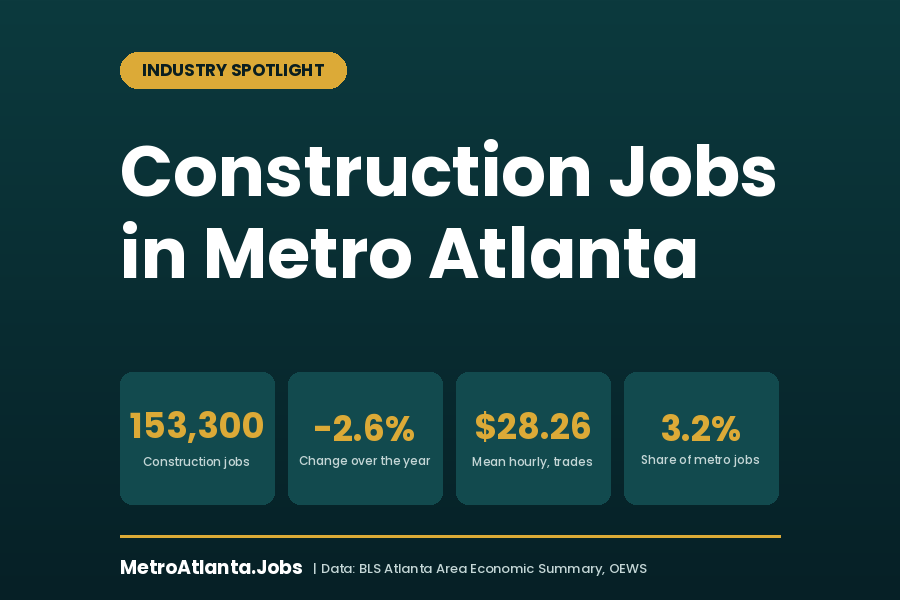
If you are looking at construction jobs in Atlanta right now, here is the honest picture: the metro is holding about 153,300 construction jobs, and that number is down 2.6 percent from a year ago [1]. That sounds like bad news, and for some workers it is. But a shrinking headline number does not mean hiring has stopped. It means demand has moved. The construction jobs in Atlanta that are hardest to fill in 2026 sit in specific trades, on specific project types, in specific counties. This guide shows you where.
The short answer
Metro Atlanta construction employment stood at 153,300 in June 2026, down 4,100 jobs from June 2025 [1]. Over that same stretch, total nonfarm employment across the metro rose by 12,700 to 3,127,800, a gain of 0.4 percent [1]. So construction lost ground while the metro as a whole added jobs.
Pay is the second thing to know. Construction and extraction occupations in the Atlanta metro earned a mean hourly wage of $28.26 in May 2025, against $31.42 nationally [2]. That is roughly 10 percent below the national average, and it is the third widest negative gap of any occupational group in this metro [2].
Here is the part that surprises people. Across all occupations, Atlanta pays slightly above the national average, $34.57 per hour locally against $33.54 nationally [2]. So this metro pays above average overall and below average in the trades specifically. If you are weighing a career move into construction, that gap is the single most important number in this article.
Two different measures get confused constantly. Construction employment of 153,300 counts jobs in the construction industry, including the estimators, schedulers, and office staff at a general contractor. The 3.2 percent figure counts construction and extraction occupations wherever they work, including electricians employed by a hospital or a county government [1][2]. They are not the same population, and neither one is wrong.
Metro Atlanta construction employment in 2026
The 153,300 figure covers the Atlanta metropolitan statistical area and comes from the Bureau of Labor Statistics area summary, most recently updated in August 2026. You can read the underlying release in the BLS Atlanta Area Economic Summary [1].
To put the decline in context, construction was one of the weaker sectors in the metro over the year while education and health services added 21,300 jobs [1]. Metro Atlanta unemployment sat at 3.5 percent in June 2026, well under the national rate of 4.4 percent [1]. This is not a weak labor market. It is a labor market where construction specifically cooled.
A single year of construction data can mislead. Residential permitting responds to interest rates within months, while commercial and industrial projects are committed years ahead and keep hiring through a downturn. A metro losing homebuilding jobs and gaining data center jobs at the same time posts a negative headline number while individual trades run short of workers. That is metro Atlanta in 2026.
What the decline probably reflects
Residential construction is the most rate sensitive part of the industry, and it is also the largest employer of framing carpenters, roofers, and general laborers in this metro. When single family and multifamily starts slow, those are the first crews to shrink. Specialty trades tied to large committed projects, particularly electrical and mechanical work, do not follow the same curve.
So the sector you target inside construction matters more in 2026 than it did in a boom year. Residential builders and industrial electrical contractors are two different job searches.
What construction pays in metro Atlanta
The most reliable local pay figure is the occupational group average. Construction and extraction occupations in the Atlanta area averaged $28.26 per hour in May 2025 [2]. At full time hours that is roughly $58,800 a year, though overtime is common in the trades and many workers land above it.
Nationally the group covers 6.4 million workers at an annual mean of $65,360 [5]. It is 3.2 percent of Atlanta employment against 4.1 percent nationally [2], so this metro is less construction heavy than the country as a whole.
Atlanta versus the nation, group by group
BLS publishes mean hourly wages for all 22 major occupational groups in both the metro and the country, May 2025 [2].
- Total, all occupations: $34.57 (Atlanta) vs $33.54 (national)
- Management: $71.58 (Atlanta) vs $69.84 (national)
- Business and financial operations: $45.37 (Atlanta) vs $45.78 (national)
- Computer and mathematical: $56.39 (Atlanta) vs $57.73 (national)
- Architecture and engineering: $49.71 (Atlanta) vs $51.36 (national)
- Life, physical, and social science: $44.12 (Atlanta) vs $45.48 (national)
- Community and social service: $31.89 (Atlanta) vs $30.49 (national)
- Legal: $73.68 (Atlanta) vs $67.07 (national)
- Educational instruction and library: $31.50 (Atlanta) vs $32.47 (national)
- Arts, design, entertainment, sports, and media: $38.56 (Atlanta) vs $38.36 (national)
- Healthcare practitioners and technical: $55.97 (Atlanta) vs $52.26 (national)
- Healthcare support: $19.33 (Atlanta) vs $19.62 (national)
- Protective service: $25.76 (Atlanta) vs $29.19 (national)
- Food preparation and serving related: $15.37 (Atlanta) vs $17.86 (national)
- Building and grounds cleaning and maintenance: $18.77 (Atlanta) vs $19.66 (national)
- Personal care and service: $18.17 (Atlanta) vs $19.74 (national)
- Sales and related: $27.12 (Atlanta) vs $26.43 (national)
- Office and administrative support: $24.25 (Atlanta) vs $24.79 (national)
- Farming, fishing, and forestry: $21.00 (Atlanta) vs $19.96 (national)
- Construction and extraction: $28.26 (Atlanta) vs $31.42 (national)
- Installation, maintenance, and repair: $30.44 (Atlanta) vs $30.44 (national)
- Production: $23.15 (Atlanta) vs $24.81 (national)
- Transportation and material moving: $28.64 (Atlanta) vs $23.96 (national)
Three things stand out. Construction and extraction carries the third widest negative gap of any group here, behind only food preparation and protective service. Transportation and material moving pays nearly 20 percent above its national figure, the clearest statement of what this economy rewards. And installation, maintenance, and repair is the one group where Atlanta lands exactly on the national number at $30.44 [2].
That last line matters. Atlanta does not underpay skilled hands-on work across the board. It underpays construction trades specifically while paying maintenance and repair at the national rate. Weighing a construction apprenticeship against a maintenance track, this metro tilts toward maintenance on pay alone.
How to read the trade figures below
BLS publishes detailed occupation wages for the Atlanta metro only for one featured occupational group each year, and for May 2025 that group was transportation and material moving, not construction [2]. So the trade by trade figures below are national. Take the national number for your trade and subtract roughly 10 percent, the gap between Atlanta and national pay for construction occupations [2]. That gives you a defensible expectation to bring to a pay conversation rather than a number someone invented.
Trade by trade national pay
These are national annual mean wages from the Bureau of Labor Statistics for May 2025, the most recent occupational wage data published [6]. Mean is an average, so a handful of high earners pull each figure above what a typical worker takes home. Across the whole group the median hourly wage is $28.63 [6].
- Elevator and escalator installers and repairers: $109,820
- First line supervisors of construction trades: $86,450
- Terrazzo workers and finishers: $84,920
- Pile driver operators: $80,710
- Boilermakers: $80,090
- Construction and building inspectors: $77,730
- Tapers: $72,710
- Plumbers, pipefitters, and steamfitters: $72,170
- Electricians: $71,490
- Structural iron and steel workers: $70,280
- Rail track laying and maintenance equipment operators: $68,740
- Brickmasons and blockmasons: $68,280
- Sheet metal workers: $67,850
- Operating engineers and other construction equipment operators: $66,290
- Reinforcing iron and rebar workers: $66,060
- Carpenters: $65,630
- Insulation workers, mechanical: $65,530
- Drywall and ceiling tile installers: $63,600
- Plasterers and stucco masons: $62,050
- Floor layers, except carpet, wood, and hard tiles: $61,760
- Stonemasons: $60,710
- Cement masons and concrete finishers: $60,050
- Glaziers: $59,720
- Tile and stone setters: $59,250
- Paving, surfacing, and tamping equipment operators: $59,000
- Roofers: $58,140
- Solar photovoltaic installers: $57,900
- Carpet installers: $56,990
- Hazardous materials removal workers: $56,430
- Painters, construction and maintenance: $55,420
- Insulation workers, floor, ceiling, and wall: $54,740
- Pipelayers: $54,700
- Paperhangers: $53,730
- Septic tank servicers and sewer pipe cleaners: $53,500
- Highway maintenance workers: $53,080
- Floor sanders and finishers: $52,460
- Construction laborers: $52,030
- Helpers, brickmasons, blockmasons, stonemasons, and tile and marble setters: $50,920
- Fence erectors: $50,530
- Helpers, roofers: $45,150
- Helpers, electricians: $44,080
- Helpers, carpenters: $44,050
- Helpers, pipelayers, plumbers, pipefitters, and steamfitters: $43,730
- Helpers, painters, paperhangers, plasterers, and stucco masons: $42,440
You can pull any of these directly from BLS Table 1 of the May 2025 wage release [6].
What the adjacent roles pay
Same survey, same month, for the roles construction firms hire outside the trades [6]. Two of these BLS did publish at the Atlanta level, because they fall in this year featured group: crane and tower operators earn $31.62 an hour locally, or $65,770 a year, and heavy and tractor trailer truck drivers earn $28.56 an hour across 41,830 metro jobs [2].
- Construction managers: $124,360
- Civil engineers: $108,670
- Occupational health and safety specialists: $93,860
- Cost estimators: $85,390
- Surveyors: $80,570
- Architectural and civil drafters: $70,740
- Surveying and mapping technicians: $58,000
Where HVAC fits
HVAC technicians are one of the most searched trades here and do not appear above. That is a classification quirk, not an oversight: BLS files heating, air conditioning, and refrigeration mechanics under installation, maintenance, and repair rather than construction and extraction. HVAC work is construction work in practice, but it sits outside the group totals quoted throughout this article. That group is also the one place Atlanta matches the nation exactly, at $30.44 an hour [2], so an HVAC technician here is not taking the roughly 10 percent local discount that the construction trades absorb.
The biggest trades by headcount
Nationally, the largest construction and extraction occupations are construction laborers at 1.1 million, first line supervisors of construction trades at 812,210, electricians at 757,220, and carpenters at 670,090 [3]. Those four together account for a little over half of the 6.4 million person group [3][5], which tells you how concentrated the field is. If you are entering the industry without experience, you are most likely entering through the laborer door, and that is a normal path rather than a dead end.
The industries employing the most construction workers are building equipment contractors at 1.3 million, foundation, structure, and building exterior contractors at 709,410, and building finishing contractors at 583,790 [3]. Building equipment contractors holds most electrical, plumbing, and mechanical firms, making it the largest employer of trades in the country. Applying directly to specialty subcontractors rather than general contractors is usually the faster route in.
Every construction job title, grouped
The Bureau of Labor Statistics files construction and extraction as a single occupational family [5]. Metro Atlanta has essentially no mining or oil and gas work, so those extraction titles are left out below. Everything else in the family is here, along with the adjacent roles construction firms in this metro hire for that BLS classifies elsewhere.
Electrical, mechanical, and piping
- Electricians
- Plumbers, pipefitters, and steamfitters
- Pipelayers
- Sheet metal workers
- Boilermakers
- Solar photovoltaic installers
Structural, masonry, and exterior
- Carpenters
- Structural iron and steel workers
- Reinforcing iron and rebar workers
- Brickmasons and blockmasons
- Stonemasons
- Cement masons and concrete finishers
- Terrazzo workers and finishers
- Glaziers
- Roofers
Site work and heavy equipment
- Construction laborers
- Operating engineers and other construction equipment operators
- Paving, surfacing, and tamping equipment operators
- Pile driver operators
- Highway maintenance workers
- Fence erectors
- Rail track laying and maintenance equipment operators
- Septic tank servicers and sewer pipe cleaners
- Hazardous materials removal workers
Interior and finishing
- Drywall and ceiling tile installers
- Tapers
- Plasterers and stucco masons
- Painters, construction and maintenance
- Paperhangers
- Insulation workers, floor, ceiling, and wall
- Insulation workers, mechanical
- Carpet installers
- Floor layers, except carpet, wood, and hard tiles
- Floor sanders and finishers
- Tile and stone setters
Helper and entry titles
- Helpers, carpenters
- Helpers, electricians
- Helpers, pipelayers, plumbers, pipefitters, and steamfitters
- Helpers, brickmasons, blockmasons, stonemasons, and tile and marble setters
- Helpers, painters, paperhangers, plasterers, and stucco masons
- Helpers, roofers
- Helpers, construction trades, all other
Supervision, inspection, and specialty
- First line supervisors of construction trades and extraction workers
- Construction and building inspectors
- Elevator and escalator installers and repairers
Adjacent roles construction firms hire
These sit outside the construction and extraction family in the BLS classification, but the work is construction work and the employers are construction employers.
- Heating, air conditioning, and refrigeration mechanics and installers
- Construction managers
- Cost estimators
- Civil engineers
- Surveyors and surveying technicians
- Architectural and civil drafters
- Welders, cutters, and solderers
- Heavy and tractor trailer truck drivers
- Occupational health and safety specialists
If you are searching our board, try the specific title rather than the word construction. A posting for a pipefitter or a cement mason will rarely use construction in the job title, and searching the broad term buries the trade roles under project manager and office listings.
Which metro Atlanta counties are hiring
Construction work does not distribute evenly across 29 counties. It follows land, permits, and capital. A few patterns hold in 2026.
Fulton and DeKalb carry the dense commercial and institutional work, meaning hospitals, universities, airport projects, and high rise interiors. That favors electricians, elevator mechanics, sheet metal workers, and glaziers. Start with our Fulton County jobs guide.
Gwinnett is where the largest single development story in the metro sits, and it has an unusual mix of industrial, institutional, and residential work underway. See the Gwinnett County jobs guide.
Forsyth and Cherokee are the northern growth counties, still adding rooftops, schools, and retail. Forsyth in particular has a major mixed use project in motion; The Gathering at South Forsyth. Both are strong territory for residential trades and site work. See the Forsyth County jobs guide and the Cherokee County jobs guide.
Henry and Paulding sit on the industrial and warehouse corridor, which means tilt wall construction, site work, and heavy equipment. That work also feeds directly into the logistics economy once the buildings open. See the Henry County jobs guide, the Paulding County jobs guide, and our Atlanta logistics jobs guide.
Cobb spans both worlds, with corporate and institutional work in the south of the county and residential growth in the north. See the Cobb County jobs guide.
Commute math matters more in construction than almost anywhere else, because you report to a site rather than an office and the site moves. A contractor based in Marietta may have you in Hall County for eight months. Ask where the work is, not where the office is.
The demand drivers behind 2026 hiring
Three forces are shaping which construction jobs in Atlanta actually get filled this year.
Data centers and power infrastructure
Data center construction is the most electrically intensive building type in common use, and Georgia has attracted a significant share of it. These projects consume electricians, low voltage technicians, and pipefitters at a rate that ordinary commercial construction does not, and they run on schedules that do not flex. This is the clearest reason a metro can shed construction jobs overall while electrical contractors still cannot staff their crews.
The megaprojects
Two developments in this metro are large enough to shape local labor markets on their own. The Rowen project in Gwinnett County is a long horizon research and innovation district, and The Gathering at South Forsyth is a major mixed use development. Both generate years of sequenced trade work rather than a single hiring spike. We track both: see our coverage of Rowen project jobs in Gwinnett County and The Gathering at South Forsyth jobs.
Warehouse and industrial buildout
The distribution corridors south and west of the city keep generating site work, concrete, steel, and roofing demand. Less glamorous than a tower, but steady, close to the interstates, and hiring in volume.
How to break into construction in metro Atlanta
There is no single door. There are four, and they suit different people.
Start as a laborer or helper
The most common entry point, with no formal credential required for many positions. The national annual mean for construction laborers is $52,030 [6], and Atlanta will typically run under that. What you are buying with a year at this level is site literacy and a foreman who will vouch for you. For a broader view of starting pay across the metro, see our entry level salaries guide.
Enter a registered apprenticeship
Apprenticeships pay you while you train and lead to journeyman status. Electrical and plumbing apprenticeships are the most common in this metro and both trades sit near the top of the pay table above. Expect four to five years. Georgia technical colleges and trade associations run the classroom side.
Pivot from an adjacent field
Warehouse workers, drivers, maintenance technicians, and military veterans with technical training all transfer well. If you are considering a move like this, our career change guide walks through how to position experience you already have.
Come in through the office
Construction firms hire estimators, project coordinators, safety managers, and schedulers, which are often easier to enter with a degree and no field experience. They sit inside the construction industry employment count, part of why 153,300 exceeds the trade headcount alone.
Getting hired in construction: what actually works
Construction hiring is faster and less formal than corporate hiring, and applications are often reviewed the same week. A few things matter more than a polished resume, though a clear one helps: see our Atlanta resume tips.
Lead with certifications. OSHA 10 or OSHA 30, a clean driving record, a forklift or aerial lift card, and any manufacturer specific training belong at the top of the page, not buried under work history.
Be specific about what you have built. "Framed 40 units" tells a foreman more than "residential construction experience."
Name your availability and your radius. Contractors screen hard on reliability and on whether you can reach the site.
Negotiate the rate. Trade pay is more negotiable than most job seekers assume, particularly when a contractor is short handed on a deadline. Our salary negotiation guide covers the approach, and the Atlanta salary guide gives you broader metro context.
Frequently asked questions
How many construction jobs are there in metro Atlanta?
Metro Atlanta held about 153,300 construction jobs as of June 2026, down 4,100 from a year earlier [1].
Is construction a good career in Atlanta in 2026?
It depends heavily on the trade. Overall construction employment is declining in this metro [1], but electrical, mechanical, and data center related work remains in demand. Trades with licensing requirements and long apprenticeships hold value best.
What does construction pay in Atlanta?
Construction and extraction occupations in the Atlanta area averaged $28.26 per hour as of May 2025, against $31.42 nationally [2]. Individual trades vary widely around that average.
Why does Atlanta pay less than the national average for the trades?
The metro pays slightly above the national average across all occupations, at $34.57 per hour versus $33.54 [2], so it is not a low wage market generally. Trade pay specifically reflects lower union density and a lower cost base across the Southeast.
Which trade pays the most?
Among construction and extraction occupations nationally, elevator and escalator installers and repairers lead at an annual mean of $109,820, followed by first line supervisors at $86,450 and terrazzo workers and finishers at $84,920 [6].
Do I need experience to get a construction job?
Not for entry level laborer and helper roles, which typically require no formal educational credential [4]. Most workers enter through this route and specialize afterward.
Which counties have the most construction work?
Fulton and DeKalb lead on commercial and institutional projects, Gwinnett and Forsyth carry the largest single developments, and Henry and Paulding concentrate industrial and warehouse work.
How long does an apprenticeship take?
Most registered construction apprenticeships in Georgia run four to five years, combining paid on the job hours with classroom instruction.
Are data centers really hiring that many construction workers?
Data centers are unusually electrical and mechanical trade intensive compared with other commercial buildings, which concentrates demand into electricians, low voltage technicians, and pipefitters rather than spreading it across all trades.
Is HVAC counted as a construction job?
Not in these statistics. The Bureau of Labor Statistics classifies HVAC mechanics and installers under installation, maintenance, and repair occupations, so they fall outside the construction and extraction totals cited here.
Get started with construction jobs in Atlanta and Metro Atlanta
- Browse current openings on our Atlanta job board
- Create a free job seeker account to save searches and get alerts
- Sign up for daily job alerts and get new jobs delivered to your email address
- Hiring construction crews? Post a job that will be shown to local candidates
- Compare job posting plans on our pricing page
- Thinking about a trades pivot? Read the career change guide
- Get metro wide context in the Atlanta job market hiring trends report
Sources
1. U.S. Bureau of Labor Statistics, Atlanta Area Economic Summary, updated August 2026
3. U.S. Bureau of Labor Statistics, Occupational Employment and Wages News Release, May 2025
5. U.S. Bureau of Labor Statistics, Occupational Employment and Wage Statistics program overview
6. U.S. Bureau of Labor Statistics, Table 1, national employment and wage data by occupation, May 2025