9 min read
If you graduated this year and the job hunt feels brutal, a new headline probably landed in your feed: Atlanta was ranked the best city for new grads in 2026. A study from the workspace data firm CoworkingCafe put Atlanta at number one among large U.S. cities for recent graduates starting their careers, and local news ran with it. The ranking is real, and Atlanta's numbers are genuinely strong. It is also true that landing an entry-level job anywhere in 2026 is harder than the cheerful headline suggests. Both things can be true at once, so this post breaks down what the study actually found, what it leaves out, and how to turn a number-one ranking into an actual job offer in Atlanta.
What the study actually found
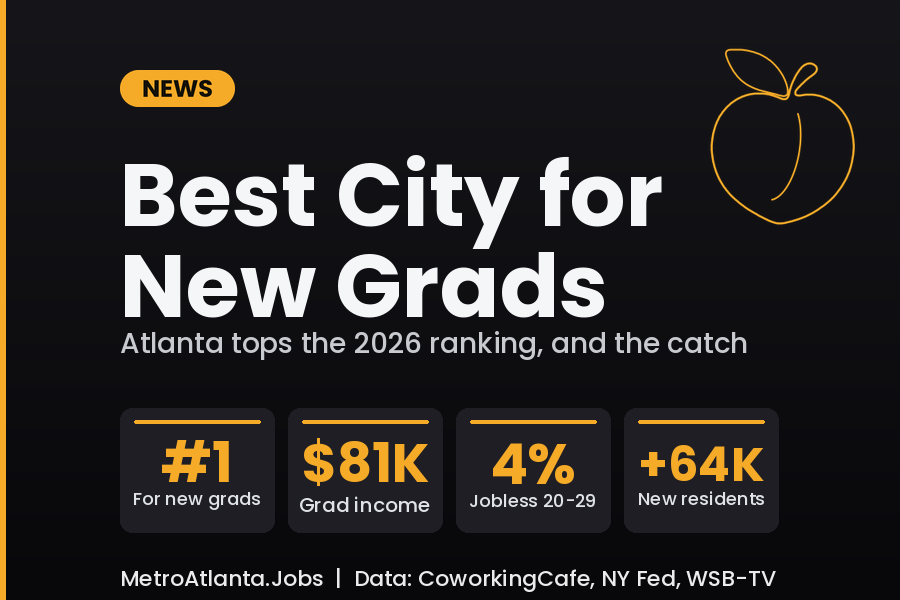
The ranking that named Atlanta the best city for new grads comes from CoworkingCafe, which scored U.S. cities on how friendly they are to recent college graduates and reported the results in June 2026 [2]. As reported by Channel 2 Action News, the study found that Atlanta had not only held its lead as the best large city to start a career, but had extended it, citing broad-based gains in employment, benefits, and affordability [1].
Here is how Atlanta scored on the factors the study weighed [1]:
Share of the population holding bachelor's degrees: 53 percent. Share of jobs considered suitable for recent graduates: 7 percent. Unemployment rate for workers ages 20 to 29: 4 percent. Median income for graduates: 81,155 dollars. Share of workers with employer-based health insurance: 68 percent. Coworking spaces per 100,000 residents: 24. Leisure establishments per 100,000 residents: 731.
The study also noted that metro Atlanta added roughly 64,000 new residents between 2024 and 2025, supported by a diversified economy spanning logistics, health care, fintech, and film production, with information technology roles projected to grow by more than a third by 2034 [1].
How Atlanta stacked up against other cities
Atlanta topped the large-city bracket, defined as cities with populations of 400,000 or more, and was one of three Southeastern metros to crack the national top 10 [1]. Here is the full top 10 list of large cities for new grads in 2026 [1]:
1. Atlanta, Georgia. 2. San Francisco, California. 3. Seattle, Washington. 4. Washington, D.C. 5. Minneapolis, Minnesota. 6. Austin, Texas. 7. Denver, Colorado. 8. Boston, Massachusetts. 9. Tampa, Florida. 10. Kansas City, Missouri.
Beating San Francisco, Seattle, and Boston, cities with far higher salaries and denser job markets, says something specific about Atlanta. The win is not built on the biggest paychecks. It is built on the balance between paychecks, cost of living, and access to early-career roles. That combination is exactly what matters most when you are starting out and your salary is still climbing.
The short version: Atlanta ranks first because it balances reasonable pay, near-average cost of living, a diversified set of growing industries, and a relatively low jobless rate for young workers. It does not rank first because entry-level hiring is easy right now. Nowhere can claim that in 2026.
The part the headline leaves out
Here is where lived experience and the ranking collide. Nationally, this is one of the toughest stretches for new graduates in years. The Federal Reserve Bank of New York, which tracks this closely, reported that labor market conditions stayed challenging for recent college graduates at the start of 2026, with the unemployment rate for recent grads at about 5.7 percent in the first quarter and an underemployment rate of 41.5 percent [3]. Underemployment means working in a job that does not typically require a degree, which is the reality for a large share of recent grads.
The trend is the uncomfortable part. The unemployment rate for young college graduates climbed from about 4.0 percent in mid-2023 to 5.3 percent by early 2026, rising faster than the overall unemployment rate over the same period [4]. Entry-level roles have tightened, hiring cycles have stretched, and the degree itself carries less of an automatic advantage than it did a few years ago.
Why has it gotten harder? The causes are debated, but New York Fed researchers have estimated that the shift to remote work, which makes it tougher for managers to train and mentor junior hires, explains a majority of the recent rise in young-graduate unemployment, more than generative AI does on its own [5]. Whatever the mix of causes, the effect on the ground is the same: more applications per opening and longer waits for a yes.
So if your search has felt slow, you are not imagining it, and a feel-good ranking does not erase that. A city-level average also does not describe your individual experience. Rankings measure the environment, not your specific field, your network, or how your search is going this month.
So is Atlanta actually a good place to start?
On the evidence, yes, comparatively. The most useful way to read the ranking is as a relative bet, not a guarantee. Two points stand out.
First, Atlanta's own young-worker numbers look better than the national picture. The study pegged the unemployment rate for workers ages 20 to 29 in Atlanta at 4 percent [1], below the roughly 5.7 percent national rate for recent college graduates reported by the New York Fed [3]. Those two figures measure slightly different groups, so this is a directional comparison rather than a head-to-head, but the direction favors Atlanta.
Second, the structural advantages are real and durable: a diversified base across logistics, health care, fintech, and film, a cost of living within about a percentage point of the national average, and a steady inflow of new residents and employers [1][2]. None of that hands you a job. All of it improves your odds compared with a higher-cost city where the same salary stretches less far. Put simply, a ranking like this is best read as a tailwind, not a finish line: it says the odds are tilted a little more in your favor here than in most large cities, which is worth something when every edge counts. For a broader read on where local hiring is heading, see our Atlanta job market and hiring trends breakdown.
What a ranking can and cannot tell you
Rankings like this are useful and limited at the same time, and knowing the difference keeps you grounded during a job hunt. What a ranking can tell you is the macro picture: whether a city has a healthy mix of employers, reasonable costs, and real demand for early-career talent. On those measures Atlanta scores well, which is genuinely helpful if you are deciding where to plant yourself.
What a ranking cannot tell you is whether you personally will get hired next month. It does not know your major, your portfolio, your network, or how many roles exist in your specific niche. A film-production hopeful and an accounting graduate are entering very different Atlanta job markets, even though they share the same number-one city. Treat the ranking as a reason to take Atlanta seriously, then do the unglamorous work that actually produces offers: targeted applications, a sharp resume, steady follow-up, and a willingness to widen your search across the metro.
Where the new grad jobs actually are in Atlanta
If the ranking is the tailwind, your industry choice is the sail. Targeting fields that are actually expanding locally is the single biggest lever a new grad controls. The study named the industries carrying Atlanta's economy, and they line up with where entry-level hiring is most active.
Technology and fintech
Atlanta is a genuine fintech center, and the study flagged information technology roles as a major growth area through 2034 [1]. Entry-level paths include support, analyst, quality assurance, and junior developer roles. Our tech jobs in Atlanta guide covers employers and pay across the metro.
Health care
Health care hires steadily across experience levels and is one of the most reliable landing spots for new grads, from clinical roles to administration and support. See our health care jobs in Atlanta guide for who is hiring.
Logistics and supply chain
Anchored by the world's busiest airport, Atlanta's logistics sector offers a deep bench of entry-level operations, coordination, and analyst roles. Our logistics jobs in Atlanta guide breaks down the field.
Where to search by location
The opportunities are spread across the metro, not just inside the city limits. New grads commonly search Fulton County, DeKalb County, Gwinnett County, and Cobb County, where many employers and lower rents sit side by side.
How to actually land a new grad job in Atlanta
A strong market still rewards a focused search. Here is a practical path.
Start by searching local listings in one place. You can browse current entry-level and early-career openings across metro Atlanta and filter by industry and location.
Create a free profile so employers can find you and you can apply faster. Setting up a job seeker profile takes a few minutes and lets you save searches across all 29 counties.
Turn on daily alerts. Early-career roles can fill quickly, so a daily job alert puts new matches in front of you first.
Know the numbers before you apply or negotiate. Our entry-level salaries in Atlanta guide shows realistic starting pay by field, and the broader Atlanta Salary Guide helps you benchmark an offer.
Tighten your resume for applicant tracking systems, which screen most early-career applications. Our Atlanta resume tips for 2026 covers formatting and keywords.
Prepare to talk pay with confidence. Even new grads can negotiate; walk through our guide to negotiating salary in Atlanta first.
Finally, lean on professional networking and stay open. Alumni groups, industry events, and employer resource groups surface roles before they are widely posted, and if your target field is slow, our Atlanta career change guide can help you pivot toward a growing one.
Frequently asked questions
Why was Atlanta ranked the best city for new grads in 2026?
A CoworkingCafe study scored large cities on graduate employment, income, benefits, cost of living, and lifestyle, and Atlanta led on the balance of those factors, extending its lead from the prior year [1][2].
What was Atlanta's median income for graduates in the study?
The study reported a median graduate income of 81,155 dollars for Atlanta, along with a 4 percent unemployment rate for workers ages 20 to 29 [1].
Is it actually a good time to graduate into the job market?
It is a tough stretch nationally. The New York Fed reported recent-graduate unemployment at about 5.7 percent in early 2026 and underemployment at 41.5 percent, describing conditions as challenging [3].
What is the unemployment rate for recent college graduates right now?
About 5.7 percent in the first quarter of 2026 nationally, per the New York Fed, up from roughly 4.0 percent in mid-2023 [3][4].
Which cities ranked behind Atlanta?
The 2026 top 10 large cities were Atlanta, San Francisco, Seattle, Washington D.C., Minneapolis, Austin, Denver, Boston, Tampa, and Kansas City [1].
What industries in Atlanta hire the most new grads?
Technology and fintech, health care, and logistics are among the most active for early-career hiring, and the study flagged technology roles as a major growth area through 2034 [1].
Does ranking number one mean it is easy to find a job in Atlanta?
No. A ranking measures the overall environment, not any individual search. Atlanta's fundamentals are strong, but you still need a focused, local strategy to land a role.
How much do entry-level jobs in Atlanta pay?
It varies widely by field. Our entry-level salaries guide breaks down realistic starting pay by role so you can set expectations and benchmark offers.
How can a new grad start a job search in Atlanta?
Search local listings, create a free job seeker profile, turn on daily alerts, tighten your resume for applicant tracking systems, and benchmark pay before you negotiate.
Get started on your Atlanta job search
Create a Free Job Seeker Profile: set up your job seeker profile to apply faster and let employers find you.
Browse All Metro Atlanta Jobs: search current openings across all 29 counties on the jobs page.
Get Daily Atlanta Job Alerts: turn on daily job alerts so new early-career roles reach you first.
Atlanta Salary Guide 2025: benchmark your pay with the Atlanta Salary Guide.
Atlanta Resume Tips for 2026: tighten your application with our Atlanta resume tips.
How to Negotiate Salary in Atlanta: prepare for your offer with our salary negotiation guide.
Sources
1. WSB-TV (Channel 2 Action News), Atlanta ranked best city for new grads to find jobs, June 23, 2026
2. CoworkingCafe, The Best Cities for Recent Grads
3. Federal Reserve Bank of New York, The Labor Market for Recent College Graduates
4. Economic Policy Institute, Class of 2026: Young college graduates face a weaker labor market